
Chlorine exposure in properly maintained pools is generally safe for babies older than about six months, but it isn’t risk-free. Peer-reviewed research links heavy infant pool attendance to a higher chance of bronchiolitis, and the risk climbs with the number of hours logged. The single best move: hold off on public pools until around 6 months, keep sessions short, and rinse your baby off right after every swim.
TL;DR:
- Babies over six months can safely swim in properly maintained pools if sessions are kept short and followed by thorough rinsing.
- Cumulative pool exposure exceeding 20 hours in infancy significantly increases the risk of bronchiolitis, especially for infants without other respiratory risk factors.
- Indoor pools with strong chlorine smell often indicate high chloramine levels, which can irritate a baby’s skin, eyes, and airways, particularly in poorly ventilated environments.
- Post-swim rinsing and avoiding prolonged exposure, combined with selecting well-ventilated pools and monitoring skin or respiratory signs, reduce health risks.
- Structured lessons with trained instructors and controlled exposure pace help limit uncontrolled microaerosol inhalation and improve water safety for infants.
Chlorine and Babies: What the Research Shows About Respiratory Risk
The most cited study on this topic followed young children and found that attending indoor or outdoor chlorinated pools before age 2 raised the odds of bronchiolitis, with an odds ratio of 1.68, based on the peer-reviewed pool exposure study. That’s a relative risk figure, not a guarantee. Most babies who swim in pools never develop bronchiolitis at all, and the study doesn’t prove chlorine caused every case. It shows an association strong enough that researchers flagged it as worth watching.
What makes the finding harder to dismiss is the dose effect. Among infants with no family history of allergies or asthma and no daycare attendance (two factors that usually explain respiratory illness on their own), the odds ratio rose substantially once total pool exposure passed 20 hours in infancy. That’s a steep climb, and it tells you something specific: this isn’t a binary “pools are bad” story. It’s a “more is different” story.
Swim lessons in Palm Beach & Broward County
Free 30 minute assessment. Try before you enroll, no commitment.
Book Free AssessmentThe numbers that matter:
- OR 1.68 for general pool attendance before age 2 and bronchiolitis risk
- OR climbs to roughly 4.45 in infants exposed more than 20 hours with no other risk factors
- Risk scales with cumulative hours, not simple yes/no attendance
A newer thread of research looks at a different exposure route entirely: drinking water. A 2026 randomized trial on chlorinated drinking water gave infants either chlorinated or de-chlorinated tap water from 6 to 18 months and found the chlorinated-water group showed higher levels of gut microbiome genes tied to antibiotic-resistance pathways. That’s a mechanistic red flag, not proof of clinical harm. No infant in the trial got sicker because of it, and researchers were careful to note the clinical meaning of that gut shift is still unclear. It’s a reason for caution with tap water, not a reason to panic about pool swimming.
Statistic to remember: infants with no other risk factors who logged more than 20 hours of pool time saw their bronchiolitis odds ratio roughly quadruple compared to the baseline 1.68 figure.
How Chlorine and Its Byproducts Affect Baby Skin, Eyes, and Airways
Pools stay clean because of a compound called hypochlorous acid, the active form of chlorine that kills bacteria and viruses on contact. That’s the whole point of chlorination, and it works well. The trouble starts when that chlorine reacts with organic material in the water: sweat, urine, sunscreen, skin cells. That reaction produces chloramines, including trichloramine, the chemical actually responsible for the sharp “pool smell” most people blame on chlorine itself.
Chloramines and other oxidant byproducts can irritate airway tissue and skin at concentrations common in ordinary pools, according to ERJ’s review of infant pool exposure. That matters more for babies for a few concrete reasons:
Ready to get your child in the water?
Book a free assessment- Infant airway reflexes that block water inhalation change around 6 months, so older infants may actually inhale more microaerosols during splashing and submersion play than younger ones who are more reflexively guarded.
- Baby skin has a thinner barrier and higher transepidermal water loss, meaning it dries out and irritates faster than adult skin exposed to the same water.
- Eyes lack the tear-film buffering adults build up over years of exposure, so redness and stinging show up sooner.
- Poorly ventilated indoor pools trap chloramine vapor near the water’s surface, right where a baby’s face spends most of its time.
None of this means chlorine is the enemy. Under-chlorinated water carries its own infection risk. The goal is balance, not avoidance.
Cutting Chlorine Exposure Before, During, and After Swim Time
You can’t eliminate chlorine exposure at a public pool, but you can control how much of it reaches your baby and how your baby’s body handles it. Think in three phases.
- Before you go: Pick off-peak hours when fewer bathers mean less organic load and fewer chloramines, and consider practical advice on UV protection for babies at pools to keep your child safe during swim sessions. Outdoor or well-ventilated pools clear chemical vapor faster than tight indoor rooms. If you can, ask the facility about their free-chlorine levels; a properly run pool follows the ranges outlined in CDC’s pool water treatment guidance.
- During the swim: Skip forced submersion. Keep head-under-water moments brief and rare for babies under a year. Cap total session length, and track weekly minutes rather than letting time add up unnoticed.
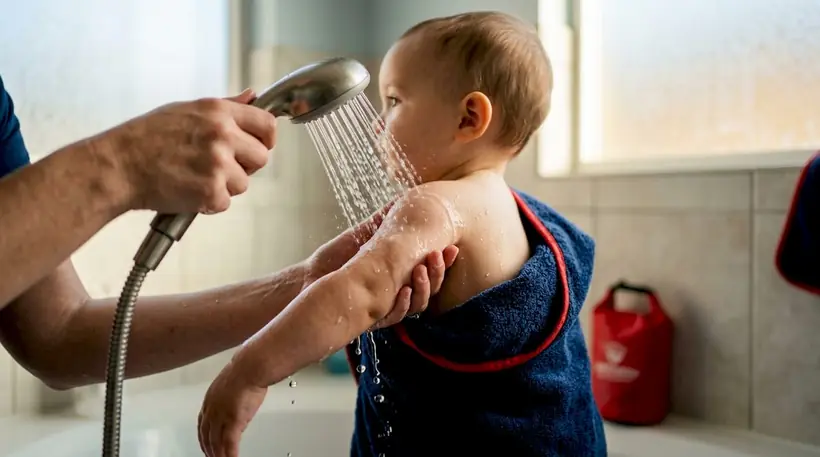
- After the swim: Rinse your baby head to toe within a few minutes of getting out. Follow with a gentle, fragrance-free emollient to counter the drying effect on their skin. Pull off wet diapers and suits right away, and watch for a cough that lingers past that evening.
If a facility’s pool smells strongly of chlorine when you walk in, that’s usually chloramines, not clean water. Ask about ventilation and how often they test.
Pro Tip: Multiply minutes per session by sessions per week to get a rough cumulative exposure number. If your baby starts showing redness, dry patches, or a cough after swims, that’s your cue to scale the number back, not just push through.
Ready to get your child in the water?
Book a free assessmentWhen to Swim, When to Wait, and What to Ask Your Provider
Most pediatric guidance points to about 6 months as the age when babies can safely start regular pool visits, according to Cleveland Clinic’s guidance on infant swimming. Premature infants or those with chronic lung conditions often need a pediatrician’s clearance first, since their airways may need more time to mature.
Watch for a few warning signs after pool visits:
- Wheezing or a cough that doesn’t clear within a day
- Eczema flares that worsen after repeated swims
- Recurring eye or ear infections tied to pool days
Any of these warrant a call to your pediatrician rather than a wait-and-see approach.
Before booking lessons anywhere, ask providers about their chlorine testing frequency, ventilation setup, water temperature, and instructor-to-child ratio. Skip the pool entirely if your baby has a fever or just recovered from a respiratory illness; a couple of days off the schedule costs nothing.
How Trained Instruction Limits Uncontrolled Exposure
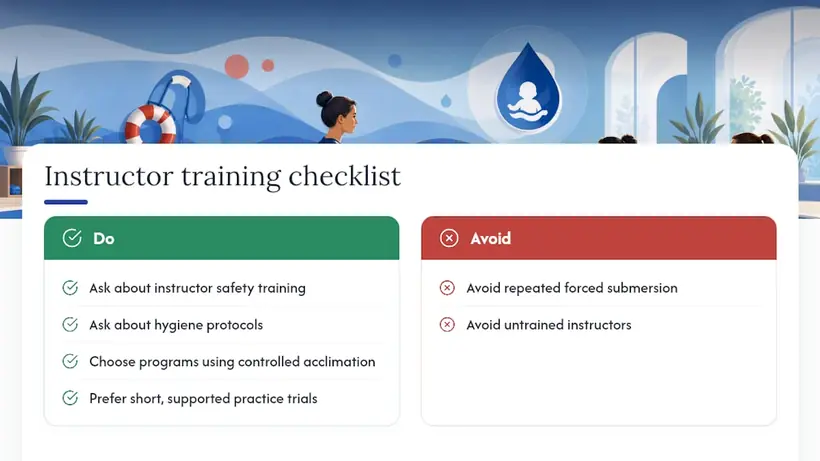
Instructors at swim academies are often trained in CPR, First Aid, and survival swim curricula built around controlled acclimation, not repeated forced submersion. Structured lessons pace practice in short, supported trials, which limits the uncontrolled head-under-water moments that drive microaerosol inhalation. Ask any provider about their instructor safety training and hygiene protocols before enrolling.
Ready to get your child in the water?
Book a free assessmentA Measured Take on Chlorine and Babies
The evidence doesn’t say keep your baby out of the pool. It says pay attention to dose. A few short, well-supervised sessions a week look nothing like 20-plus cumulative hours of unstructured splashing, and the research treats those two scenarios very differently. Lean on trained programs that pace exposure deliberately, and if your baby has a history of eczema, asthma, or prematurity, loop in your pediatrician before you build a swim routine.
, SUPERHERO
Safe, Structured Swim Time Starts With the Right Setup
Some swim schools offer structured alternatives to unsupervised pool time for families who want their baby building water confidence without the guesswork of a crowded public pool. Lessons can be paced around controlled acclimation instead of repeated submersion, sessions may run in heated pools with manageable ratios, and parents often receive regular updates to track progress.
Various lesson formats such as private lessons at home, small group classes, and parent-and-child sessions can be designed to limit exposure patterns noted by research, while helping babies become comfortable and capable in water. Families who prefer to guide early water time themselves can start with the online courses designed for parent-led instruction. If you’re ready to book, visit Superhero Swim Academy to check lesson availability in your area.