
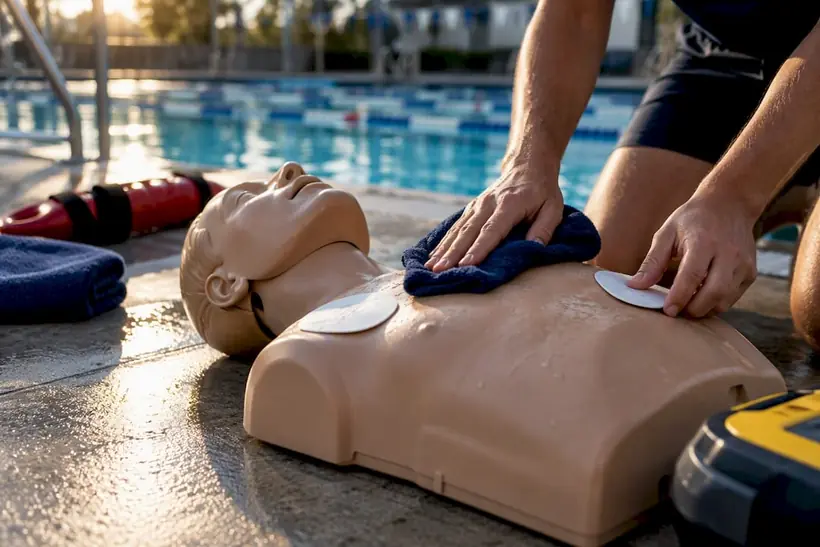
The credential you need is Professional Rescuer or BLS-level CPR covering Adult and Pediatric/Child CPR with AED, and it must include a hands-on skills component. Online-only certificates don’t meet governing-body standards. Your two real paths: an approved BLS/Professional Rescuer course with a live skills session, or the Red Cross Safety Training for Swim Coaches (STSC) pathway, which pairs online content with in-water verification. A current lifeguard certification can sometimes cover the skills portion.
TL;DR:
- Only certified courses that include both in-water skills verification and a hands-on component meet governing-body standards for swim instructor CPR certification.
- Certificates must be specific, such as BLS for Healthcare Providers or Red Cross Lifeguarding-to-STSC pathways, and sometimes require annual renewal despite being valid for two years.
- In-water skills practice typically takes 50 minutes to 3 hours, depending on prior certification status, emphasizing realistic rescue scenarios like victim extraction and airway clearing.
- Lapsed CPR certification can void insurance coverage and liability protection for both instructors and their clubs, making timely renewal and tracking essential.
- Effective CPR for drowning victims prioritizes rescue breathing and proper victim handling over standard adult cardiac arrest protocols, with realistic in-water drills improving response speed and technique.
What CPR/BLS Course Types Actually Count for Swim Instructors?
“CPR certified” means almost nothing to a governing body until you specify the level. What they want is Professional Rescuer or BLS, the tier built for people whose job puts them near emergencies, not the community-awareness class offered at a company health fair. That distinction is why a coach who took a one-hour online CPR refresher last year still gets flagged during roster review.
The credential needs two components: Adult and Pediatric/Child CPR training, plus AED use. USA Swimming will not accept unlisted or online-only certifications, and neither will most YMCA associations.
Swim lessons in Palm Beach & Broward County
Free 30 minute assessment. Try before you enroll, no commitment.
Book Free AssessmentAccepted providers generally include:
- American Red Cross (BLS for Professional Rescuers, or the STSC pathway)
- American Heart Association (BLS for Healthcare Providers, including blended HeartCode formats)
- ASHI (American Safety and Health Institute)
- National Safety Council
- Starfish Aquatics Institute
Instructor-level certifications (the credential that lets you teach CPR to others) and certificates earned outside the United States are frequently rejected outright, since governing bodies can’t verify the skills standard behind them. If your card doesn’t match a name on your organization’s approved list, don’t assume it counts. Check first, ask questions second.
How Do You Get Certified as a Swim Instructor Step by Step?
Getting certified isn’t complicated, but skipping a step is how coaches end up sidelined mid-season. Here’s the order that actually works:
- Pull your club or governing body’s accepted course list before you book anything. USA Swimming and YMCA publish specific course names, not general categories.
- Complete the online modules first if your course is blended. STSC, for example, requires roughly 3 hours of online content regardless of your prior experience.
- Schedule the hands-on skills verification. Depending on your certification history, this runs anywhere from about 50 minutes to 3 hours.
- Document everything immediately. Scan or photograph your certificate the day you receive it. Don’t wait.
- Upload proof to the right system. That might be Deck Pass for USA Swimming members, a YMCA association portal, or simply your employer’s HR file.
Ready to get your child in the water?
Book a free assessmentPro Tip: Set a calendar reminder for 60 days before your card expires, not 60 days after. Renewal courses fill up fast during peak swim season, and a lapsed certification can pull you off the deck the same day it expires.
Which Courses and Providers Meet Governing-Body Rules?
Course names matter more than most instructors realize. “BLS for Healthcare Providers,” “CPR/AED for Professional Rescuers,” and the Red Cross lifeguarding-to-STSC pathway all satisfy the requirement. A generic “CPR/First Aid” class from a workplace safety vendor usually does not, even if it covers similar material.
Here’s where instructors get tripped up:
- Two-year cards aren’t always two years. Some organizations, including certain YMCA associations, only recognize the first year of a two-year card for coach eligibility purposes. Plan renewal on an annual cycle, not whatever expiration date is printed on the card.
- “Blended” doesn’t automatically mean compliant. HeartCode and similar online modules must be paired with an actual in-person skills session. An online-only HeartCode completion certificate, by itself, satisfies nothing.
- Confirm the skills session exists before you pay. Call the provider and ask directly whether hands-on verification is included, not implied.
What Does the In-Water Skills Verification Actually Require?
The in-water portion is where paperwork meets practice, and it varies more than most instructors expect. If you’re new to STSC or your prior certification has expired, plan for roughly 3 hours of in-water skills training on top of the online content. If you already hold a current STSC or First Aid certification, that drops to about 50 minutes.
Expect to demonstrate:
- Water entries appropriate for a rescue scenario
- Victim approaches and rescue carries
- In-water rescue techniques, including handling a non-swimming or panicked victim
- Competence performing CPR technique adaptations relevant to a drowning victim, not just a dry-land manikin scenario
Ready to get your child in the water?
Book a free assessmentIf you already hold a current lifeguard certification from an approved lifeguarding program, the in-water skills portion may be waived. You still have to complete the online content. Don’t assume a lifeguard card exempts you from the entire process.
How Often Do You Need to Renew CPR Certification?
Plan around one year, not two, even when your card says otherwise. YMCA associations and similar bodies frequently require annual renewal recognition, and building your compliance calendar around the printed expiration date is how instructors get caught off guard mid-season.
A few habits prevent that:
- Set renewal reminders 60 to 90 days before expiration, not at the deadline.
- Upload certificates to your governing body’s portal (Deck Pass, YMCA systems) as soon as you receive them.
- Keep every scan in one organized folder, labeled by name and expiration date, rather than scattered across email threads.
If you took a course that isn’t on your organization’s approved list, or you’re certified through a foreign program, don’t retake the entire course by default. Contact your local American Red Cross chapter and ask about a challenge assessment, a fee-based skills evaluation that lets you demonstrate competency directly instead of sitting through hours of redundant content.
Pro Tip: Renew during the off-season if your schedule allows it. Waiting until three weeks before a summer program launch means competing with every other coach in your region for the same limited class slots.
Ready to get your child in the water?
Book a free assessmentHow Does Lapsed CPR Certification Affect Insurance and Liability?
This is the part that gets glossed over until it’s a problem. USA Swimming states plainly that coaches without current safety requirements are not covered by insurance and become ineligible for membership. That’s not a technicality. A lapsed CPR card can void both your personal liability protection and your club’s coverage the moment your card expires, regardless of how many years you’ve coached without incident.
Background checks and child protection training usually travel alongside CPR requirements as a combined compliance package, not separate boxes to check on separate timelines. A few practical moves protect you:
- Tell your club immediately if you know a certification is about to lapse.
- Track expiration dates somewhere your employer can see, not just in your own calendar.
- Pause on-deck duties voluntarily if your certification lapses. Coaching without current credentials isn’t worth the exposure to you or your club.
How Should You Modify CPR Technique for Drowning Victims?
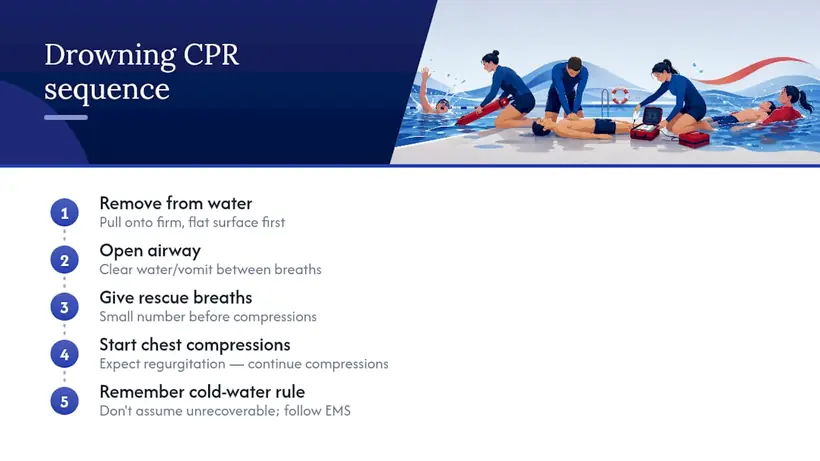
CPR on a drowning victim isn’t identical to CPR on a cardiac arrest patient found on dry land, and that distinction matters for how you sequence your response. Drowning is primarily a respiratory event before it becomes a cardiac one. The person’s heart usually stops because they’ve been deprived of oxygen, not the reverse.
That changes your priority order. Where standard adult CPR protocols often emphasize immediate chest compressions, rescue breathing takes on added weight in drowning response because reoxygenating the victim addresses the actual cause of arrest. Many training programs teach starting with a small number of rescue breaths before moving into standard compression cycles, specifically for submersion victims.
Ready to get your child in the water?
Book a free assessmentWater and vomit in the airway complicate rescue breathing in ways a dry-land scenario never does. You may need to clear the airway between breaths, and you should expect regurgitation once compressions begin. That’s common with drowning victims, not a sign you’re doing something wrong. Keep going.
Cold-water submersion adds another layer. Victims of prolonged cold-water immersion can sometimes be revived even after unusually long submersion times, so a coach should not assume a victim is unrecoverable based on time alone unless directed otherwise by arriving EMS personnel.
Positioning matters too. Getting the victim onto a firm, flat surface before starting compressions is non-negotiable. Compressions performed while a victim is still partially in water are ineffective and can injure both you and the victim. Pull them clear first, even if it costs you ten extra seconds.
How Does CPR Fit With Other Water Rescue Skills?
CPR is the last step in a chain, not a standalone skill you deploy in isolation. The moments before you start compressions determine whether compressions matter at all, and that’s exactly what a well-built STSC or lifeguard course drills into muscle memory.
A real rescue sequence looks like this: recognize distress, approach safely, extract the victim without becoming a second victim yourself, then assess and begin CPR if needed. Skip the recognition and approach phases, and you’re starting CPR too late or with unnecessary risk to yourself. That’s why in-water skills verification tests entries, approaches, and carries alongside CPR competence rather than testing CPR in a vacuum.
Ready to get your child in the water?
Book a free assessment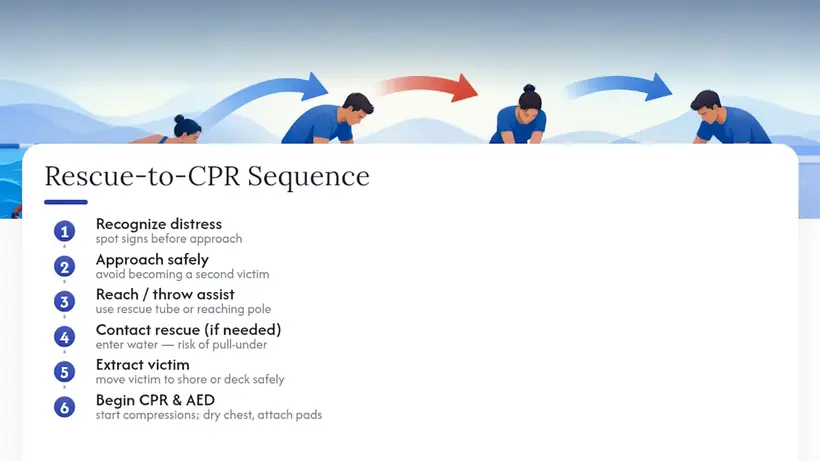
Reaching and throwing assists come before contact rescues in almost every training framework, for good reason. A rescue tube or reaching pole gets a victim to safety without putting a second person in danger. Contact rescues, where you physically enter the water and make contact with a struggling swimmer, carry real risk of the victim pulling you under. Instructors trained only in CPR, without the surrounding rescue skills, are dangerously undertrained for what actually happens poolside.
AED use integrates here too. Once a victim is out of the water and CPR begins, AED application should happen as fast as safely possible, and most approved courses drill the sequence of drying the chest, attaching pads, and continuing compressions during analysis. A coach who’s practiced this only on a classroom manikin, dry and stationary, will move noticeably slower the first time they do it poolside with a wet, non-cooperative body. Repetition under realistic conditions is what closes that gap.
What Makes CPR Harder to Perform in Aquatic Environments?
Wet skin, slippery pool decks, and crowded space around a pool edge all work against you the moment an emergency starts. None of that shows up in a classroom manikin drill, and it’s exactly why the in-water skills component exists instead of a purely online certificate.
A few recurring challenges instructors report:
- Getting the victim out of the water fast enough. Every second spent struggling with extraction is a second CPR isn’t starting.
- Slippery decks and unstable footing during compressions, especially on textured but wet pool surfaces.
- Noise and chaos from other swimmers, parents, or panicked bystanders competing for your attention right when you need to focus.
- Regurgitation and airway clearing, which happens often with drowning victims and can catch an undertrained rescuer off guard.
- Adrenaline affecting technique, where instructors compress too fast or too shallow under stress despite training correctly in calm conditions.
Ready to get your child in the water?
Book a free assessmentThe fix for most of these isn’t more classroom time. It’s repeated, realistic in-water practice, which is exactly what separates a course with a genuine skills verification from one that treats the hands-on portion as a formality. Instructors who’ve drilled extraction and compression sequences on a wet deck, under mild time pressure, respond faster and with steadier technique than those who’ve only rehearsed on dry land.
What Should You Do After Administering CPR?
CPR doesn’t end the emergency. What you do in the next ten minutes, and the next ten days, determines whether the incident becomes a lawsuit, an insurance claim, or a manageable event your club handles correctly.
Immediately after: call 911 if you haven’t already, or confirm someone else has. Continue CPR or rescue breathing until EMS arrives and takes over, unless you’re physically unable to continue. Once EMS is on scene, give them a clear handoff, how long the victim was submerged, when CPR started, and any AED shocks delivered.
After the immediate scene clears, your club’s emergency action plan should specify who talks to the victim’s family, who documents the incident in writing, and who notifies your insurance carrier or governing body. Write your own account of events as soon as possible, while details are fresh, and before comparing notes with anyone else present. Most clubs require an incident report within 24 hours, and some insurance policies condition coverage on timely reporting.
Don’t skip the personal aftermath either. Performing CPR on a child, especially one you know, is genuinely difficult even when it goes right. Many clubs offer or require debriefing support after a serious incident, and using it isn’t a sign you weren’t prepared. It’s part of doing the job responsibly over a full career, not just surviving one shift.
Ready to get your child in the water?
Book a free assessmentThe Real Gap Between Certification and Competence
Most articles on this topic treat certification as the finish line. It isn’t. A card in a drawer tells a club you completed a course; it says nothing about whether you’d move correctly on a wet deck with a panicked parent screaming behind you.
The conventional advice, “get certified, renew on time,” is necessary but incomplete. What actually protects a child in the water is the muscle memory built during the in-water skills portion that too many instructors treat as a box to check rather than the entire point of the requirement. A 50-minute skills session for an experienced coach isn’t padding. It’s the difference between technique you’ve rehearsed under realistic conditions and technique you’ve only read about.
If you take one thing from this guide, prioritize the hands-on practice over the paperwork. Renew on schedule, yes. But push your club or training provider for real repetition, not just a passing skills check every one or two years. The certificate proves compliance. The repetition is what actually saves someone.
, SUPERHERO
Get Certified and Skills-Verified Through Superhero Swim Academy
Superhero Swim Academy exists because certification on paper and competence in the water are two different things, and closing that gap is what our Swim Instructor Certification program is built around. Unlike a generic online course, ours pairs proprietary survival-swim training with real in-water practice, so instructors leave with skills that hold up under pressure, not just a card in a folder.
Our coaches train in CPR, First Aid, and a survival-swim curriculum before they ever step on deck. If you need an in-water skills session, our at-home lesson options give you a structured setting to practice extraction, positioning, and rescue sequences with a qualified instructor. Ready to close the gap between your certificate and your skill? Visit Superhero Swim Academy to enroll in instructor certification or book a skills session today.