
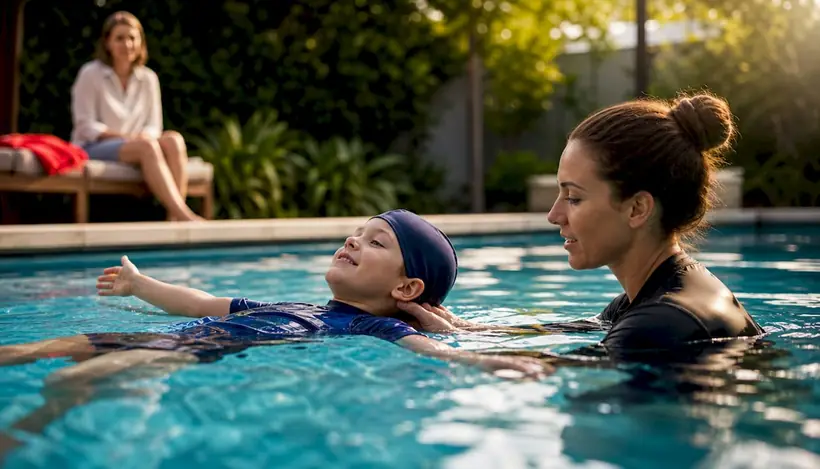
For home or private swim lessons, arrive prepared, follow the instructor’s lead, supervise siblings closely, and skip floaties if your instructor says no. Good home swim lesson etiquette exists for one reason: it keeps the water safe and lets your child actually learn. Show up ready, stay calm on deck, and save your questions for the right moment.
TL;DR:
- Most private instructors require CPR and First Aid certification and emphasize progress through a series of at least 8 to 12 consistent lessons for noticeable results.
- Parents should arrive 10 to 15 minutes early, prepare the pool bag with proper swimwear, diapers, and water, and avoid scheduling lessons during nap times or right after large meals.
- During lessons, parents must stay within arm’s reach for infants and toddlers, avoid coaching, and keep distraction sources like phones or siblings away to ensure water safety and effective learning.
- Parents should ask permission before recording lessons, focus on their own child, and respect instructor policies on filming and supervision to protect privacy and minimize distractions.
- Avoid lessons when children are sick, fighting illness, or overtired, and always cancel with plenty of notice if needed, recognizing that consistent attendance is key to water skill development.
What Should Parents Prepare Before a Home Swim Lesson?
Arrive 10 to 15 minutes early. That window covers a bathroom trip, a quick change, and a minute with the instructor to flag anything unusual (a rough night, a new fear of water, a cold coming on). Rushing in at the exact start time throws off everyone’s rhythm, including your child’s.
Here’s what belongs in the pool bag:
- A snug swimsuit (loose suits drag in the water and slow kids down)
- A swim diaper if your child isn’t toilet trained
- A towel, a plastic bag for wet items, and a change of clothes
- Water and a light snack for after class
- A hair tie or swim cap for longer hair, plus goggles only if the instructor allows them
Swim lessons in Palm Beach & Broward County
Free 30 minute assessment. Try before you enroll, no commitment.
Book Free AssessmentFeed a light snack one to two hours before the lesson, not right before getting in. And try to avoid scheduling around nap time. A groggy, overtired toddler fights the water for reasons that have nothing to do with swimming. If you’re using a locker room, change there instead of on the pool deck. Most facilities and private instructors expect it, and it keeps the deck dry and safe.
Where Should Parents Sit During a Swim Lesson?
Pick a spot where the instructor has room to move, and stay out of the direct teaching lane. That’s the short version of poolside etiquette for swim lessons, and it solves most of the friction that comes up between parents and instructors.
A few specifics make it concrete:
- Sit or stand where the instructor can walk the pool’s edge freely without stepping around you
- Save questions for after class or a scheduled check-in, not mid-lesson
- Don’t coach from the deck. Instructors commonly ask parents not to correct technique or repeat commands during class because it confuses the child about whom to listen to
- Keep your own energy steady. Kids read a parent’s tension faster than they read water depth, and an anxious parent on deck tends to produce an anxious kid in the pool
If you disagree with something the instructor is doing, that’s a real conversation, but it happens after the lesson, not shouted across the pool.
Ready to get your child in the water?
Book a free assessmentWhen Should You Keep Your Child Home From a Lesson?
Skip the lesson for fever, vomiting, diarrhea, or an active respiratory illness, even a mild one. Pool water and locked-in air don’t mix well with a contagious kid, and one sick child in a private lesson setting can expose an instructor and any siblings present.
Swim diapers are non-negotiable for children who aren’t toilet trained. Standard diapers absorb water and swell, and they don’t contain anything the way a swim diaper does. Change diapers off the pool deck whenever possible, since pool policies generally require changing away from the water’s edge and often require showering before entry.
Timing still matters here too: avoid the usual nap window, and feed that light snack one to two hours out. A child who’s hungry, overtired, or fighting a stomach bug isn’t going to absorb much from the lesson anyway.
Should Kids Wear Floaties, Goggles, or Swim Caps?
Most instructors ban floaties and water wings for beginners, and there’s a real reason behind it. These devices hold the body vertical in the water, which builds the wrong muscle memory for the horizontal position kids need for independent floating and self-rescue. A child who’s always propped upright by a float never learns what their body does without one.
Goggles are more of a judgment call. Older kids working on technique often benefit from them. Beginners usually don’t wear them at first, so they get comfortable with water on their face without a barrier. Ask your instructor which stage your child is at before packing them.
Beyond that:
- Snug swimwear and tied-back hair reduce drag and distraction
- Bring a towel and a plastic bag for wet gear so you’re not scrambling afterward
- Skip toys on the deck, and definitely skip glass containers near the pool
Ready to get your child in the water?
Book a free assessmentPro Tip: If your child is attached to a favorite floatation toy, let them hold it during the car ride and hand it off before the lesson starts. The transition is easier than a cold turkey ban at poolside.
For families weighing floatation aids for casual pool time outside of lessons, this comparison of arm floats versus swim vests breaks down the tradeoffs, though neither replaces instructor supervision during formal lessons.
How Close Should Parents Stay During the Lesson?
Touch supervision is the standard for infants and toddlers, meaning an adult stays within arm’s reach at all times unless the instructor specifies otherwise for a drill. The American Academy of Pediatrics is clear that lessons are one layer of drowning prevention, not a replacement for constant, active supervision.
Before you book, it’s fair to ask about instructor certifications directly. CPR and First Aid certification should be standard, not a bonus feature.
Drowning remains a leading cause of unintentional death for young children, which is exactly why instructors enforce no-open-swim policies during structured lesson time. That rule isn’t about being strict for its own sake. It keeps the water calm, keeps distractions low, and keeps every set of eyes focused on the one child who’s actively working with the instructor.
A few habits make you a better partner in that safety net:
- Silence your phone during the lesson
- Stay ready to assist if the instructor directs you to, especially with younger siblings nearby
- Don’t let siblings run or play near pool’s edge while the lesson is underway
Ready to get your child in the water?
Book a free assessmentDo Condo and Shared Pool Rules Affect Home Swim Lessons?
If you’re booking a private instructor to come to a condo, apartment complex, or neighborhood pool, check with the property manager or HOA first. Some buildings restrict commercial teaching on shared property, and getting caught off guard mid lesson is an avoidable headache.
Pick a lesson zone that doesn’t block the ladder or interfere with other residents doing laps, and keep noise reasonable. Shared-pool etiquette around scheduling and equipment placement keeps private lessons welcome instead of becoming a source of complaints. Get consent before recording anything, since other residents have a reasonable expectation of privacy at a shared amenity. Clean up floats, noodles, and kickboards promptly so the pool returns to normal use the second the lesson ends.
How Can Parents Support Progress Between Lessons?
Progress in the water is rarely a straight line, and most instructors recommend committing to a series of 8 to 12 consistent lessons before expecting real, visible change. Bailing after two or three sessions because “nothing’s happening” usually just means you stopped before the curve bent upward.
Here’s how to use the time between lessons well:
- Run short bath-time drills. Pouring water over the head, blowing bubbles in the tub, brief face dunks. Two or three minutes, done calmly, without forcing it.
- Follow any homework the instructor sends home rather than inventing your own drills.
- Celebrate specific behaviors (a longer bubble, a calmer face dunk) instead of big outcomes like “swimming.”
- If pacing feels off, whether too slow or too fast, ask about adjusting the format rather than pulling out entirely.
Ready to get your child in the water?
Book a free assessmentPro Tip: Keep a one-line note after each lesson: what your child tried, what felt hard. Instructors love specifics, and it turns your after-class chat into something useful instead of a vague “how’d it go?”
How a Trained Provider Enforces These Rules in Practice
Superhero Swim Academy’s instructors are trained in CPR, First Aid, and a survival swim curriculum built specifically for infants, toddlers, and young children. That’s the baseline parents should expect from any private provider, not a bonus.
What sets a structured program apart is communication. Parents who receive written goals and simple homework tend to see faster, clearer progress, because everyone knows what “success” looks like for that week rather than guessing. Superhero Swim Academy builds its private lessons around exactly that kind of feedback loop, updating parents on milestones instead of leaving them to interpret splashing from the sidelines. Enforced etiquette, in other words, isn’t red tape. It’s what lets a survival skill get learned faster and more safely.
What’s the Right Way to Handle a Canceled Lesson?
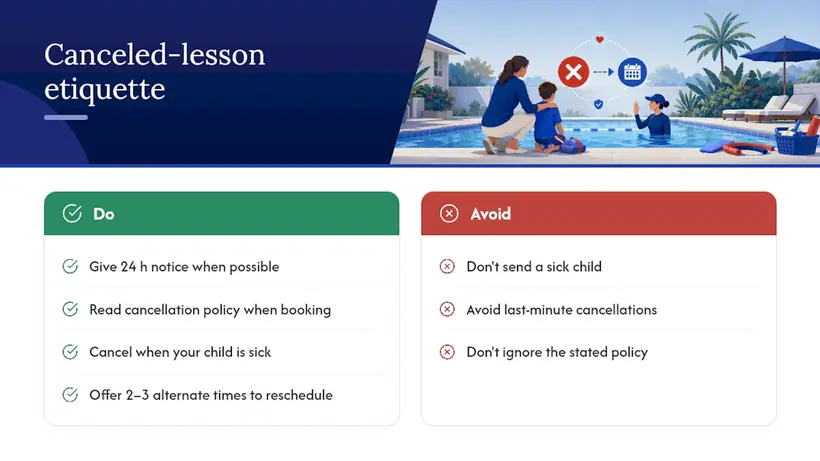
Give as much notice as you possibly can, ideally 24 hours, if your child is sick, you have a schedule conflict, or weather makes an outdoor lesson unsafe. Private instructors often build their whole week around a fixed slot list, and a late cancellation can mean they lose that time entirely rather than filling it with another family.
Most private and home swim programs have a stated cancellation window, commonly somewhere between 12 and 24 hours before the lesson. Read that policy when you book, not after you’ve missed the deadline. Some instructors charge a partial fee for late cancellations. That’s not punitive. It reflects the fact that the time was reserved specifically for your child and likely can’t be resold on short notice.
Ready to get your child in the water?
Book a free assessmentIf your child is sick, cancel rather than pushing through. Nobody benefits from a feverish toddler getting into a pool, and sending a contagious kid to a lesson risks the instructor’s health and any other children on the schedule that day.
On the flip side, be patient if your instructor needs to reschedule. Weather, facility issues, and instructor illness happen. A provider who cancels for a genuinely sick instructor is protecting your child, not being unreliable.
When you do need to reschedule, offer two or three alternate times rather than a single rigid option. It respects the instructor’s other commitments and usually gets you rebooked faster than back-and-forth guessing.
Why Lesson Time Deserves Your Full Attention
A private swim lesson is professional instruction time, not a social hour by the pool. Treating it that way changes how you show up. Framing lessons as focused learning time, rather than a casual hangout, helps parents naturally dial back chatter, phone use, and the urge to narrate the lesson from the sidelines.
That focus matters more than it might seem. Young children pick up on distraction fast. If a parent is scrolling a phone, chatting with another parent, or letting siblings roam and shout near the water, the child in the lesson often mirrors that scattered energy instead of staying tuned in to the instructor.
A few habits keep the time protected:
- Put your phone away or on silent for the full session
- If a sibling came along, bring a quiet activity that doesn’t require your constant narration
- Save catching up with other parents for before or after, not during
- Resist the urge to call out encouragement or corrections mid-drill. It’s well meaning, but it splits your child’s attention between you and the instructor at the exact moment they need to focus on one voice
Ready to get your child in the water?
Book a free assessmentTwenty or thirty minutes of genuinely undistracted lesson time, a few times a week, adds up to real skill gains faster than double the time spent half paying attention. Instructors notice which kids arrive with parents who treat the lesson as real work, and it tends to show up in how quickly those kids progress through drills.
Is It Okay to Record Swim Lessons on Video?
Ask your instructor before you record anything, every time, not just once at the start of the season. Policies vary by provider, and some private instructors are fine with a quick clip of a milestone moment but uncomfortable with continuous filming throughout the lesson.
There’s a privacy layer here too, especially in group or shared-pool settings. Other children and their families are in frame whether you intend it or not, and most people don’t want their kid’s photo or video circulating without their knowledge. If you’re at a condo or community pool, this matters even more, since neighbors using the same facility have a reasonable expectation that they won’t end up in a stranger’s video.
A simple approach works for most families:
- Ask permission before each recording session, not just generally
- Keep the camera focused on your own child, not other kids in a group lesson
- If you plan to post footage publicly (social media, a family blog), mention that specifically. “Can I record this?” and “Can I post this online?” are different questions with different answers
- Respect a “no” without pushing. Some instructors ban recording entirely because it distracts the child, who starts performing for the camera instead of focusing on the skill
For private one-on-one home lessons, recording tends to be simpler since there’s usually only your own child in frame. Even then, check with the instructor first. Some feel that being on camera changes a young child’s behavior in the water, and they’d rather teach without that added variable.
Ready to get your child in the water?
Book a free assessmentAn Instructor’s View on What Calm Parents Do Differently
A child who sees a calm, quiet parent on deck tends to settle into the lesson faster than one whose parent is anxious, hovering, or narrating every move. That’s not a judgment on nervous parents. It’s just what shows up, lesson after lesson.
Etiquette rules aren’t there to make parents feel like they’re being graded. They exist to give your child the clearest possible path to learning a skill that keeps them safer around water.
, SUPERHERO
Ready to Book a Home or Private Swim Lesson?
For parents seeking swim lessons with built-in etiquette and safety standards, consider options that incorporate these elements from the start, rather than ones requiring negotiation on day one. A qualified instructor typically has training in CPR, First Aid, and a focused survival swim curriculum, so supervision and readiness rules are usually standard practice rather than something parents must enforce themselves.
Initial contact with a swim instructor commonly involves a safety-focused discussion including your child’s comfort level in water, health considerations, and setting clear goals for the lessons. Progress updates may be provided as your child develops skills. If you’re interested in private or home swim lessons, visit Superhero Swim Academy to check availability and start planning lessons.