
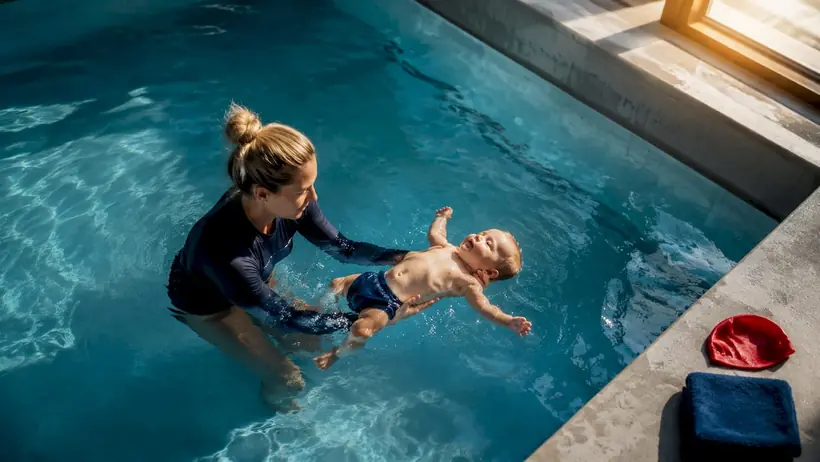
The single most important infant swim safety rule is constant, within-arm’s-reach supervision. Swim lessons help, floating devices help, pool fences help, but none of them replace a caregiver who is close enough to touch a baby in water at all times. Layer every other precaution on top of that one habit, and you’ve covered the basics.
TL;DR:
- Constant supervision within arms’ reach is essential; other safety measures like fences and alarms are secondary layers of protection.
- Infant survival lessons improve water competency but do not prevent drowning, which remains the leading cause of death in children ages 1 to 4.
- Never rely on inflatable floats or neck rings, and always treat even shallow water like pools with strict supervision.
- Structural barriers should surround home pools on all sides, with self-closing gates and alarms, as most drownings happen when supervision lapses.
- CPR training and a clear emergency plan are critical, as quick response in drowning incidents can significantly improve outcomes.
What layers of protection actually look like
Touch supervision means your hand stays within reach of your baby in the bath or pool, every second, no phone, no book, no “just one text.” It sounds obvious until you’re at a pool party and someone asks you a question. Infants can go underwater silently in seconds, with no splashing or crying to alert you, so the American Academy of Pediatrics treats close physical proximity as the baseline, not an option.
Around that baseline, add environmental layers:
- Four-sided pool fencing with a self-closing, self-latching gate that separates the pool from the house, recommended to be of sufficient height to prevent easy climbing
- Door alarms on any exit leading to the water
- Removed pool ladders when the pool isn’t in use
- Rigid pool covers rated for the pool’s size, not floating tarps
Swim lessons in Palm Beach & Broward County
Free 30 minute assessment. Try before you enroll, no commitment.
Book Free AssessmentFor flotation, U.S. Consumer Product Safety Commission guidance is blunt: only U.S. Coast Guard-approved life jackets count as safety gear. Inflatable arm rings and pool noodles are toys.
Pro Tip: Walk your home once a year and check every water source a toddler could reach, toilets, mop buckets, pet bowls, not just the pool. The CPSC flags these as recurring, underestimated hazards.
What survival and infant swim lessons teach, and what they don’t
Survival swim curricula for infants and toddlers usually build toward two skills: the rollback-to-float, where a baby learns to turn onto their back and rest, and the swim-float-swim sequence, where a slightly older toddler paddles a short distance, flips to float and breathe, then paddles again. These are trained motor patterns, not instincts, and they require repetition to hold up under real panic.
The evidence is genuinely mixed on how far this generalizes. Research summarized on NCBI Bookshelf notes limited proof that early reflex training prevents drowning outright, while stronger water competency evidence applies to children age 4 and up. The AAP lands in the middle: lessons are a layer of protection, often appropriate starting around age 1, but no child is ever “drown-proof.”
Drowning is the leading cause of unintentional death for children ages 1 to 4, and most of those incidents happen in home pools and bathtubs, according to the CDC. That statistic alone is the reason lessons never stand in for supervision.
What matters for class quality:
- Water heated to roughly 87 to 94°F for children under 3, per HealthyChildren.org
- Trained, certified instructors, not lifeguards moonlighting as baby swim teachers
- Small class sizes or private instruction so a real skill progression is possible
Ready to get your child in the water?
Book a free assessmentBath time and small-water safety rules that actually matter
Bathtubs kill more infants than most parents assume, and the fix is almost entirely behavioral. A few non-negotiables:
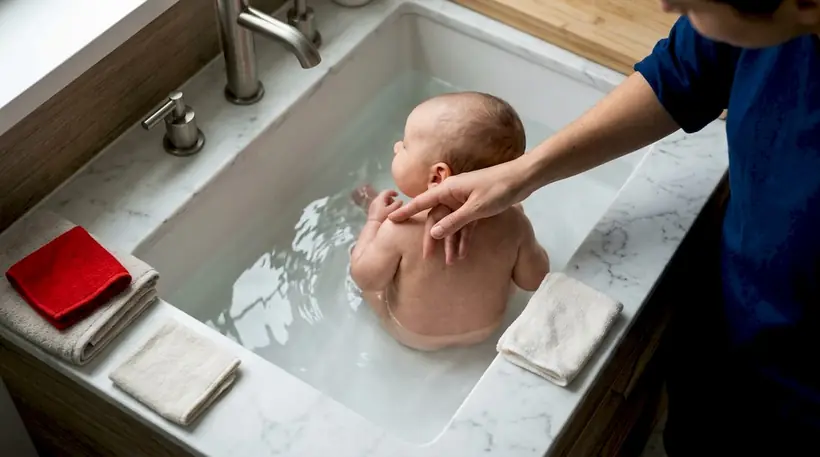
- Keep one hand on your baby the entire bath. If the phone rings or the doorbell buzzes, wrap the baby in a towel and bring them with you.
- Set your water heater or check faucet output so bathwater never exceeds 120°F, which limits scald risk, and keep bath sessions short enough to avoid chilling a small body.
- Empty portable and inflatable pools completely right after use, and store the ladder separately so a toddler can’t climb back in unsupervised.
- Close the toilet lid, latch it if your child is mobile, and keep buckets and basins empty or turned over when not in active use.
Children can drown in as little as one inch of water, which is the reason a five-gallon bucket in the garage deserves the same respect as a backyard pool.
Pool and yard protections that actually reduce risk
Structural barriers buy you time and reduce silent, unsupervised access, which is exactly when most toddler drownings happen. The details matter more than people expect:
- Fencing should surround the pool on all four sides, separate from the house, at least 4 feet tall with no footholds a toddler could climb
- Gates need self-closing, self-latching hardware, with the latch mounted high enough that small hands can’t reach it
- Door and window alarms on house exits add a layer, though they generate enough false alarms that some parents disable them, undermining the whole point
- Rigid pool covers help when the pool is closed for the season, but a cover is never a substitute for supervision or fencing while the pool is in use
- Clear floating toys out of the pool area between sessions, since a stray toy is often what draws a toddler back to the water alone
Ready to get your child in the water?
Book a free assessmentEven portable above-ground pools that are shallow need fencing, since a toddler who falls in often can’t climb back out.
Emergency readiness: CPR, a plan, and pool-side gear
Infant and child CPR training changes outcomes in the minutes before paramedics arrive, and it’s a skill every regular caregiver around water should have. The American Red Cross runs infant and child-specific courses, and local hospital systems often offer the same. Beyond training itself:
- Assign a dedicated “water watcher” at any gathering with a pool, someone whose only job is watching the water, rotated every 15 to 20 minutes
- Keep a phone, a rescue ring, and a shepherd’s crook within reach of the pool deck, not stored in a garage
- Post your address near the phone so anyone can give it to a 911 dispatcher without hesitating
- Know the sequence: pull the child out, check breathing, start CPR immediately if needed, call 911 or have someone else call while you work
Pro Tip: Practice your emergency plan out loud once with every regular caregiver, grandparents, sitters, older siblings, so nobody freezes during the ten seconds that matter most.
Neck floats, floaties, and the videos that mislead parents
Baby neck floats and inflatable rings show up constantly on social media, often paired with footage of an infant “swimming” happily. What that footage doesn’t show is the incident reports behind it. The FDA and AAP have both warned that neck floats can fail, slip, or restrict breathing, and they’ve been tied to injuries and deaths.
A baby kicking in a neck float is showing a reflex, not a swimming ability. That distinction gets lost in a 15-second clip.
- Skip neck floats and inflatable rings entirely
- Use only U.S. Coast Guard-approved life jackets sized for your child’s weight
- Treat supervised parent-child water play, hands-on, close contact, as the safer substitute for any flotation gimmick
Ready to get your child in the water?
Book a free assessmentHow to choose a swim instructor for your infant
Not every program that markets “baby swim lessons” is built the same way, and the gap shows up fastest in an emergency. Run through this before you enroll:
- Ask for proof of current CPR and First Aid certification for every instructor who will be in the water with your child.
- Confirm the pool is heated to the recommended range for infants and ask how often water quality is tested.
- Ask about student-to-instructor ratio. Private and small-group formats let survival skills build incrementally instead of rushing a baby into deep water.
- Request the program’s written safety policy and emergency procedure, and ask how parents are updated on progress.
- Ask for references from current or recent families.
Red flags worth walking away from: instructors who push early full submersions before a baby shows readiness, no written safety policy, or vague answers about what happens if a child struggles mid-lesson.
Pro Tip: A good program should welcome the question “what’s your emergency procedure?” without hesitation. If they seem annoyed by it, that’s information.
Superhero Swim Academy’s infant water acclimation guide walks through what a safe, age-appropriate progression looks like before you ever set foot in a lesson.
Ready to get your child in the water?
Book a free assessmentBeyond the pool: bathtubs, lakes, and beaches
Pools get most of the attention, but infants encounter water in plenty of other settings, each with its own risk profile. A bathtub is the highest-frequency, lowest-guard-down environment in most homes, precisely because it feels routine. Treat every bath with the same touch-supervision standard you’d use poolside, and never rely on a bath seat or ring as a substitute for your hand.
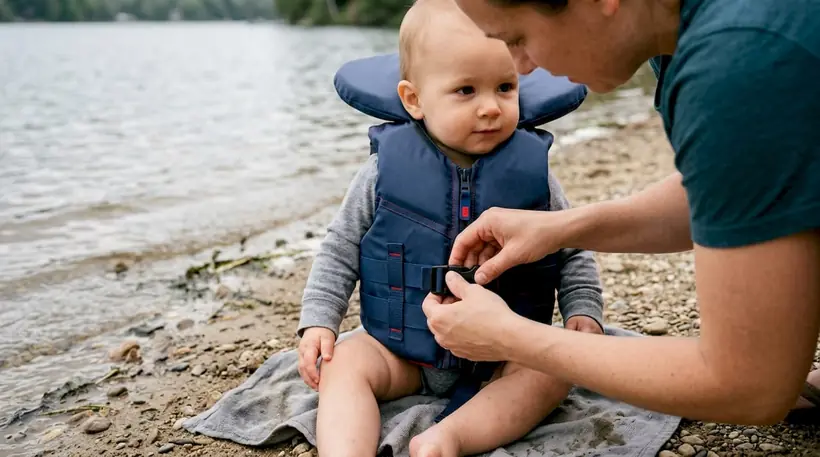
Lakes and ponds add murky water, uneven footing, and sudden depth changes a pool never has. A baby who’s comfortable floating in a heated, clear pool can panic in cold, cloudy lake water where they can’t see the bottom or judge depth. Keep infants in a properly fitted, U.S. Coast Guard-approved life jacket anytime they’re near open freshwater, even sitting on the shoreline, since a slip on a muddy bank happens fast.
Beaches introduce waves, currents, and undertow that behave nothing like still water. Even calm-looking surf can knock a toddler off their feet, and a receding wave can pull a small body faster than a caregiver expects. Stay within arm’s reach in the surf zone, avoid inflatable rafts as flotation in open water, and check for posted rip current warnings before letting any child near the waterline.
Every one of these settings shares the same rule: supervision has to match the unpredictability of the environment, not just the depth of the water.
Ready to get your child in the water?
Book a free assessmentWhy we build survival skills into every lesson
We train every Superhero Swim Academy instructor in CPR, First Aid, and our own survival swim curriculum because lessons only matter if they’re taught safely. Over 2,500 children have gone through our program, and parents consistently report faster progress and more confident kids in the water. But we’re clear with every family: lessons are one layer. Supervision, barriers, and a real emergency plan still carry the weight at home.
, SUPERHERO
Ready to start survival swim lessons?
Superhero Swim Academy is the alternative to guessing your way through infant water safety alone. Instead of piecing together tips from videos and hoping they hold up, you get a CPR and First Aid certified instructor running a proven survival curriculum, whether that’s a private lesson at your own pool, a parent-and-child session, a small heated-pool group class, or in-home concierge instruction across Palm Beach and Broward counties.
Your first lesson focuses on comfort and readiness, not forcing submersion, and every session follows a written safety protocol your instructor will walk you through before your child ever enters the water. If you want to know more about what that structure looks like day to day, our breakdown of how instructors keep infants safe in water covers the specifics. Parents outside our service area, or those who want to teach their own child, can also enroll in our online parent courses.
Visit the Superhero Swim Academy schedule page to check class availability and enroll today.