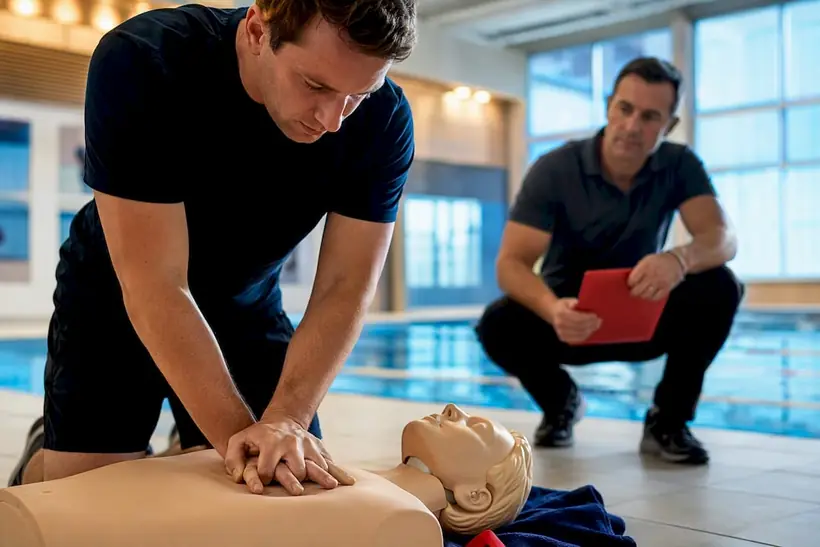
Online-only certification rarely satisfies hiring managers on its own. The format most employers accept pairs remote coursework with verified in-water skills, usually through a proctored session or logged supervised hours. Before you enroll anywhere, expect to also need current CPR/First Aid, proof of practical skills, and a certificate an employer can actually verify.
TL;DR:
- Most online swim instructor courses require in-water skills verification through proctored sessions or logged supervised hours to be recognized by employers.
- In-water skills, CPR, and First Aid are typically prerequisites or bundled with hybrid certification programs, which usually take one to eight weeks to complete.
- Employers verify credentials with digital certificates that include unique IDs and QR codes, along with proof of practical skills, recertification, and background checks.
- Choosing a certification program should involve ensuring clear pathways to in-water verification, verifiable digital credentials, and recognition by local employers.
- The most effective training combines remote coursework with in-person practice, as verified skills are essential for employment, not just theoretical knowledge.
What Does Online Swim Instructor Certification Actually Teach?
The remote portion of any legitimate program covers the thinking side of teaching, not the physical side. Expect coursework built around:
- Water safety fundamentals and drowning prevention basics
- Teaching progressions for different ages and skill levels
- Lesson planning and class management for group and private settings
- Inclusive and adaptive instruction for learners with different needs
- Assessment tools for tracking student progress
Swim lessons in Palm Beach & Broward County
Free 30 minute assessment. Try before you enroll, no commitment.
Book Free AssessmentThis theory matters. It shapes how you sequence skills, read a room of nervous six-year-olds, and adapt a lesson when a kid freezes at the wall. What it can’t do is verify you can actually demonstrate a rescue, hold a proper support position, or read distress in the water in real time. The Certified Fundamental Swim Instructor program runs about 12 hours of online coursework spread across multiple modules, with quizzes and lesson-plan templates built in. That’s a fairly standard load. Programs built around adaptive aquatics tend to stand out here, since inclusive teaching is increasingly what employers screen for, not an afterthought.
Is Online-Only Certification Enough for Employers?
Almost never, at least not for anyone hoping to teach in a licensed pool or work for an established swim school. Major instructor programs pair online coursework with in-water skills verification rather than issuing credentials off theory alone, and that pattern holds across the industry.
Three things typically force the hybrid model:
- Coach-safety standards that require documented, supervised in-water hours before sign-off.
- Pool-safety organizations that will not recognize a credential without a proctored skills check.
- Youth-program employers who ask for a signed skills form, not just a PDF certificate.
Some providers handle the in-water piece efficiently. A two-part model with a day of online home-study followed by a single day of instructor-led, in-person training can get you certified in as little as two days when scheduling cooperates. Others rely on local proctors or periodic clinics you book after finishing the online modules.
Pro Tip: Before you pay for any course, ask exactly who will proctor your in-water check and how far you’ll need to travel. That logistics question, not the coursework, is usually what stretches a two-week plan into two months.
Ready to get your child in the water?
Book a free assessmentHow Long Does It Take and What Does It Cost?
The steps are consistent across most programs:
- Apply and confirm prerequisites
- Complete the online modules at your own pace
- Secure or renew CPR/First Aid certification
- Schedule and complete the in-water skills check
- Pass the exam and receive your certificate
Online coursework alone often runs 4 to 12 hours, which you can usually finish in a week if you’re motivated. Total elapsed time, including the skills check, tends to run anywhere from one to eight weeks, largely dictated by how quickly you can book a proctor. Costs scale with what’s included: online-only certificates commonly cost a few hundred dollars, while hybrid programs that bundle the skills session and CPR/First Aid often cost more. USA Swimming and similar bodies also structure coach education as modular, self-paced coursework, so you can spread the online portion across weeks without losing progress, which matters if you’re working another job while you certify.
Ready to get your child in the water?
Book a free assessmentHow Do Employers Verify Your Certification?
Hiring managers want more than your word that you finished a course. Look for programs that issue:
- A digital certificate with a unique ID and QR code an employer can scan and verify online
- A downloadable, permanent record rather than an emailed screenshot
A well-designed certificate template makes verification faster for both sides, and it signals the issuing program takes credentialing seriously. Beyond the certificate itself, expect employers to ask for current CPR/First Aid cards, a background check, and documented proof of your in-water hours or a proctor’s signed skills form. Many will also ask about your recertification schedule, since letting a credential lapse is a common reason otherwise-qualified applicants get passed over.
How to Choose the Right Online Swim Instructor Certification Program
Run any program you’re considering through this checklist before you pay for it:
- Does it offer a clear path to in-water skills verification, not just online quizzes?
- Does it issue a verifiable digital credential with a unique ID?
- Does it require CPR/First Aid as a prerequisite or bundle it in?
- Is it recognized by employers in your area, not just by the provider’s own marketing?
When you talk to a provider, ask specifically how proctoring works, who signs off on your skills checklist, what the refund policy looks like if you fail the practical, and whether local employers have actually hired their graduates before. Confirming proctor credentials and the exact skills checklist upfront avoids the scheduling surprises that stretch out completion time.
Ready to get your child in the water?
Book a free assessmentWalk away from any program that has no in-water option at all, issues a certificate with no way to verify it, or is vague about prerequisites and recertification. Those gaps tend to surface later, usually right when you’re trying to get hired.
Pro Tip: Ask a potential employer directly which certifications they accept before you enroll anywhere. A five-minute phone call can save you from paying for a credential that never gets you an interview.
Why Superhero Swim Academy Builds Training Around Verified Skills
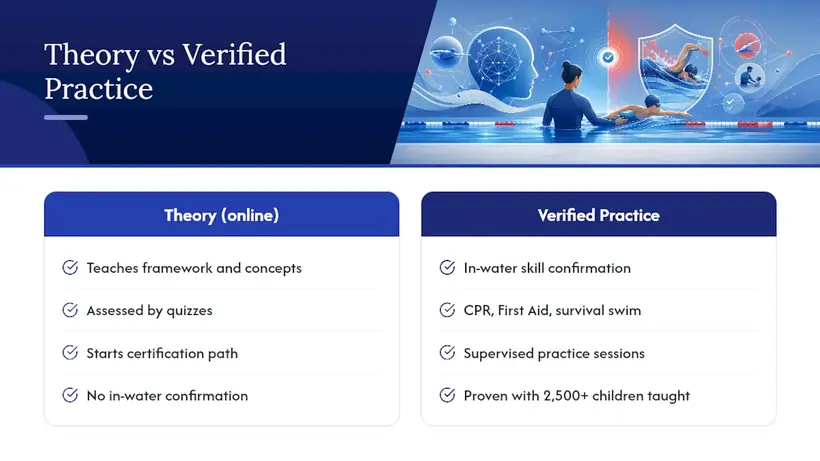
Online modules teach the framework. Verified practice in the water is what makes an instructor safe to hire, and that’s the standard Superhero Swim Academy trains to. Every instructor works through CPR, First Aid, and the academy’s own survival swim curriculum, with in-person practice sessions that confirm skills rather than assuming them from a quiz score. That approach comes from teaching more than 2,500 children, with parents consistently reporting real gains in water confidence and safety within a short stretch of lessons. If you’re weighing an infant and toddler certification path, the same principle applies: theory gets you started, supervised practice gets you hired.
Ready to get your child in the water?
Book a free assessmentGet Certified With a Program Built for Both Online Learning and Real Skills Verification
Superhero Swim Academy’s online courses are built around the exact gap this article has been pointing at: solid remote coursework paired with a real path to in-water verification, so you’re not left holding a certificate nobody can confirm.
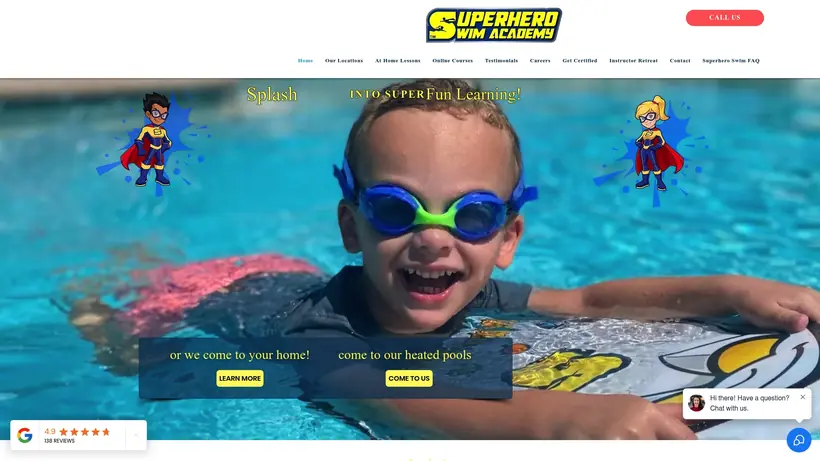
Enroll and you’ll work through structured online modules covering water safety, teaching progressions, and lesson planning, then move into hands-on practice through the academy’s instructor retreat for supervised, in-person skills verification. Most learners finish the online portion within a couple of weeks and complete the in-water component on a set retreat schedule, walking away with a credential built to hold up when an employer checks it. If you’re ready to move past a certificate that just sits in a folder, start with the online courses page and see which track fits your schedule.
Where to Verify Requirements Yourself
Check these directly before enrolling: Red Cross swim coach training standards, USA Swimming coach education, and the USSSA certification application for prerequisite details. Program rules change, so confirm current requirements with the issuing body itself.
Ready to get your child in the water?
Book a free assessmentSuperhero Swim Academy’s Take on Online-First Training
Nobody disputes that remote coursework works for teaching theory. Progressions, lesson structure, class management, all of that translates fine to a video and a quiz. The part that gets glossed over is that no employer worth working for will put an instructor alone with a child in water based on a passed quiz.
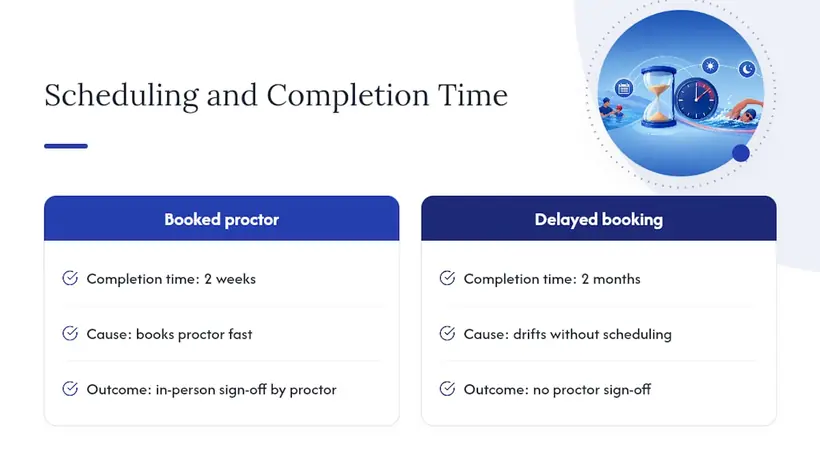
What’s underrated is how much the logistics of skills verification matter more than the coursework itself. Two candidates can finish identical online modules, and the one who books a proctor fast finishes in two weeks while the other drifts for two months. That’s not a curriculum problem. It’s a scheduling problem nobody warns you about upfront.
We built our own instructor training around that reality rather than around what sounds impressive in a marketing email. Online modules get you the framework. The retreat gets you signed off by someone who watched you do the work, not someone who graded a multiple-choice test.
, SUPERHERO