
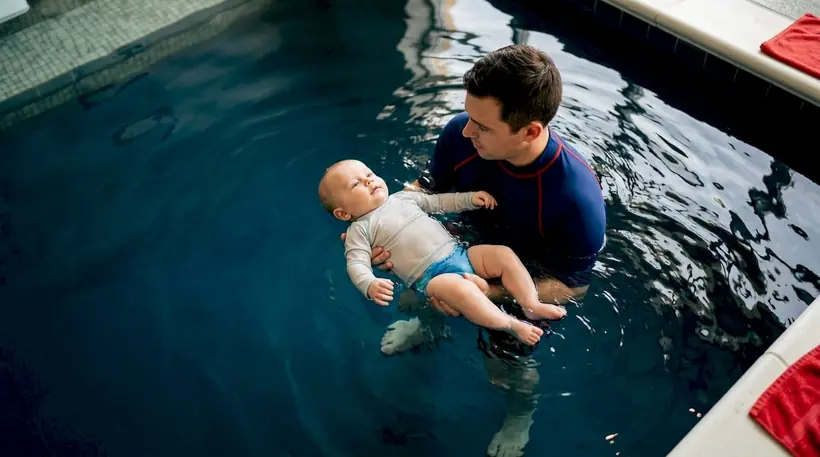
Aim for warm water in the range recommended for infant pools, keeping it toward the warmer side for babies under six months. Start sessions at about 10 minutes and limit total pool time to a maximum around 30 minutes for babies under a year. Confirm the actual temperature with a pool thermometer before getting in, and end the session the moment you see shivering, blue lips, or fussing that doesn’t settle.
TL;DR:
- Babies under six months should only be introduced to water temperatures at the high end of 87 to 93°F, ideally closer to 93°F for comfort and safety.
- A pool temperature of 84°F is acceptable for babies over six months, especially if they wear a wetsuit or remain active to generate warmth.
- Pool sessions should start at around 10 minutes and not exceed 30 minutes for infants under a year, with immediate removal if signs of cold distress appear.
- Use a floating thermometer to measure water at the correct depth and time heating at least 12 hours in advance to reach the recommended temperature.
- Ensure pool facilities provide balanced chemistry, heated changing areas, proper safety equipment, and certified instructors to maximize infant safety in water.
What Is the Ideal Pool Temperature for Infants by Age?
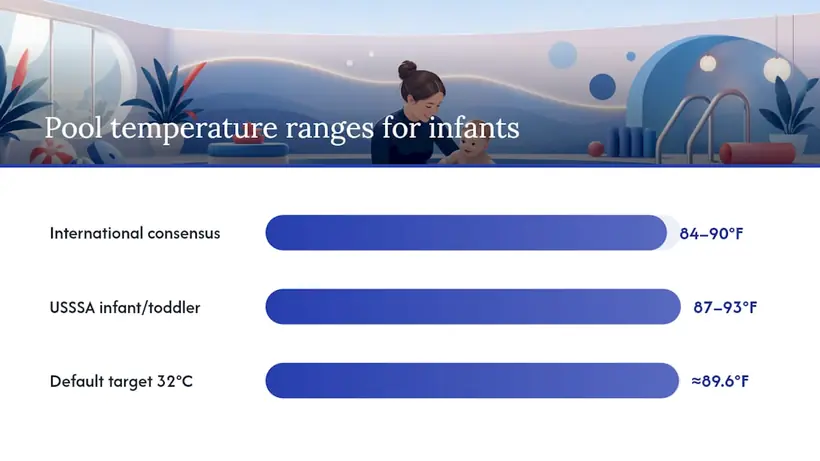
Newborns and babies under six months have the least tolerance for cool water, and the guidance reflects that. The USSSA Infant Toddler Guidelines recommend 87 to 93°F (30 to 34°C) for infant and toddler programs, calling it the range that keeps babies comfortable enough to actually focus on learning instead of just surviving the cold. A public-health review puts the international consensus closer to 84 to 90°F (29 to 32°C), with 32°C (about 89.6°F) showing up repeatedly as the default target for instructional pools serving young infants.
Those numbers aren’t in real conflict. They overlap heavily in the high 80s, and the small gap comes down to how conservative different organizations want to be. For babies under six months, lean toward the top of the range every time.
Swim lessons in Palm Beach & Broward County
Free 30 minute assessment. Try before you enroll, no commitment.
Book Free AssessmentThe reason comes down to basic physiology. A baby’s surface area is large relative to body mass, and infants carry far less insulating fat than adults do. Their thermoregulation system, the internal mechanism that keeps body temperature steady, isn’t fully developed yet either. That combination means babies lose heat faster than they can generate it, which is exactly what the Cleveland Clinic points to when it warns that infants are especially sensitive to sudden temperature shifts. A pool that feels merely “cool” to you can chill a baby fast.
By 6 to 12 months, babies handle slightly cooler water better, and by the toddler years, most kids tolerate the lower end of the 84 to 90°F range without trouble, especially with active movement keeping them warm. Wetsuits change the math further. A snug neoprene layer can let a toddler comfortably swim in water a few degrees cooler than what a bare-skinned infant would need, since the suit is doing part of the insulating work water alone can’t.
How Long Can a Baby Safely Stay in the Pool?
Short and slow wins here. The USSSA guidelines recommend starting infant sessions around 10 minutes, then building up gradually as the baby shows comfort and stamina in the water. Most babies under 12 months should stay under a 30-minute ceiling total, even once they’re used to swimming, with warm-up breaks worked in rather than one continuous stretch.
Watch the baby, not the clock. These are the signs it’s time to get out immediately:
- Shivering or chattering, even mild
- Pale, blue-tinged, or mottled skin, especially around the lips
- Sudden lethargy or a baby who goes quiet and limp instead of active
- Changes in breathing rhythm or refusal to feed afterward
Ready to get your child in the water?
Book a free assessmentIf you see any of these, wrap the baby in a warm towel right away and move to a warm room. Cold water doesn’t just risk discomfort. It disrupts a baby’s motor control and can cause real distress, which works against everything a swim lesson is trying to teach.
How Do You Check and Warm Up a Backyard Pool?
A pool that “feels warm” to an adult hand is a bad test. Use a floating pool thermometer and check the water at swimming depth, not just the surface, since surface water reads warmer than what a baby’s body actually sits in. Measure it about 24 hours before a scheduled lesson, then check again right before entry, since sun, wind, and evaporation can shift the number by a few degrees in either direction.
For home pools, plan ahead. Raising water temperature takes real time.
- Run the pool heater 12 to 24 hours before the session for a meaningful temperature climb
- Add a solar cover overnight to trap heat instead of losing it to evaporation
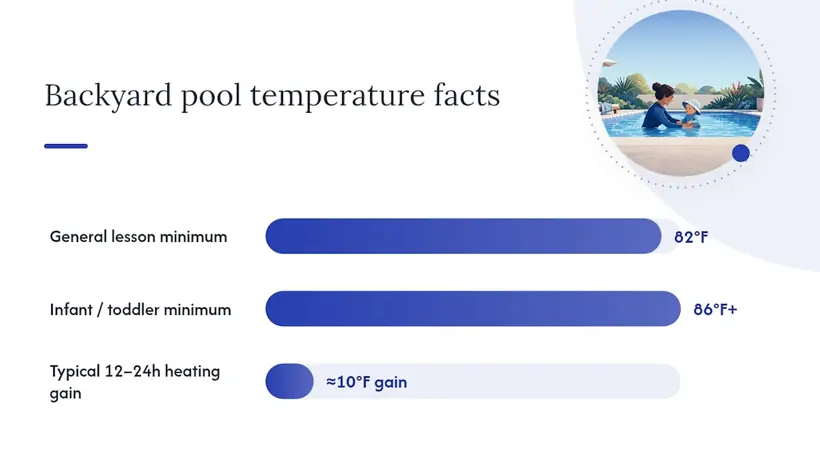
- Expect roughly 10°F of gain over a 12 to 24 hour heating window on most residential systems, according to backyard pool prep guidance for swim instructors
- Don’t count on midday sun alone to hit an infant-safe target in cooler months
Many mobile swim instructors won’t teach below certain thresholds. Operational minimums commonly cited are around 82°F for general lessons and 86°F or higher specifically for infants and toddlers, largely to prevent hypothermia risk during a lesson. If your pool can’t reach that number in time, the better move is to reschedule, shorten the session to a brief acclimation dip, or move the lesson to a facility with a dedicated heated pool.
Pro Tip: Test the water at the same depth where the baby will actually float or sit, not where your hand naturally reaches at the pool edge. A two-foot difference in depth can read two or three degrees cooler.
Ready to get your child in the water?
Book a free assessmentFor more on why heated facilities tend to outperform backyard setups for infant learning, see Do Heated Pool Classes Really Benefit Babies?
What Should a Baby Wear to Stay Warm in the Pool?
Clothing helps, but it’s a supplement to warm water, not a substitute for it. A thin neoprene wetsuit or thermal swimwear adds a real layer of insulation, particularly useful for public pools that run cooler than a dedicated infant program, or for toddlers who want longer play sessions. It won’t fully protect a baby in genuinely cold water, though, so don’t use a wetsuit as an excuse to skip checking the temperature.
Keep these ready poolside:
- A large hooded towel or robe for the instant the baby exits the water
- A warm hat, since babies lose a lot of heat through the head
- Dry clothes staged and within arm’s reach, not in a bag across the deck
- A properly fitted swim diaper under any wetsuit or swimsuit
- Skip inflatable arm floats or neck rings during lessons. They interfere with an instructor’s ability to guide proper body position and don’t belong in a survival-swim curriculum.
Ready to get your child in the water?
Book a free assessmentWhat Should Parents Confirm Before a Baby Swim Lesson?
A quick checklist before you show up saves a wasted trip and keeps the session safe. Run through these before committing to a class or a home lesson:
- Ask for the measured water temperature, not a guess, ideally taken within the hour before the lesson starts.
- Confirm pool chemistry is balanced. Improperly treated water can irritate a baby’s skin and eyes faster than an adult’s.
- Check for a heated changing area or warm deck space, since a chilly bathroom after a warm pool undoes half the benefit.
- Verify compliant drain covers and pool fencing, standard safety items that matter more with a baby who can’t self-rescue.
- Ask about instructor certification, specifically CPR and First Aid training, and how the curriculum is structured for infants versus older toddlers.
- Get the session-length policy in writing or verbally confirmed so you know the plan matches the 30-minute ceiling for babies under a year.
If a pool falls short, ask whether the heater can run ahead of time, request a shorter acclimation-only visit instead of a full lesson, or choose a facility built around heated infant programs from the start. For a deeper walkthrough of easing a baby into new water conditions, Infant Water Acclimation: A Safe, Step-by-Step Guide covers the gradual approach in more detail. Parents newer to infant routines overall may also find value in broader newborn-prep resources like why newborn care classes matter for first-time parents.
Ready to get your child in the water?
Book a free assessmentHow Superhero Swim Academy Puts These Numbers Into Practice
Instructors complete CPR and First Aid training before teaching infants, and lessons are designed with short, age-appropriate formats based on recommended temperature and time ranges. On the deck, that means checking water temperature before a session starts, pacing lessons with built-in warming breaks, and keeping parents updated in real time rather than after the fact. We’ve applied this approach across more than 2,500 children taught in Palm Beach and Broward counties, and it shapes the practical guidance we share on our blog resources on infant water safety as well.
Ready for Warm, Guided Swim Lessons?
Getting the temperature right is only half the equation. The other half is having an instructor who knows how to read a baby’s comfort in real time and adjust before a shiver becomes a problem. The academy offers private, small-group, and parent-and-child survival swim lessons in heated pools in South Florida, with instructors trained in CPR, First Aid, and an infant-focused curriculum. If you’re ready to book a session or want to see what’s available near you, visit Superhero Swim Academy or check our locations across Palm Beach and Broward counties to find a class.