
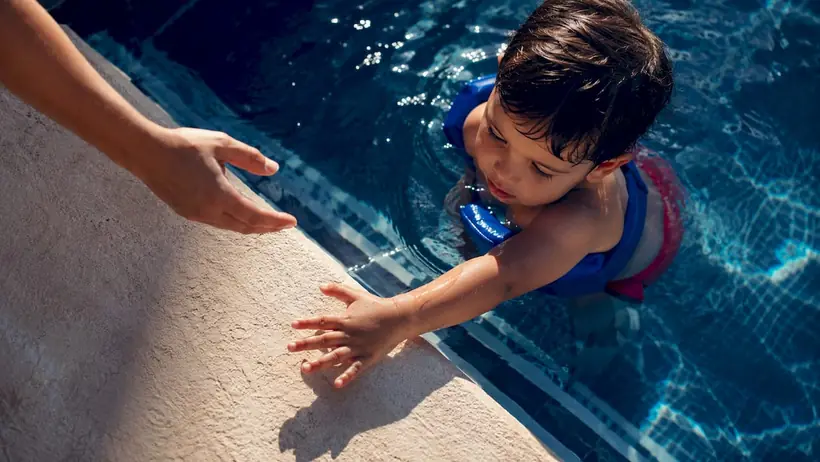
Puddle jumpers float, and some models carry a genuine U.S. Coast Guard approval label, but that label certifies manufacturing standards, not swimming ability. They’re safe only as one layer of protection during constant, arm’s-reach supervision in calm pool play. For open water, boats, or docks, a true USCG-approved life jacket is the right call, and no flotation device replaces early survival swim lessons.
TL;DR:
- Puddle jumpers are certified for manufacturing standards, not swimming ability, and they are safe only in constant supervision during calm pool play.
- Using puddle jumpers can lead to dangerous false confidence and muscle memory for incorrect floating posture, increasing drowning risks around water.
- Proper use involves checking labels, fitting straps tightly, staying within arm’s reach, and removing devices during skill-building to promote correct swimming techniques.
- A USCG-approved life jacket is mandatory for open water, boats, and docks, as puddle jumpers do not self-right an unconscious or face-down person.
- Skill development, not device dependence, should be the focus of swim lessons, with safety layered through education, supervision, and formal survival training.
Why Puddle Jumper Safety Is a Bigger Question Than the Label Suggests
The biggest danger with puddle jumpers isn’t usually the device failing. It’s what the device does to everyone’s behavior around the water.
Parents relax. Kids get bold. That combination is where trouble starts, according to a Consumer Reports analysis of puddle jumpers and floaties, which found the false sense of security these devices create can be more dangerous than any mechanical flaw. A toddler bobbing happily at the surface looks capable. That look is deceiving, and it invites a parent to glance at a phone or step away “for just a second.”
There’s a physical problem layered on top of the behavioral one. Puddle jumpers strap around the arms and torso to hold a child upright and vertical in the water. That’s the opposite of how you actually stay afloat and swim, which requires a horizontal body position. Kids who spend hours in a puddle jumper build muscle memory for the wrong posture entirely, one that doesn’t translate to floating on their back or kicking toward a ledge without help.
Swim lessons in Palm Beach & Broward County
Free 30 minute assessment. Try before you enroll, no commitment.
Book Free AssessmentDevice mechanics matter too, even if they’re the smaller piece of the risk:
- Straps can slip loose or loosen gradually as a child squirms or grows.
- Buckles can pop open, especially on older, sun-worn foam.
- Foam degrades with UV exposure and chlorine, losing buoyancy over years of use.
- Most puddle jumpers are Type III personal flotation devices, meaning they keep a wearer upright but do not self-right an unconscious or face-down child, according to WaterWiseKids’ safety checklist.
The stakes behind all this are stark. Drowning remains a leading cause of unintentional injury death among young children, and most fatal drownings among kids ages 1 to 4 happen in swimming pools, according to CDC drowning data. That statistic is exactly why safety experts talk about “layers” instead of relying on any single device. A puddle jumper can be part of a layered system. It cannot be the whole system.
Parent accounts back this up with painful specificity. One mother’s public warning, shared with Good Morning America, described how her toddler’s habitual puddle jumper use may have built confidence and muscle memory that worked against him in the moment he needed real swimming skills. That’s not a reason to panic. It’s a reason to be precise about how and when these devices belong in your routine.
Ready to get your child in the water?
Book a free assessmentHow Do You Use a Puddle Jumper Safely?
If you’re going to use one, treat it like a tool with rules attached, not a babysitter. Here’s the sequence that actually reduces risk:
- Check for the label. Look for a printed “U.S. Coast Guard approved” tag and confirm the child’s weight falls inside the listed range. An unlabeled or off-brand version has not gone through the same performance testing.
- Run the pinch-and-lift test. With the device on, pinch the shoulder straps and lift gently. If you can pull it up over the child’s chin or ears, it’s too loose and needs tightening or a smaller size.
- Stay within touch supervision. Arm’s reach, every second, whenever the device is on. Assign one adult as the designated Water Watcher and keep that person’s phone out of hand for the full rotation.
- Keep sessions short and calm. Puddle jumpers belong in gentle, supervised play, not extended free swim while adults socialize.
- Remove it during skill practice. If you’re working on floating, kicking, or breath control, take the puddle jumper off so your child actually learns the horizontal body position that keeps swimmers safe.
- Inspect before every use. Check buckles, straps, and foam panels for cracking, fading, or looseness. Replace the device at the first sign of wear.
Pro Tip: Alternate your pool sessions. Spend part of the time with hands-on support teaching horizontal floating, and save the puddle jumper for short, relaxed play afterward. That order matters more than most parents realize. It keeps the device from becoming the only posture your child ever practices.
One more rule that has no exceptions: puddle jumpers are for pools, not boats, docks, or open water. Those settings call for a real life jacket, which is a different device built for a different job.
Ready to get your child in the water?
Book a free assessmentWhen Should You Choose a Life Jacket Over a Puddle Jumper?
The setting decides the device, not personal preference. A USCG-approved life jacket is required for boating and strongly recommended for any open water, and it’s built to turn an unconscious wearer face-up. Puddle jumpers, as Type III PFDs, are not designed to do that, according to WaterWiseKids.
That distinction should guide every decision you make about which device goes in the bag:
- Boats, docks, and marinas: life jacket, always, no exceptions.
- Lakes, rivers, and the ocean: life jacket, even for strong young swimmers, because currents and depth change the math.
- Backyard or community pools with constant supervision: a puddle jumper can work as a supervised play aid, never as a safety net you walk away from.
- Fitting a life jacket: match it to your child’s actual weight (not age), check that it doesn’t ride up past the ears when lifted by the shoulders, and confirm the label says U.S. Coast Guard approved.
For education around basic buoyancy concepts, a resource like Brainie Comics’ guide to sink and float science breaks down why some objects float and others don’t in kid-friendly terms, which can help you explain to a curious four-year-old why the jumper works the way it does.
What Age Should Kids Stop Using Puddle Jumpers?
There’s no universally recommended safe age for puddle jumpers, and that surprises a lot of parents who assume there’s a chart somewhere. There isn’t. Manufacturer weight ranges tell you fit, not readiness, and a USCG-approved label was never meant to function as a developmental green light.
What actually matters is skill progression, not a birthday. Swim organizations point to starting formal lessons around age one, with instruction built around specific, testable skills:
Ready to get your child in the water?
Book a free assessment- Back floating independently for a sustained stretch.
- Controlled breath holding and comfortable submersion.
- Turning and reaching to the wall or exiting a pool without help.
The American Red Cross’s swim lesson framework structures instruction around exactly this kind of skill-building rather than device dependence. A workable plan looks like this: enroll in lessons early, practice supervised skill-building without any flotation device layered on top, and only then let puddle jumper use taper down naturally as real competence grows.
One mistake undoes progress faster than anything else: putting a child who has learned to float and swim back into a puddle jumper for convenience. That resets the muscle memory you just spent weeks building. Once a child can float and self-rescue, let those skills do the work.
What Superhero Swim Academy Wants Parents to Understand
Survival-focused swim lessons teach something a flotation device physically cannot: the ability to flip onto your back, float, breathe, and self-rescue without help. That’s the entire gap between “looks safe in the pool” and “actually is safe in the water,” and it’s the gap Superhero Swim Academy was built to close.
A puddle jumper can hold a child up. It can’t teach a child what to do when the strap comes off, the boat rocks, or the water gets rough. Only practiced skill does that.
A few steps close that gap faster than most parents expect:
- Enroll your child in survival swim lessons that prioritize horizontal floating and self-rescue over splash-and-play time.
- Get every caregiver in the rotation certified in CPR, since seconds matter in a water emergency.
- Set up a formal Water Watcher rotation with zero phone use during shifts.
- Inspect every flotation device in your pool bag before each outing, not just at the start of the season.
Ready to get your child in the water?
Book a free assessmentSuperhero Swim Academy’s instructors train specifically in this survival curriculum, with parents regularly reporting real gains in water confidence and skill within a short stretch of lessons. If you want a structured path from “floats with help” to “can self-rescue,” start with survival swim lessons at Superhero Swim Academy or explore the online courses built for parents who want to teach these skills at home.
Where This Guidance Comes From
The USCG’s PFD approval policy clarifies what that label actually certifies. Consumer Reports synthesizes expert risk analysis. CDC drowning data shows scale and setting. WaterWiseKids and Good Morning America add practical and personal weight to the numbers.
Our Take: What the Evidence Actually Supports
The conventional advice on puddle jumpers tends to split into two extremes: either they’re fine because “the label says approved,” or they’re dangerous and should be thrown out entirely. Both miss the point. The evidence supports a narrower, more useful conclusion: puddle jumpers are a supervised play tool with a specific job, and they fail only when parents ask them to do a different job, like teaching swimming or replacing attention.
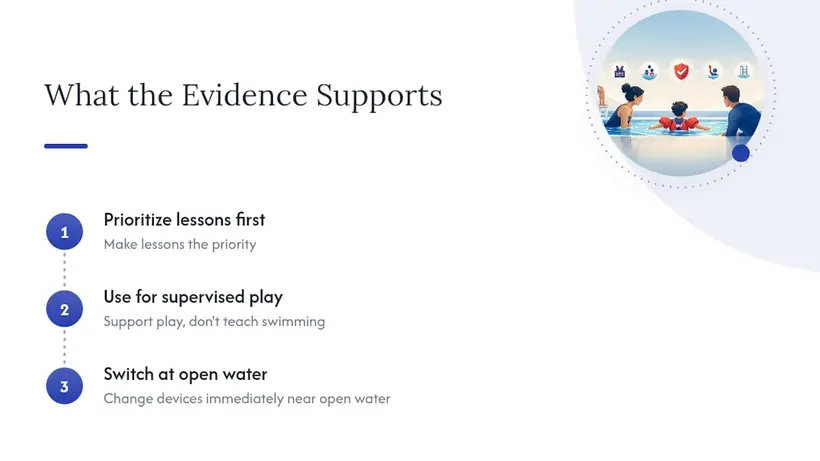
What’s overrated is the label itself. Parents treat USCG approval as a safety guarantee when it’s a construction standard. What’s underrated is timing. The order in which you introduce lessons, supervised skill practice, and flotation devices matters more than which brand you buy.
Ready to get your child in the water?
Book a free assessmentIf you take one thing from this, prioritize lessons first. Let the puddle jumper support play, not skill. And when your child moves near open water, switch devices without hesitation. That single habit prevents more harm than any product review ever will.
, SUPERHERO