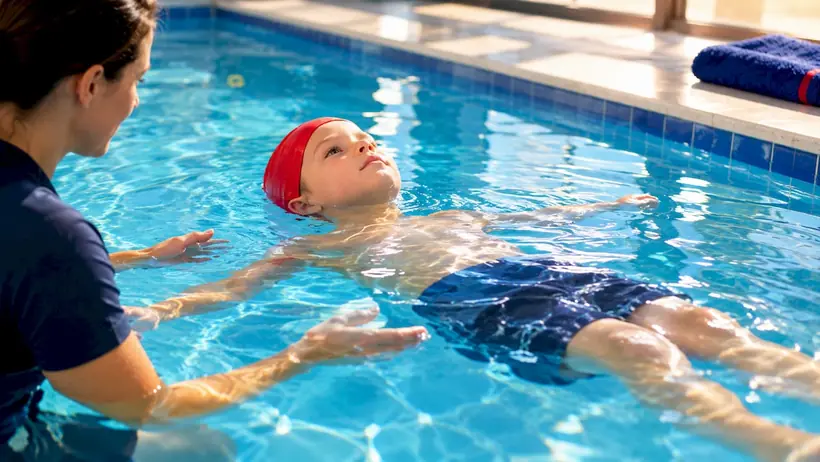
A survival swim curriculum teaches short, repeatable self-rescue skills, like the roll-to-back float and the swim-float-swim sequence, so a child who accidentally falls into water can turn face up, breathe, and work toward safety. The core skills parents should expect are a controlled roll to a floating position, sustained floating or treading with the airway clear, and short directed swims toward an exit or wall. None of this replaces active adult supervision; it’s one layer in a much bigger safety plan.
TL;DR:
- Most survival programs focus on simple, repeatable skills such as rolling to a back float, short swim-float-swim cycles, and sustained treading or floating to maximize safety during emergencies.
- The curriculum emphasizes clear, measurable “must-see” skills instead of subjective judgments, with adjustments based on water environment and child’s age.
- Instructors must have current CPR and First Aid certifications, alongside specialized survival pedogogy training, and lessons should include transparent progress checklists.
- Parent reinforcement through brief supervised practice at home supports skill retention but should never replace active supervision or formal lessons.
- Starting survival swimming lessons as early as four months can build reflexive responses, but the focus remains on safety skills rather than stroke techniques until responses are automatic.
What Does a Survival Swim Curriculum Look Like Week to Week?
Most survival programs run in short, frequent sessions rather than long weekly classes. Infants and young toddlers typically do best with private, one-on-one lessons of 10 to 15 minutes, several times a week, because the skills rely on muscle memory built through repetition, not endurance. Depending on the child’s age, temperament, and water exposure, reliable responses can take anywhere from a few weeks to a couple of months to solidify.
The progression generally follows a set order:
Swim lessons in Palm Beach & Broward County
Free 30 minute assessment. Try before you enroll, no commitment.
Book Free Assessment- Acclimation: getting comfortable with submersion, temperature, and the sensation of water on the face.
- Back float: learning to roll from a facedown or vertical position into a stable float.
- Swim-float-swim: chaining short swims with floating rest breaks to conserve energy.
- Distance and exit practice: extending swims toward a wall, steps, or shoreline and climbing out unassisted.
Instructors track progress against a “must-see” checklist, borrowing from frameworks like the RLSS Survival Swimming Guide, which spells out exactly what a passing skill looks like rather than leaving it to a subjective “seems fine.” A program that can’t tell you what success looks like on a given day probably doesn’t have a real curriculum behind it.
Good programs also adjust the finish line based on where the child will actually swim. A curriculum built for a controlled backyard pool sets different distance and treading targets than one designed for open water with waves or current, according to research on adapting survival swimming curricula to local water conditions.
Ready to get your child in the water?
Book a free assessmentWhich Survival Skills Matter Most, and How Are They Measured?
Three skills form the backbone of nearly every credible curriculum, and each one has a specific job to do in an emergency.
Roll-to-back float. The child learns to turn from a facedown or vertical position into a relaxed float on their back, chin up, ears in the water. The “must-see” version of this skill is a sustained float with a clear airway and minimal thrashing, not a panicked, arm-flailing version that tires the child out in seconds.
Swim-float-swim. This is the signature move of most infant and toddler survival programs. The child swims a short distance, rolls to float and rest, then swims again, repeating the cycle toward an exit. It mimics what a real fall into water demands: short bursts of effort separated by recovery, not one continuous swim to shore.
Treading and airway control. Older toddlers and preschoolers add treading water or sustained floating, often with a target of 30 to 90 seconds depending on age and program design, per the skill benchmarks outlined in the RLSS survival guide. The purpose isn’t to build a strong swimmer; it’s to buy time until a rescuer arrives.
- Roll to float: sustained, relaxed, airway clear.
- Swim-float-swim: repeatable cycle over 10 to 50 meters, adjusted by environment.
- Treading: age-appropriate duration with visible breath control.
- Exit practice: climbing out unassisted, including in wet clothing.
Programs that layer in clothed swim trials or varied water types (a pool wall versus a dock ladder) are preparing children for what actually happens: falls rarely occur in swimsuits on a calm, warm day.
Ready to get your child in the water?
Book a free assessmentWhen Should a Child Start, and How Does the Curriculum Change With Age?
Survival swim instruction can start earlier than most parents expect, but readiness depends on development, not just birthdays.
- Infants (around 4 to 12 months). Programs that start this early rely on head and neck control and reflexive responses, pairing short directed swims with back-float rest, an approach that looks different from stroke-first teaching for older kids and works best delivered one-on-one by a trained instructor.
- Toddlers (1 to 3 years). Expect longer swim-float-swim cycles, more independent floating, and the beginning of directional awareness toward exits.
- Preschoolers (3 to 5 years). Treading duration increases, exit practice gets more consistent, and some programs start blending in basic stroke mechanics once survival skills are solid.
- Refreshers, at any age. Skills fade as children grow, gain confidence, or go through a stretch without pool time, so periodic re-evaluation matters as much as the initial lessons, according to the Lifesaving Society’s Swim to Survive guidance.
Once survival competency is consistent, most curricula start layering in formal stroke technique. That transition should be gradual. Rushing a child into freestyle before the float and swim-float-swim sequence is automatic tends to undo the safety benefit the survival lessons were built for.
How Do Lesson Formats and Safety Protocols Compare?
Private one-on-one lessons remain the standard for infants and early survival work because the skills are built through repetition with immediate, individualized correction. Semi-private lessons (two children, one instructor) work well once a child has some baseline comfort in the water. Parent-and-child classes suit very young infants who aren’t yet doing independent skill work, and group lessons make sense mainly for older kids refining stroke technique after survival basics are locked in.
Whatever format you choose, a handful of safety elements should be non-negotiable:
- A clearly defined instructor-to-student ratio, ideally 1:1 or 1:2 for infants and toddlers.
- A documented venue risk assessment covering water depth, temperature, and visibility.
- A written emergency response plan, not just a verbal assurance.
- Clear policy on personal flotation devices, used for comfort during teaching but never relied on during skill testing, since testing should reflect what the child can do unassisted.
Ready to get your child in the water?
Book a free assessmentPro Tip: Ask to observe a lesson before enrolling, and ask specifically how the instructor documents progress. A program with real “must-sees” will show you a checklist, not just tell you your child is “doing great.”
Safety planning of this kind, including venue assessment and supervision protocols, mirrors the structure recommended in the RLSS survival swimming guide. If a pool area at home is part of the picture, physical barriers matter just as much as lessons; a look at pool design and barrier trends is worth a read for any family building or renovating a home pool.
What Credentials Should an Instructor Actually Have?
An instructor teaching survival skills to an infant or toddler should carry current CPR and First Aid certification at minimum, along with specific training in survival swim pedagogy rather than general swim-team coaching. That distinction matters more than most parents realize: teaching a competitive swimmer to swim faster is a different skill set from teaching an 8-month-old to roll to a float on reflex.
Credible programs measure outcomes against a defined standard, similar to the checklist model used in RLSS guidance or Swim-to-Survive-style benchmarks, rather than a vague sense that a child is “coming along.” Look for:
- Verifiable CPR and First Aid certification, current and renewable.
- A stated curriculum with skill descriptions and pass/fail criteria, not just a lesson plan.
- Regular parent progress updates tied to specific milestones.
- Willingness to let you observe lessons and ask questions about methodology.
Superheroswimacademy has built its instructor training around CPR, First Aid, and a proprietary survival curriculum, and reports having taught more than 2,500 children under that model, with parents sharing regular progress updates as part of the process.
Ready to get your child in the water?
Book a free assessmentHow Should Parents Reinforce Skills Between Lessons?
Short, supervised practice at home helps skills stick, but it should never substitute for structured lessons or active supervision. A few minutes of guided floating or a supervised swim-float-swim rep in a backyard pool, always within arm’s reach of an adult, reinforces what’s happening in class.
- Practice in short bursts, two or three times a week, rather than long unsupervised pool time.
- Schedule a refresher lesson every few months, especially after a growth spurt or a long break from the water.
- Treat lessons as one layer among several: fencing, door alarms, and constant direct supervision all matter just as much as taught skills.
- Watch for red flags, like a child suddenly refusing to float, showing new fear of water, or performing inconsistently. That’s a signal for reassessment, not just more practice.
Pro Tip: If your child aces the float in the bathtub but panics in the pool, don’t assume the skill is “in there somewhere.” Treat it as not yet learned and go back to the instructor.
Global drowning-prevention guidance consistently frames these home practices as a supplement, not a substitute, for supervision, per the WHO global report on drowning.
Why Survival-First Beats Stroke-First for Young Children
Stroke technique looks impressive, but it doesn’t help a toddler who falls into a pool fully clothed and disoriented. Survival-first curricula prioritize what a child can do reflexively under stress: roll, float, breathe, and move toward safety in short bursts. Formal stroke work has its place, but it belongs after the survival sequence is automatic, not before. None of this changes the baseline rule: a lesson is a skill, not a guarantee, and an adult’s eyes on the water remain the real safety net.
Ready to get your child in the water?
Book a free assessment, SUPERHERO
Ready to Start? What to Look for in a Program Near You
If you’ve read this far, you already know what a real survival swim curriculum should include: measurable skills, a clear progression, and instructors who can show you a checklist, not just a smile. Superheroswimacademy builds its program around exactly that model, offering private lessons at its pools, at-home instruction for families who want one-on-one attention in a familiar setting, and online resources for parents who want to understand the curriculum before booking.
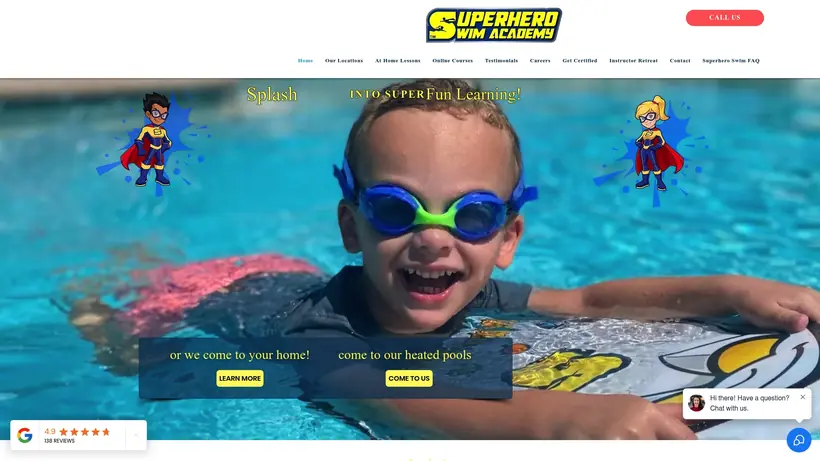
For infants and toddlers, the Parent and Toddler classes start at $115 per month, while Private Lessons at Our Pool run $325 to $600 per month depending on frequency. Families who prefer instruction in their own backyard can look into at-home lesson packages, available with two, three, or four private sessions weekly. Parents who want to learn the curriculum themselves, or reinforce it between lessons, can explore the Infant Course and Mission Map online resources.
Before enrolling anywhere, ask to observe a lesson and request the instructor’s CPR and First Aid credentials; a program confident in its methods will welcome both. To see how the curriculum works firsthand, book a trial lesson through Superheroswimacademy’s main site and watch a “must-see” checklist in action.
Ready to get your child in the water?
Book a free assessmentWhere to Read More on Survival Swim Standards
- RLSS Survival Swimming Guide: skill definitions and “must-see” criteria.
- Lifesaving Society Swim to Survive: roll, tread, swim standard.
- WHO Global Report on Drowning: worldwide drowning prevention data.
- American Red Cross water safety resources: CPR and layered safety guidance.