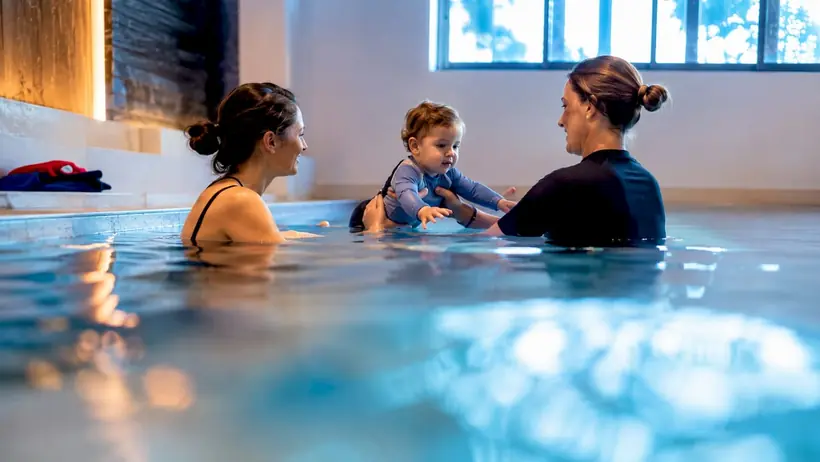
For infants and toddlers in Palm Beach and Broward counties, the best winter swim lessons take place in heated indoor pools or through in-home private instruction, since both keep water temperature and body comfort consistent regardless of the cold front outside. Parent-and-child classes and short survival intensives round out the solid options for winter. Some local providers run safety-first survival lessons through the colder months, built around CPR-trained instructors and a curriculum designed for exactly this age group. The rest comes down to matching the format to your child’s age and temperament.
TL;DR:
- Heated indoor pools should be prioritized for infants and cold-sensitive children to maintain water temperature and prevent discomfort during lessons.
- Short, intensive survival courses lasting two to three weeks provide faster skill acquisition but require consistent attendance and practice.
- Instructors must hold current CPR and First Aid certifications and follow a dedicated survival curriculum; large groups or vague descriptions are red flags.
- Pool water should be maintained at mid-80s to low-90s Fahrenheit during winter sessions, and safety protocols include immediate warming and hygiene considerations.
- Supervision, physical barriers, and CPR training remain essential safety layers, as lessons alone cannot fully prevent drowning risks.
Where to Find Winter Swim Lessons in Florida (and Which Format Fits)
Winter in South Florida rarely drops below swimmable temperatures, but pool water cools faster than the air, and that changes where lessons actually work.
Heated indoor pools solve the temperature problem outright. Water stays in a controlled range no matter what’s happening outside, which matters most for infants who lose body heat faster than older kids. Heated outdoor pools work too, though wind chill on wet skin between drills can make a session feel colder than the water itself.
Swim lessons in Palm Beach & Broward County
Free 30 minute assessment. Try before you enroll, no commitment.
Book Free AssessmentIn-home private lessons give infants and cold-sensitive toddlers a shorter transition from house to pool, no car ride in a wet swimsuit, and a one-on-one pace that many babies handle better than a group setting. Parent-and-child classes focus on water acclimation, comfort, and bonding rather than solo self-rescue, and they’re a reasonable starting point for kids who aren’t ready for structured survival drills. Short intensive survival sessions, often called swim bootcamps, compress lesson frequency into two to three weeks to build the muscle memory survival skills require.
- Heated indoor pools: best temperature consistency, ideal for infants
- In-home private lessons: least disruption, most comfort for cold-sensitive kids
- Parent-and-child classes: best for acclimation before formal survival training
- Intensive short-term sessions: fastest path to reliable self-rescue skills
Is My Child Ready for Winter Swim Lessons?
The American Academy of Pediatrics says swim lessons can begin around age 1 and function as one layer of protection, not a guarantee against drowning. That distinction shapes how you should think about timing.
The numbers that matter: In Broward County, drowning claimed 53 lives with a rate of 2.6 per 100,000 in recent Florida health data , and Palm Beach County recorded 39 deaths at a rate of 2.4. Statewide, Florida logged 452 drowning deaths at a rate of 1.9 per 100,000. Research summarized by CHOP’s injury prevention team found formal lessons associated with drowning-risk reductions as high as 88% for children ages 1 to 4. Evidence for babies under 1 is much thinner.
Ready to get your child in the water?
Book a free assessmentThat gap between age groups is worth sitting with. Lessons for a 6-month-old are mostly about acclimation and comfort, not proven risk reduction. Lessons for a toddler past their first birthday have real evidence behind them. Before booking, ask yourself three things: can your child hold their head steady and move their limbs with some control, do they tolerate face-in-water without panic, and are you prepared to get in the pool yourself for touch-supervision sessions? If the answer to the third one is no, that’s worth addressing before day one.
What Survival Swim Lessons Actually Teach Winter Learners
Survival swim is not the same thing as stroke lessons, and confusing the two sets up parents for disappointment. A recreational class teaches kids to swim well. A survival class teaches a child what to do if they end up in water unsupervised, and that distinction changes everything about how the lessons run.
The core skill sequences look like this:
- Swim, float, swim: the child swims a short distance, rolls to a back float to breathe and rest, then continues swimming toward safety or the pool edge.
- Roll back to float: often the first skill taught to younger toddlers, since it’s the foundation everything else builds on.
- Parent participation: touch supervision during early sessions, where an adult stays within arm’s reach in the water, is standard practice in most survival programs.
Timelines vary by age and temperament, but expect several weeks of consistent, frequent sessions before a child shows a reliable response. This isn’t a skill you can teach once a week for a month and call finished. Survival responses need to become automatic, which means repetition matters more than any single “aha” moment in the pool.
Pro Tip: Practice the float at home in the bathtub. Hum a song while your child leans their head back against your hand. That same muscle memory transfers to the pool and speeds up progress.
Ready to get your child in the water?
Book a free assessmentWinter Pool Safety: Temperature, Timing, and Illness Policies
Cold water changes the rules slightly, even in Florida. Here’s what to check before enrolling for the season.
- Ask about water temperature. Most infant and toddler programs keep pools in the mid-80s to low-90s Fahrenheit range during cooler months. If a provider can’t tell you the number, that’s a gap worth asking about further.
- Plan the transition out of the pool. Have a warm, dry towel and clothing ready immediately after the session, and warm up the car before the drive home. Wet hair and cool air is the most common source of post-lesson discomfort.
- Confirm pool hygiene standards. Indoor heated pools need proper chlorine or sanitation balance, since warmer water can accelerate bacterial growth if maintenance lags.
- Ask about illness and make-up policies. Winter brings more colds and stomach bugs. A good program has a clear policy for missed sessions during an intensive block, not a vague “just call us.”
- Never treat lessons as your only safety layer. The Florida Department of Health recommends stacking protections: a dedicated Water Watcher during any pool time, physical barriers like fencing, life jackets for non-swimmers around open water, and CPR training for every caregiver in the house.
That last point deserves repeating because lessons alone give parents a false sense of security. Nonfatal drowning incidents send far more children to emergency rooms than fatal ones, according to state health data, and most of those incidents happen during brief supervision lapses, not during structured lessons.
How to Choose a Winter Survival Swim Program
Not every swim school built for summer camp season translates well to a focused winter survival program. Here’s what actually separates a credible provider from one coasting on marketing.
Verify instructor credentials directly. Every instructor working with your child should hold current CPR and First Aid certification, plus documented training in a specific survival curriculum, not just general swim instruction experience. Ask whether the school runs background checks on staff who work one-on-one with kids.
When you call or tour a facility, ask these questions:
Ready to get your child in the water?
Book a free assessment- What is your average class size for survival lessons, and how do you group by age or skill?
- How do you track and report my child’s progress week to week?
- What’s the pool temperature during winter sessions?
- What does your insurance and liability waiver actually cover?
- What role do you expect me to play during lessons?
Watch for red flags: no instructor can name their CPR certification provider, the curriculum description is vague (“we teach swimming basics”), or you see large mixed-age groups labeled as “survival” classes. Survival skills require close, individualized attention, especially for infants. A crowded group setting undercuts the entire premise.
Pro Tip: Ask for a single trial lesson before committing to a package. A program confident in its curriculum will let you watch one session and see how progress gets communicated before you pay for a full block.
Scheduling and Cost: What a Realistic Winter Plan Looks Like
Frequency drives speed. A short intensive block, four or five days a week for two to three weeks, builds survival responses faster than once-weekly group classes stretched over months. That speed comes at a higher upfront cost, while weekly group sessions cost less per class but take longer to produce a reliable skill.
- Private or in-home lessons: highest cost per session, fastest individualized progress
- Small group classes: moderate cost, slower pace, still effective with consistent attendance
- Community or nonprofit programs: lowest cost, worth checking with local recreation departments for winter availability
- Intensive bootcamp blocks: higher total cost, compressed timeline, best for parents who want results before a specific date
Ready to get your child in the water?
Book a free assessmentWhatever format you choose, pair it with home practice and constant supervision. Lessons build the skill. Supervision keeps your child safe while that skill is still developing.
A Founder’s View on Winter Lessons and What Actually Keeps Kids Safe
I’ve spent years training instructors in survival curriculum and CPR certification, and the pattern I see every winter is the same: parents assume cooler weather means fewer lesson options, when really it just means picking the right pool and format. What changes outcomes isn’t the season. It’s whether the instructor is actually trained for survival skills, not just general swim coaching, and whether parents stay engaged between sessions instead of treating lessons as a drop-off service.
, SUPERHERO
Book Winter Swim Lessons With Superhero Swim Academy
Some programs run safety-first survival lessons through the winter in heated pools in the South Florida area, plus in-home private sessions for families who want a calmer, one-on-one setting for infants and cold-sensitive toddlers.
Instructors typically hold current CPR and First Aid certification and work from a survival curriculum built specifically for infants and young children, not adapted from adult swim programs. Parent-and-child classes are available for babies still working on water acclimation, and the online courses give parents tools to reinforce skills at home between sessions. Many children have gone through similar programs, with parents reporting real progress in swim confidence within weeks, not months.
Before you book, ask about pool temperature, instructor certifications, and how progress gets tracked. Then head to the Superhero Swim Academy home page to check winter availability in your area and get started.