
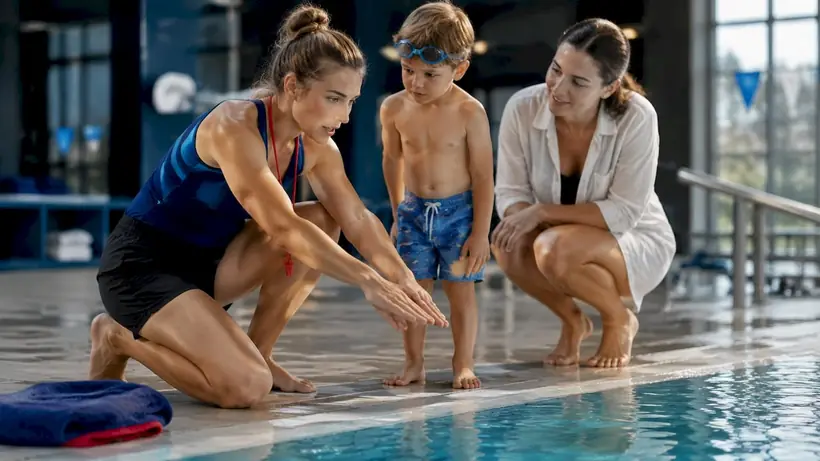
Yes, a swim instructor business startup is viable, and you can prove it in weeks, not months. Get CPR/First Aid and a recognized instructor certification, secure pool access, and book five paying families for a pilot round of survival-swim lessons. Everything else, from your business structure to your marketing plan, can build around what that pilot teaches you.
TL;DR:
- Securing five paying families in the first 30 days through pilot lessons confirms market demand without initial facility or staff investment.
- Certification with CPR/First Aid and a recognized instructor credential is mandatory to legally and safely teach water survival skills.
- Launching as a private or mobile lessons business minimizes startup costs, with revenue heavily dependent on instructor utilization and package sales.
- Building strong local partnerships and referral programs can rapidly generate initial clients more effectively than paid advertising.
- Maintaining strict safety protocols, clear communication, and organized operations helps ensure retention and scalable growth beyond the pilot phase.
Your 30-Day Swim Instructor Business Startup Checklist
You don’t need a facility, a fleet of instructors, or a five-year plan to find out if this works. You need proof that families will pay you, and you can get that proof in 30 days.
Here’s the sequence that gets you from idea to first paid lesson without wasting money on things you don’t need yet:
- Market-test first. Find five families through friends, a local parenting group, or one daycare willing to host a pilot. Don’t build anything until you know people will pay.
- Get certified. Complete CPR/First Aid and a recognized instructor credential such as the American Red Cross Water Safety Instructor certification. This is non-negotiable before you touch a child in the water.
- Lock in pool access and insurance. Rent time at a community pool, hotel pool, or a family’s backyard pool, and get liability coverage in place before your first session.
- Set your price and booking flow. Keep it simple, a flat per-lesson rate or a small five-pack, and use whatever payment app you’re comfortable with.
- Run the pilot. Teach five families, ask for honest feedback, and track whether they rebook.
Swim lessons in Palm Beach & Broward County
Free 30 minute assessment. Try before you enroll, no commitment.
Book Free AssessmentIf those five families rebook or refer someone, you have a business. If they don’t, you’ve lost a month, not a life’s savings.
Which Business Model Fits a New Swim Coaching Startup?
Four models dominate this industry, and each one demands a different amount of cash and risk before you see a dollar of revenue.
- Private or mobile lessons: You travel to backyard pools or clients’ facilities. Lowest overhead, fastest to launch, but your income caps at how many hours you can physically teach.
- Rented-pool group classes: You rent time at a YMCA, hotel, or community pool and run small group sessions. Better margins per hour than private lessons, but you’re now negotiating facility relationships and liability terms.
- Owning a facility: Highest control over scheduling, water temperature, and branding, and by far the highest capital requirement. Rarely the right starting point.
- Franchising: Buys you a curriculum and brand recognition, but you’re paying ongoing fees and following someone else’s playbook.
Most swim coaching startups should launch as private/mobile or rented-pool group lessons, then decide whether facility ownership makes sense once demand outpaces your calendar.
Your one-page swimming instructor business plan should define who you serve (infants and toddlers, competitive-track kids, adult beginners), where you find them, and what makes your approach different, survival skills, a specific curriculum, or flexible scheduling. Map your revenue streams: per-lesson fees, package sales, and any online or group offerings. Track a short list of numbers that actually predict profitability:
- Instructor utilization rate (booked hours divided by available hours)
- Revenue per instructor-hour
- Average package size and rebooking rate
Ready to get your child in the water?
Book a free assessmentIf you plan to approach a lender or bring in a partner, a three-year forecast should show month-by-month enrollment growth, seasonal dips (swim demand often drops in winter outside heated pools), and the point where instructor payroll stops eating your entire margin.
What Legal Structure and Insurance Do You Need?
Forming an LLC separates your personal assets from anything that happens in the water, and every serious operator in this business runs as one. It’s not expensive to set up, and skipping it means a single incident could put your house, not just your business, at risk.
Insurance and paperwork you need before your first lesson:
- General liability insurance covering instruction-related incidents.
- Professional liability coverage if you’re also offering certification training or consulting.
- Signed waivers and parental consent forms for every enrolled child, updated annually.
- Background checks on every instructor you hire, plus documented reference verification.
- A simple recordkeeping system for certifications, incident reports, and attendance.
When you approach a pool for a rental agreement, confirm who carries liability during your sessions, what the facility’s own safety certifications look like, and whether their insurance names you as an additional insured party. Some facilities require proof of your coverage before they’ll even discuss a time slot.
Pro Tip: Ask every insurance broker you call, “What happens if a parent sues over a near-drowning incident during a private lesson at their home?” If the broker hesitates or can’t answer clearly, keep calling.
Ready to get your child in the water?
Book a free assessmentWhat Certifications Does a Swim Instructor Business Need?
CPR and First Aid certification is the floor, not the ceiling. Because no federal or state license governs private swim instruction in the U.S., the industry has effectively set its own standard: instructors are expected to hold both baseline emergency training and a recognized teaching certification like the Red Cross WSI, which requires periodic renewal to stay current.
Build your hiring and onboarding process around these non-negotiables:
- CPR/First Aid certification, renewed on the standard cycle (usually every two years).
- A recognized instructor credential demonstrating both swimming competency and teaching ability.
- A structured onboarding period where new instructors shadow experienced ones before leading solo sessions.
- Regular safety drills specific to survival-swim methods, not just general lifeguard training.
- Background checks and verified references for every hire, no exceptions, no shortcuts.
Documented training does more than reduce your liability. It becomes your best sales pitch. When a parent asks why your CPR-certified instructors cost more than a college kid teaching lessons at the neighborhood pool, you have a specific, credible answer. If you’re mapping out your own path to becoming a certified swim instructor, start with the credential before you spend a dollar on marketing.
Ready to get your child in the water?
Book a free assessmentHow Should You Structure a Survival-Swim Curriculum?
Technique comes second. For infants, toddlers, and young children, the priority is survival skills, floating, breath control, and self-rescue positioning, before stroke mechanics. Drowning remains a leading cause of unintentional death among young children, which is exactly why survival competency has to anchor your early lessons rather than sit as an afterthought.
The research backs a mixed-method approach. A 2025 study found that multiteaching, blending guided discovery with direct instruction, correlated with higher measured aquatic competence than rigid, command-style teaching alone.
Structure your curriculum around clear levels with measurable checkpoints:
- Level 1: Comfort in water, breath control, and basic floating with instructor support.
- Level 2: Independent floating, rolling to breathe, and short self-rescue swims.
- Level 3: Combining floating and swimming into a continuous survival sequence.
- Level 4+: Stroke refinement and endurance once survival skills are solid.
Assess progress at set intervals rather than guessing, and report it to parents in plain language they can act on. A broader review of swimming teaching programs found wide variation in methods and duration across the industry, which tells you two things: there’s no single “correct” program length, and a pedagogically sound, integrated approach outperforms a generic one. Adapt your session plan for format, private lessons can move faster through levels since you’re working one-on-one, while group classes need built-in rotation so no child sits idle waiting for a turn.
Ready to get your child in the water?
Book a free assessmentHow Do You Run Efficient Daily Operations?
Your curriculum can be flawless and your business will still struggle if your scheduling is a mess. Operational systems, not teaching talent alone, determine whether a swim coaching startup survives its first year.
Build these into your operations from day one:
- Block scheduling by skill level, not just by time slot, so instructors aren’t jumping between wildly different lesson plans all day.
- Target 70 to 80% instructor utilization as a realistic benchmark. Higher than that and you risk burnout; lower and you’re bleeding payroll.
- Offer packages over single lessons wherever possible. Packages improve cashflow predictability and reduce the no-show rate that kills single-session pricing.
- Require booking software with auto-reminders, waitlists, and integrated billing. Manual scheduling by text message does not scale past a handful of clients, a point industry operational guides consistently reinforce.
- Keep a facility checklist: water temperature logs, chemical balance checks, emergency exits, and a stocked first-aid kit at every session location.
If you’re rotating between multiple pools, build a simple equipment inventory and booking process so nothing gets left behind and no family gets double-booked.
How Do You Get Your First Paying Students?
Your first ten families rarely come from ads. They come from relationships you build deliberately in the first few weeks.
- Partner with pediatricians and daycares. A simple flyer or a five-minute conversation with a daycare director can produce more leads than a week of paid social ads.
- Optimize your Google Business Profile with real photos, service areas, and reviews. Local search is where most parents start when a friend recommends “a swim instructor near me.”
- Run a low-cost trial offer, a single discounted lesson, to get hesitant families in the water.
- Build a referral program that rewards current families for bringing in friends. Word of mouth in parenting circles moves fast once a few families vouch for you.
- Host a free open-house session at your pool partner’s facility to let skeptical parents watch before they commit.
Ready to get your child in the water?
Book a free assessmentTrack your cost to acquire a customer against what that family spends with you over a year. If a $50 ad spend brings in a family that books a $400 package and renews twice, that’s a channel worth scaling. If it costs you $150 to land a single-lesson client, drop it and reinvest in partnerships instead.
What Does It Cost to Start, and When Do You Break Even?
Budget conservatively, because most new owners underestimate working capital needed to cover the gap between launch and steady enrollment.
Rough startup cost buckets to plan around:
- Certifications and training: CPR/First Aid plus your instructor credential.
- Insurance: general liability at minimum, professional liability if you add training services.
- Pool rental or mobile equipment: noodles, kickboards, floatation aids, and a portable first-aid kit.
- Software and booking tools: scheduling, billing, and automated reminders.
- Marketing: a basic website, local ads, and printed materials for partner locations.
- Payroll reserve: enough to cover instructor pay through slow enrollment weeks.
A simple unit-economics example: if you charge $60 per private lesson and your pool rental costs $25 per hour, you clear $35 per instructor-hour before payroll. At 70% utilization across a 20-hour week, that’s roughly 14 billable hours, real revenue, but it only becomes a business once you stack multiple instructors or shift toward package pricing that locks in repeat revenue instead of one-off bookings.
Your biggest profitability levers: fill group classes to capacity instead of running half-empty sessions, sell packages instead of single lessons to smooth cashflow, and negotiate lower per-hour rental rates once you can commit to consistent weekly blocks.
Ready to get your child in the water?
Book a free assessment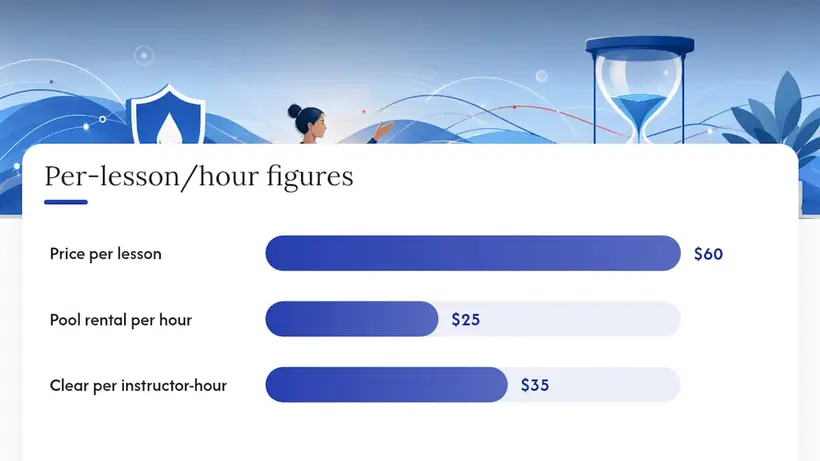
What’s the Realistic 30–90 Day Launch Timeline?
Turning this guidance into a calendar you can actually follow makes the difference between “someday” and a real launch date.
- Days 0 to 30: Complete certification, secure your pool slot, finalize insurance, and run your five-family pilot.
- Days 30 to 60: Analyze pilot feedback, adjust pricing or scheduling, and launch local marketing, partnerships, GBP optimization, and your referral program.
- Days 60 to 90: Hire your first additional instructor if enrollment supports it, formalize your curriculum levels, and set enrollment and utilization targets for month four.
Track three numbers weekly during this window: pilot-to-paid conversion rate, instructor utilization, and referral volume. When you approach a pool for partnership, come with a specific ask, “We need two hours every Tuesday and Thursday morning,” rather than a vague request for “some pool time.” Facility managers respond to specifics.
How Superhero Swim Academy Applies These Principles at Scale
Superhero Swim Academy built its operating model around the same priorities covered in this guide, just executed at scale across Palm Beach and Broward counties. Instructors complete training in CPR, First Aid, and a survival-swim curriculum before leading sessions.
- Instructors follow a survival-swim curriculum rather than improvising lesson plans session to session.
- Parents receive clear goals and progress updates to keep them informed.
- Safety protocols govern every lesson format, including private sessions, group classes, and parent-and-child sessions.
- The academy has taught thousands of children, with parents reporting meaningful swimming improvement in short timeframes.
Ready to get your child in the water?
Book a free assessmentThat combination, documented training plus visible parent communication, is what turns a single pilot into a business families trust enough to refer their friends to.
What Nobody Tells You Before You Launch
Every new operator underestimates two things: how much a single cancellation wave can disrupt a week’s cashflow, and how much parents care about communication over technique in the first few weeks. Systems fix both. A clear rebooking policy protects your cashflow; a simple weekly progress note to parents does more for retention than any marketing campaign you’ll run.
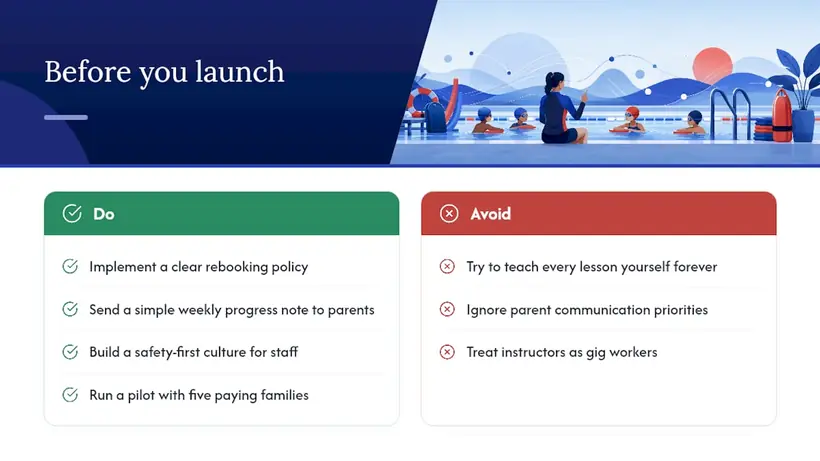
Your real job as the owner isn’t teaching every lesson forever. It’s building a safety culture strict enough that you’d trust any instructor you hire with your own child, and a communication rhythm parents can set their expectations by. Staff retention follows naturally once instructors feel like they’re part of something structured rather than gig work.
Start with the pilot. Everything else in this guide only matters once you’ve proven five families will pay you.
, SUPERHERO