
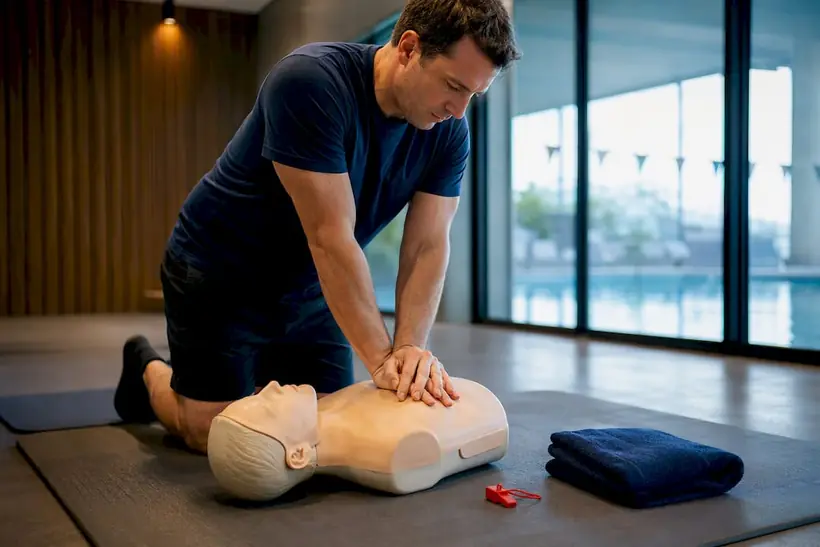
Recertifying as a swim instructor means keeping four things current at once: your instructor award (typically good for 24 months), CPR/AED, First Aid, and a background check, plus mandatory online updates like Athlete Protection Training. Miss any single piece, and you’re no longer “current” even if your main certificate hasn’t technically expired. Start by logging into your issuing organization’s member portal right now to check your status and Member ID.
TL;DR:
- Recertification requires maintaining multiple credentials simultaneously, including instructor awards valid for 24 months and annual updates for CPR, First Aid, and background checks.
- Online-only CPR courses are usually insufficient; instructors need hands-on CPR certification like Professional Rescuer or BLS-level to remain authorized.
- Completing all online modules before attending in-person assessments reduces delays, with options including blended courses, single-day recerts, or re-entry pathways for lapsed certifications.
- Fees typically range from $65 to $150, but missing shorter-cycle renewals like CPR can extend the process and cause delays.
- Regularly tracking expiration dates for each credential and keeping certificates backed up ensures continuous compliance and avoids last-minute scrambling.
What Does Swim Instructor Recertification Actually Require?
Swim instructor recertification isn’t one renewal. It’s a stack of separate credentials that each run on their own clock, and they all have to be green at the same time for you to legally teach.
Here’s the full list most certifying bodies expect current:
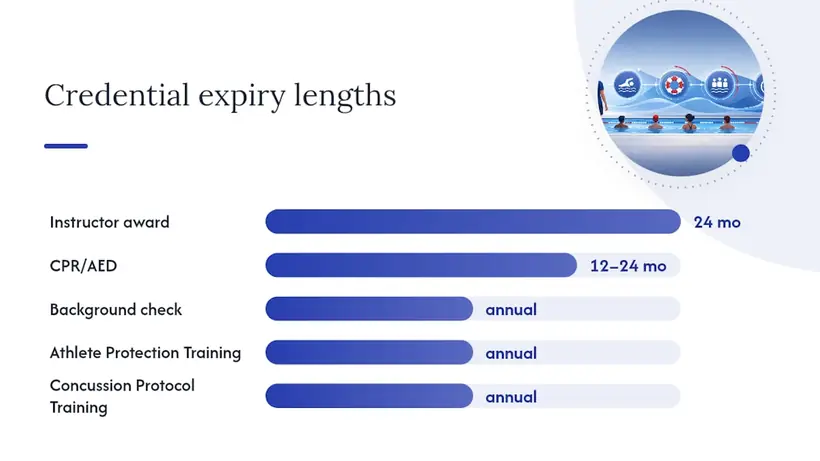
- Instructor award (WSI, Swim Instructor certification, or equivalent), commonly valid for 24 months
- CPR/AED, usually renewed annually or every two years depending on the course
- First Aid, often bundled with CPR but tracked separately
- Background check, typically refreshed annually through the employing organization or governing body
- Athlete Protection Training (APT), an annual online requirement for anyone coaching or instructing minors
- Concussion Protocol Training (CPT), another commonly annual online module
- Organization-specific mandatory updates, which change year to year and get added without much fanfare
Swim lessons in Palm Beach & Broward County
Free 30 minute assessment. Try before you enroll, no commitment.
Book Free AssessmentUSA Swimming’s guidance for coaches and instructors makes this stacking explicit: some pieces are tracked annually while the instructor certification itself runs on a two-year clock, and coaches must maintain the full credential set simultaneously to remain eligible to teach or coach. The Lifesaving Society follows a similar model, where Swim Instructor recertification revalidates the award for 24 months but still requires mandatory updates and a skills assessment on top of that base window.
Pro Tip: Set your recert reminder around your shortest-expiry item, not your instructor award. If your CPR lapses every 12 months, that’s the deadline that actually controls when you stop being “authorized to teach,” regardless of what your main certificate says.
One detail trips up more instructors than anything else: online-only CPR often doesn’t count. Most aquatics employers and certifying bodies require Professional Rescuer or BLS-level CPR with a hands-on skills component, not a click-through course. If you’re not sure which CPR type your employer accepts, ask before you pay for a course that gets rejected. CPR-certified instructors also tend to be the ones parents and employers trust fastest, so it’s worth getting this piece right the first time.
Ready to get your child in the water?
Book a free assessmentHow Do You Complete Swim Instructor Recertification?
The process is faster when you tackle it in order instead of jumping straight to a recert class.
- Look up your current record. Find your Member ID and check your certification status through your issuing organization’s portal before you register for anything. If your record is missing or looks wrong, fix that first.
- Finish mandatory online updates. Complete APT, CPT, and any organization-specific modules before you show up for an in-person session. Programs increasingly turn candidates away at the door if required online modules aren’t done first.
- Choose your recert path. Options usually include a blended course (online plus a single pool day), a straight in-person recert, or a re-entry application if your certification lapsed. Each has different time estimates, so pick based on how much time you actually have.
- Submit proof and pass skills verification. Attend the in-water assessment, submit your documentation, and receive your updated digital certificate, often with a QR code employers can scan directly.
Red flags that stall this process include expired CPR discovered mid-registration, background check paperwork that never got submitted, and online-only CPR courses that get rejected at the skills check. The American Red Cross’s WSI re-entry pathway offers a route for instructors whose certification has lapsed beyond the usual renewal window, so missing a deadline does not necessarily mean the end. This option typically involves a longer process than standard recertification.
What Course Formats and Fees Should You Expect?
Most instructors choose between three formats, and picking the wrong one wastes both time and money.
- Blended recert: online coursework followed by a single in-person pool session, typically the fastest option if you complete the online piece ahead of time.
- Single-day in-person recert: commonly around four hours, combining classroom review with in-water skill demonstration. Full attendance is usually required. Regional Lifesaving Society recert courses follow this exact structure.
- Combined recert: covers multiple awards (swim instructor plus lifeguard instructor, for example) in one session, which saves time if your teaching hours and prior evaluations still qualify you.
Ready to get your child in the water?
Book a free assessmentEligibility generally requires a prior instructor award, often within the last five years, plus completed mandatory online modules and, in some programs, a minimum number of teaching hours logged since your last certification. Fees vary by organization and region but commonly land in the $65 to $150 range, and that price typically covers the course materials, instructor time, and your updated digital certificate. It usually does not cover background check fees, which are often billed separately.
Where Do You Check and Verify Your Certification Status?
Every major certifying body now runs a searchable portal, and checking yours takes less time than reading this section.
- USA Swimming instructors and officials track status through the Officials Tracking System (OTS) and complete required trainings via USA Swimming University, with LSCs managing recertification specifics locally.
- Red Cross-certified instructors can look up records and request the WSI re-entry pathway if a certification has lapsed.
- Lifesaving Society instructors check status through their regional affiliate’s member system.
If your record is missing or shows outdated information, contact your Local Swimming Committee or issuing body directly and request a reprint or correction, uploading any physical proof you still have. Digital certificates with unique IDs and QR codes have become the standard proof employers ask for, so save yours the moment you receive it. Employers like YMCA branches routinely require these uploads during coach registration.
Ready to get your child in the water?
Book a free assessmentFees, Timelines, and Common Recertification Mistakes
Recertification courses generally require a moderate fee that varies by provider, and digital certificates are typically issued within days to a couple of weeks after completion.
Common mistakes leading to delays include:
- Allowing CPR certification to expire before the instructor award, as CPR often has a shorter renewal cycle
- Using online-only CPR courses when a hands-on Professional Rescuer or BLS-level certification is required
- Delaying submission of background check paperwork
- Omitting mandatory online modules, resulting in denial from attending in-person sessions
If you miss your recertification window, re-entry applications or full recertification courses offer ways to regain certification. It’s worthwhile to check with the issuing organization about possible exception periods or grace windows.
Staying Current Is a Discipline, Not a One-Time Task
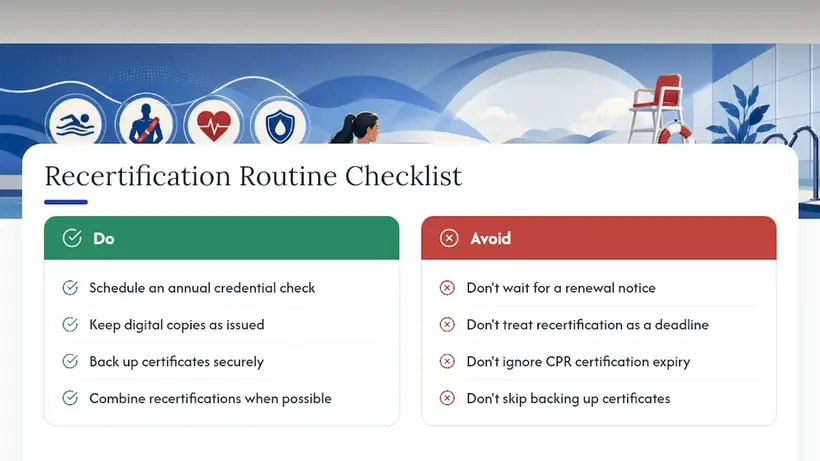
Most instructors treat recertification like a deadline to survive instead of a routine to build. That’s backwards. The instructors who never scramble are the ones who schedule an annual credential check on their own calendar, independent of what any renewal notice says, and who keep digital copies of every certificate the moment it’s issued.
Ready to get your child in the water?
Book a free assessmentAt Superhero Swim Academy, instructor training goes beyond the minimum stack. Every instructor completes rigorous CPR and First Aid training as part of our own curriculum, not just what’s legally required, and we run an annual Instructor Retreat specifically to keep skills sharp between recert cycles. It is recommended to combine recertifications when possible, keep digital certificates backed up, and pay close attention to CPR certification expiration, as it often causes the most issues.
, SUPERHERO
How Superhero Swim Academy Supports Your Recertification
If you’re staring down a stack of expiring credentials, Superhero Swim Academy gives you a faster route than piecing together separate courses from separate providers. Our online courses cover the mandatory updates instructors need most, and instructors in Palm Beach and Broward counties can pair that online work with in-person verification and hands-on development through our Instructor Retreat program.
Some swim lesson providers build their training pathways around their survival swim curriculum used with many children, helping instructors understand both paperwork and practical skills. If you want to see how our programs fit into your recert timeline, visit Superhero Swim Academy and check current course availability today.