
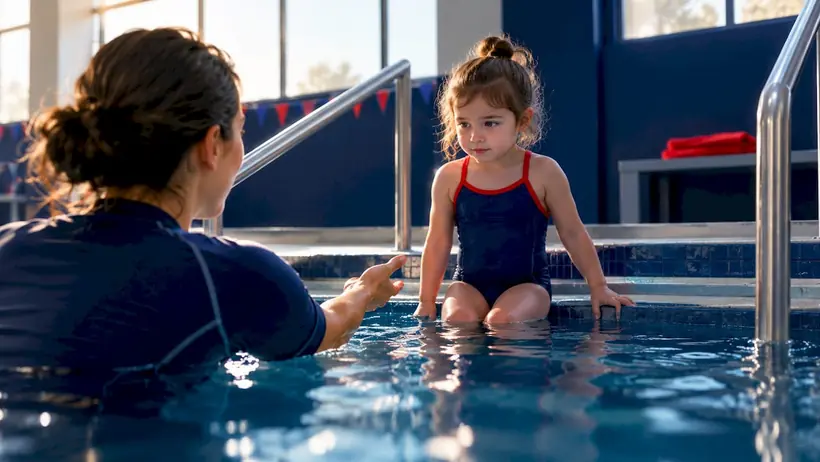
Swim lesson regression is common and usually temporary. The fastest fix is consistent, supportive re-entry into lessons paired with close communication with your child’s instructor. Don’t quit or scold your child for the setback. Instead, keep showing up, flag the change to your instructor right away, and consider bumping up lesson frequency or booking a short intensive block, since consistent water time speeds recovery more than anything else you can do at home.
TL;DR:
- Most swim skill regression is temporary and can be reversed with consistent, supportive lessons and clear communication with the instructor.
- Regression is often caused by interrupted lessons, fear, routine changes, instructor switches, or developmental shifts, not by permanent ability loss.
- Signs include hesitation, sloppy technique, emotional pushback, and safety red flags such as panic and gasp breathing, requiring immediate instructor attention.
- Twice weekly lessons or short intensive blocks speed up recovery, especially when combined with playful home practice and emotional reassurance.
- Prioritize emotional safety, routine stability, and trust-building by maintaining consistent instructors and managing anxiety, as these factors heavily influence how quickly skills return.
What Is Swim Lesson Regression, Exactly?
Swim lesson regression happens when a child loses ground on skills, confidence, or behavior they had already mastered. A kid who happily floated on their back in June suddenly clings to the wall in September. A confident bubble blower starts holding their breath at the surface instead of submerging. That’s regression, and it’s different from the normal rustiness after a week off.
It shows up more in younger children, usually kids under four, because their motor memory and emotional regulation are still developing. A three year old’s brain hasn’t built the same durable skill pathways an eight year old’s has, so a break, a scare, or even a growth spurt can knock loose something that seemed locked in.
Swim lessons in Palm Beach & Broward County
Free 30 minute assessment. Try before you enroll, no commitment.
Book Free AssessmentThe good news: most of these skills come back. Regression almost always points to an emotional gap, a practice gap, or both, not a permanent loss of ability. Treat it as information, not failure.
Common Causes Behind Swimming Skills Setbacks
Most swim instruction challenges trace back to one of five triggers, and figuring out which one is at play changes how you respond.
- Interrupted lessons. A summer break, a family vacation, or even two weeks off for illness lets skills fade. Industry instructors often use a rough rule of thumb: for roughly every month out of the water, expect about a week of focused practice to regain what was lost.
- Fear and anxiety. A scary moment, like slipping underwater unexpectedly or watching another child panic, can spike water anxiety fast. Research on swimming achievement confirms that fear of water is one of the strongest predictors of slower progress, and it affects some children more than others.
- Routine or life changes. A new sibling, a move, disrupted sleep, or starting school can spill over into how a child handles any structured activity, swimming included.
- Instructor or class changes. A new teacher, a different group of kids, or a class with mismatched skill levels can shake a child’s sense of safety even when nothing about their actual swimming ability has changed.
- Physical and developmental shifts. Growth spurts change buoyancy and coordination overnight. A cold, an ear infection, or general fatigue can also make a child look like they’ve backslid when they’re really just off their game that week.
Signs Your Child Is Slipping Backward
Watch for a cluster of changes, not just one off day. Here’s what actual regression tends to look like in the water and on the pool deck:
- Hesitation at the water’s edge. Refusing to walk down the steps or clinging to you at drop off when they used to walk right in.
- Sloppier technique. A kick that used to be steady turns floppy, or a child who submerged confidently now tilts their chin up to avoid getting their face wet.
- Regression to crutches. Reaching for a flotation device or the wall far more than their skill level should require.
- Emotional pushback. Crying, avoiding specific drills, or a general spike in clinginess and anxiety around lesson time.
- Safety red flags. Panic, breath holding that leads to gasping, or visible loss of breath control are not “wait and see” signs. These need immediate attention from your instructor and possibly a pause to reassess, not more pressure.
Ready to get your child in the water?
Book a free assessmentYour Recovery Plan: What to Do This Week and This Month
Recovery works best as a short list of priorities, tackled in order, not a scattershot of everything at once.
Talk to the instructor first. Tell them specifically what changed and when. Ask them to set one or two small, observable goals with you, like “put face in water three times this session,” rather than chasing the next skill level.
Get back in the water consistently. Once weekly lessons are the slowest path back. For kids who’ve regressed, twice weekly lessons or a short intensive block tend to rebuild both skill and comfort noticeably faster, with studies on water-fear interventions showing adaptation often completes in a few months when practice stays active and frequent.
Practice small and playful at home. Five to ten minutes, two or three times a week, in a bathtub or a calm pool, works better than long sessions. Keep it a game, not a drill.
Praise the process, not the outcome. “You put your whole face in that time” beats “good job swimming.” Skip comparisons to how they swam last spring or how a sibling is doing.
Consider private lessons or the same instructor for a stretch. Consistency with one trusted adult rebuilds emotional safety faster than rotating through different teachers.
Keep the session itself calm. A warm pool, a quieter time slot away from a crowded public swim, and a predictable routine (same bag, same towel, same “see you soon” phrase at drop off) all reduce the sensory load a nervous child is managing.
Pro Tip: Pick one tiny, specific goal per lesson instead of a general one. “Blow three bubbles” is something a child can actually succeed at and feel proud of. “Get better at swimming” isn’t.
If sleep disruption or a new routine is part of what triggered the setback, a tool like Naluna can help you track and stabilize a young child’s schedule while you work on the water side of things.
Ready to get your child in the water?
Book a free assessment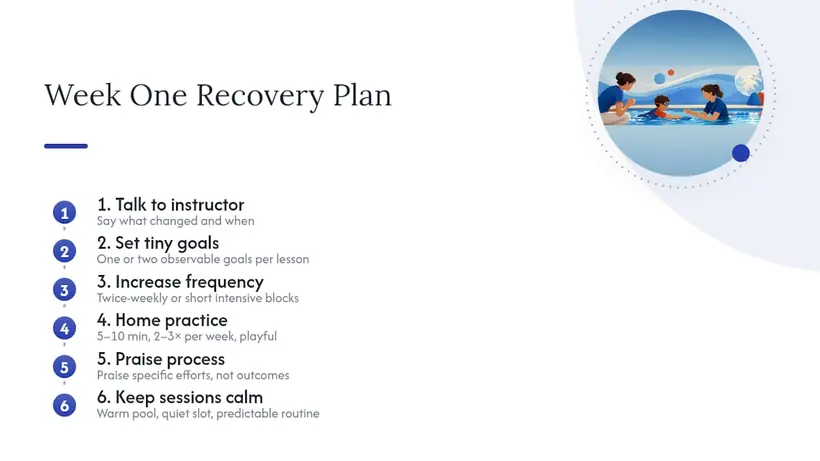
When Regression Needs More Than Time in the Water
If your child is still stuck after four to eight weeks of consistent lessons, that’s the signal to escalate, not push harder on your own. Some setbacks need a different kind of help than more repetition.
Ask your swim school about private lessons, a short intensive block, or an instructor experienced in trauma-informed teaching if your child shows real panic, breath-holding, or fear that doesn’t ease with gentle exposure. A good instructor will adapt the lesson plan to the child in front of them rather than sticking rigidly to a curriculum page that isn’t working for that particular kid that week.
If the anxiety spills into other parts of life, bath time, car rides, loud rooms, talk to your pediatrician or a child therapist. Water fear is sometimes one visible piece of a bigger sensory or anxiety pattern worth addressing directly.
How Trained Instructors and Small Classes Speed Recovery
Instructor quality matters more during a setback than during smooth progress. A teacher trained in CPR, First Aid, and a structured survival swim curriculum brings more than credentials, they bring the judgment to tell the difference between a child who needs encouragement and one who needs a slower pace.
Small class sizes matter just as much. A child working with the same instructor across multiple sessions, in a group small enough for real one-on-one attention, rebuilds trust faster than one shuffled through rotating teachers and crowded classes. That consistency is key to how specialized swim programs structure their private and small-group lessons, with instructors trained specifically in a survival swim curriculum and clear progress goals shared with parents at each stage.
Ready to get your child in the water?
Book a free assessmentAsk your current program for a written skill map or progress checklist. Parents who can see specific, small goals, rather than vague “level up” milestones, are better equipped to reinforce the right things at home and recognize real progress instead of assuming nothing changed.
The Psychological Toll of Falling Behind in the Water
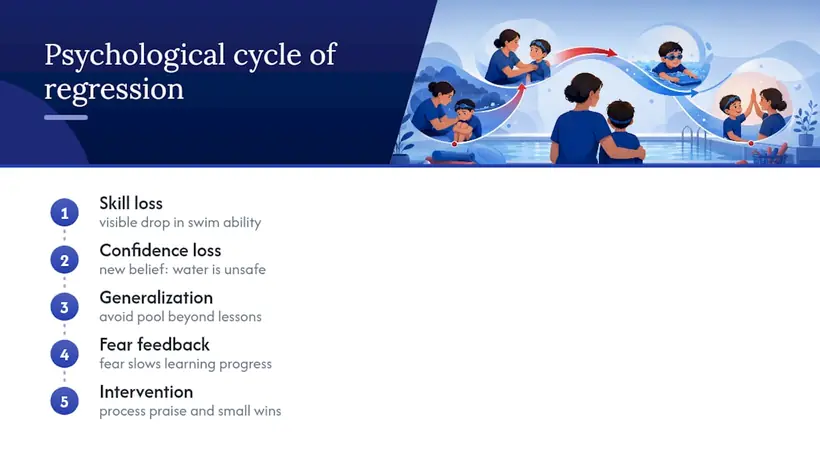
Skill loss is the visible part of regression. The confidence loss underneath it is often the bigger problem. A child who could swim across the pool independently and now clings to the wall isn’t just missing a skill, they’re carrying a new belief that the water is unsafe or that they’ve somehow failed.
That belief can generalize. Kids who feel embarrassed in front of peers during a group lesson sometimes start avoiding the pool entirely, even at birthday parties or on vacation, well beyond the swim class itself. Younger children in particular struggle to separate “I had a hard day at swim” from “I am bad at swimming” or “the pool is scary.”
Fear feeds itself. Research on swimming achievement found that higher fear of water directly correlates with slower learning, which means an anxious child doesn’t just feel worse, they genuinely progress more slowly, which can deepen the anxiety further. Breaking that loop early matters more than pushing skill drills.
This is exactly why process praise and small wins carry real weight during recovery. A child who hears “you tried something hard today” rebuilds a sense of competence even on a day when their stroke looked worse than last month. Protecting the emotional relationship with the water is often the actual recovery work, with the physical skills following once confidence returns.
Ready to get your child in the water?
Book a free assessmentPreventing Regression Before It Starts
The single biggest lever against regression is consistency. Casual splash time at a backyard pool or beach day is fun, but it doesn’t reinforce the specific skills a structured lesson builds, and long gaps between formal lessons are when skills quietly slip. Year-round or close-to-year-round lessons, even at reduced frequency during off seasons, keep the forgetting curve from ever gaining real momentum.
Build predictable routines around lesson days: same bag, same pre-swim snack, same arrival time. Predictability lowers a young child’s baseline stress, which matters because fear of water tends to be picked up indirectly, through a parent’s own hesitation, a sibling’s scary story, or one bad experience, more often than through any single dramatic event.
Keep language neutral around water. Avoid phrases like “be careful, you’ll drown” that plant fear, even with good intentions behind them. Frame swim time as a skill to build, not a danger to survive.
Watch for early wobbles and address them immediately instead of hoping they resolve on their own. A single hesitant lesson rarely needs intervention. Three in a row is worth a conversation with your instructor before it hardens into avoidance.
Finally, protect sleep and routine stability around big life changes. A new sibling, a move, or a school transition doesn’t have to derail swim progress if you anticipate the disruption and either lighten the load temporarily or keep lessons as one of the few unchanged anchors in the week.
Ready to get your child in the water?
Book a free assessmentHow Regression Looks Different by Age
A toddler’s setback and a seven year old’s setback rarely look the same, and treating them identically usually backfires.
Infants and young toddlers (roughly 4 months to 2 years) regress mostly through comfort, not skill, since survival reflexes at this age are still developing and highly sensitive to routine changes. A break in lessons often shows up as fussiness at drop off or resistance to submersion that wasn’t there before, rather than a lost technical skill.
Preschoolers (ages 3 to 4) are the group most likely to show dramatic, visible regression, partly because this is peak age for new fears, independence struggles, and the classic “I don’t want to” phase that touches every activity, not just swimming. Expect more emotional pushback here than technical skill loss.
Early elementary kids (ages 5 to 7) tend to regress in specific technical pieces, a kick that gets sloppy, breath control that slips, rather than overall water comfort. Peer comparison starts mattering at this age too, so a child who feels behind classmates may act out or disengage even if their actual skills are fine.
Kids 8 and up regress least often and recover fastest once they do, since their motor patterns are more durable. When they backslide, it’s usually tied to a specific event (a scary moment, an injury, a long break) rather than general developmental churn.
Ready to get your child in the water?
Book a free assessmentPlateau or Regression? How to Tell the Difference
A plateau is a temporary stall in progress. Regression is a step backward from a skill your child already had. Confusing the two leads to the wrong response, either panicking over a normal pause or ignoring a real setback because you assume it’s “just a phase.”
A plateau looks like a child who still swims the same distance and form they did a month ago but hasn’t added anything new. They’re not scared, not avoiding drills, and not losing ground, they’re consolidating. Coaching guidance consistently points out that plateaus respond best to targeted, technique-focused correction rather than simply piling on more pool time, since the issue is usually one specific technical limiter, not a lack of practice volume.
Regression looks different: skills that were solid are now shaky, and there’s usually an emotional or behavioral component alongside the technical one, hesitation, clinginess, or outright refusal. If your child is doing the same drills at the same level with a flat trajectory, that’s a plateau. If they’re doing worse than they were doing a month or two ago, that’s regression, and it calls for the recovery steps above rather than just a technique tweak.
Get Back on Track With the Right Support
Recovery is not about finding a magic drill that fixes everything overnight. It’s about frequency, emotional safety, and one consistent adult in the water with your child long enough for trust to rebuild. That’s a slower, less flashy answer than most parents want, but it’s the one the evidence actually supports.
If your child needs more consistent contact time to rebuild confidence, private lessons at home let you set a frequency, two, three, or four private sessions a week, that matches how fast your child is recovering rather than a fixed weekly slot. For families who want structured small-group instruction, Superhero Swim Academy’s lesson programs pair kids with trained instructors in classes small enough to notice a bad day before it becomes a bad month. Parents who want to reinforce skills between lessons can also explore the academy’s online courses for structured at-home practice that stays aligned with what’s happening in the pool.
Ready to get your child in the water?
Book a free assessmentWhat We Think Parents Get Wrong About Regression
Most advice on swim lesson regression treats it as a scheduling problem: miss lessons, lose skills, add more lessons. That’s true as far as it goes, but it skips the part that actually determines how fast a child recovers, which is whether the child feels safe enough to try again.
We think the conventional advice underweights the emotional side badly. Parents get told to “just keep practicing,” and when that doesn’t work fast enough, some pull kids out entirely, which is close to the worst move available. A child who regresses and then loses lessons on top of it loses both the skill and the trust needed to rebuild it.
What actually works is smaller than people expect: one goal per lesson, the same instructor for a stretch, praise aimed at effort instead of outcome. None of that sounds dramatic. It’s also the difference between a six week recovery and a six month one. Prioritize consistency and emotional safety first. The strokes come back once the fear leaves.
, SUPERHERO