
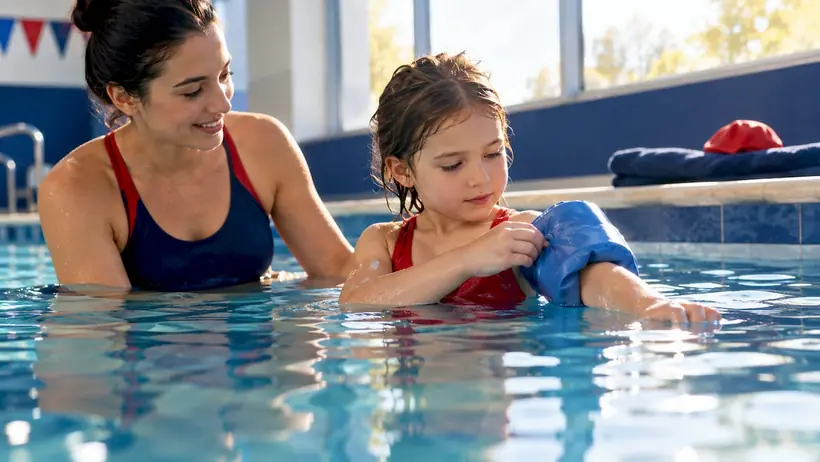
Wean your child off floaties gradually in shallow, standing water by becoming their flotation and practicing short, supported horizontal skills, always within arm’s reach. The American Red Cross notes that 70% of toddler drownings happen when the child isn’t even expected to be in the water, which is exactly why supervision and skill building matter more than any inflatable device.
TL;DR:
- Most children are ready to transition off floaties between ages 3 and 5 when they can face the water comfortably, follow basic instructions, and stand unaided in shallow water.
- It’s safer to gradually fade support over multiple short sessions rather than removing floaties all at once, ensuring muscle memory and confidence develop steadily.
- Structured swim lessons with trained instructors significantly accelerate progress, especially with a focus on horizontal body positioning, breath control, and survival skills.
- Always use a USCG-approved life jacket for open-water activities, as floaties are toys and do not provide reliable safety in lakes, rivers, or on boats.
- Common mistakes include rushing the support removal, reintroducing floaties after progress, practicing in deep water too soon, and distracted supervision, which can lead to setbacks or accidents.
Why Move Away From Floaties?
Floaties train kids to swim upright, chin up, arms flailing at the surface. That vertical habit fights against everything real swimming requires: a horizontal body position that lets kids float, glide, and actually propel themselves. Once a child gets used to bobbing vertically, breaking that motor pattern takes real, repeated practice in the water.
There’s also a safety gap most parents don’t think about until it’s too late.
- Floaties can slip off, deflate, or shift position without warning.
- They create false confidence in both the child and the parent, who may relax supervision because the child “looks safe.”
- They’re toys, not safety equipment; Consumer Reports is blunt that puddle jumpers and arm floats don’t substitute for swim instruction.
Swim lessons in Palm Beach & Broward County
Free 30 minute assessment. Try before you enroll, no commitment.
Book Free AssessmentA USCG-approved life jacket is a different category entirely: tested, rated, and designed to keep a child face-up in open water. Floaties were never built for that job.
When Is My Child Ready to Start Weaning Off Floaties?
Skip the birthday-based rule of thumb. Readiness is about what your child can already do in the water, not how old they are.
Look for these signs before you start:
- Willingly puts their face in the water without panicking
- Can blow bubbles or exhale through the nose underwater
- Follows simple one-step instructions (“kick your feet,” “reach for me”)
- Stands comfortably in shallow water without clinging
Most kids hit this stage somewhere between ages 3 and 5, but that’s a loose reference point, not a deadline. Hold off if your child shows acute fear of water, can’t yet follow basic directions, or recently had a scary experience in the pool. Pushing a frightened child through this process usually backfires and can set progress back for weeks.
Ready to get your child in the water?
Book a free assessmentStep-by-Step Weaning Plan for Shallow Water
The WaterWiseKids approach to weaning kids off puddle jumpers and floaties centers on one idea: you become the flotation device before you fade out entirely. Here’s a practical progression to run in short, repeatable sessions.
- Warm-up and connection. Start every session with two or three minutes of splashing, singing, or simple games so your child associates the water with fun, not pressure.
- Become the flotation. Hold your child firmly under the arms or belly, keeping their body horizontal at the surface. Practice face-in-water games like blowing bubbles at floating toys.
- Fade to fingertips. Once they’re relaxed with a firm hold, shift to supporting them with just your fingertips under the chest or hips.
- Hover hand. Keep your hand an inch above their body, ready to catch, while they attempt to hold the horizontal float on their own.
- Short unsupported glides. Let them push off from you and glide two or three feet before you catch them again.
- Layer in skills. Teach breath control first, then back floating, then kicking with a board, then short glides to the wall, then combine those pieces into an actual stroke.
Move to the next step only after your child strings together three successful attempts in a row, a threshold instructors commonly use to confirm the skill has actually stuck rather than being a lucky try.
Use goggles to cut down on disorientation, and turn face-in-water drills into games: toy retrieval dives, countdown jumps, “who can blow the biggest bubbles.” If you’re weaning off a physical device rather than just your own support, partially deflate arm floats over several sessions instead of removing them all at once. Aim for short sessions, ten to fifteen minutes, three to four times a week; consistency beats marathon pool days.
Pro Tip: Keep a life jacket rated by the U.S. Coast Guard on hand for any open-water outing, lake, or boat trip. Save device-free practice exclusively for supervised, shallow pool conditions where you’re within arm’s reach the entire time.
Ready to get your child in the water?
Book a free assessmentPairing the Transition With Swim Lessons and Safer Alternatives
Practice at home works, but structured lessons close the gap faster. The Red Cross swim lesson framework teaches horizontal positioning, breath control, and survival skills in a progression that’s harder to replicate solo, since instructors catch small form problems parents often miss.
When picking a program, look for:
- Instructors trained specifically in survival swim technique, not just general swim strokes
- Small class sizes, ideally one or two children per instructor
- A curriculum that prioritizes breath control and floating before stroke mechanics
- Regular parent updates so you know exactly what’s being worked on
For open water, the rule doesn’t change no matter how well the weaning is going: always use a properly fitted, USCG-approved life jacket. Puddle jumpers are not a substitute in lakes, rivers, or on boats, ever. Consumer Reports frames this as layered protection: barriers, supervision, swim skills, and life jackets each cover a gap the others miss, and no single layer replaces the rest.
Ready to get your child in the water?
Book a free assessmentCommon Mistakes and How to Fix Them
Most setbacks trace back to a handful of predictable errors.
- Pulling support too fast. Jumping from a firm hold straight to unsupported swimming skips steps kids need.
- Backsliding into floaties. Reintroducing a device after real progress often erases the muscle memory just built.
- Deep water too soon. Every new skill needs to be proven in shallow water first.
- Distracted supervision. Phones and conversations are exactly how kids slip under unnoticed, even for a few seconds.
If your child regresses, don’t push forward. Drop back one step in the progression, add more shallow-water reps, and lean on games rather than drills for a session or two. Practitioners consistently find that rushing the process causes setbacks, while a patient, incremental fade sticks. If fear persists for several weeks, or your child reacts unsafely to being in the water at all, that’s the point to bring in a professional instructor instead of troubleshooting solo.
Publisher Perspective: How Superhero Swim Academy Approaches This Process
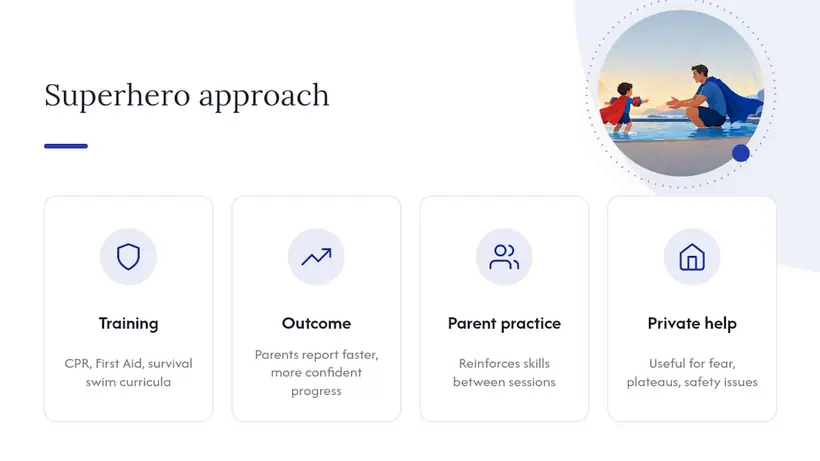
Instructors at swim academies often train in CPR, First Aid, and follow specialized survival swim curricula before working with children. That’s not paperwork. It’s what lets an instructor read the difference between a toddler who needs one more rep and one who needs a completely different approach that day.
Ready to get your child in the water?
Book a free assessmentMany children have gone through similar swim programs, and parents often report faster, more confident progress than expected. Parent-led practice can help reinforce skills between sessions. When fear, plateaus, or safety concerns occur, private or at-home lessons with instructors provide guidance that can improve progress.
, SUPERHERO
How Superhero Swim Academy Can Help
Some swim academies offer guided programs for parents wanting trained instructors to handle the transition during the weaning process. Parent and toddler classes run $115 per month and work well for families who want to learn the fade-support method alongside their child. Semi-private lessons start from $185 per month, and private lessons at our pool range $325 to $600 per month for one-on-one progression through survival swim skills.
A first session focuses on reading exactly where your child sits on the readiness scale: comfort with face-in-water, breath control, and following basic cues, then builds a plan from there. Classes stay small, usually just two children, so instructors can adjust in real time instead of running a fixed script. Parents get regular updates on what’s improving and what still needs work. If home is easier logistically, at-home lessons bring the same structured progression to your own pool, with two, three, or four private sessions weekly depending on how fast you want to move. Book a session and get a read on where your child stands before the next pool day.