
Do Heated Pool Classes Really Benefit Babies?
- superheroswim
- 14 hours ago
- 10 min read

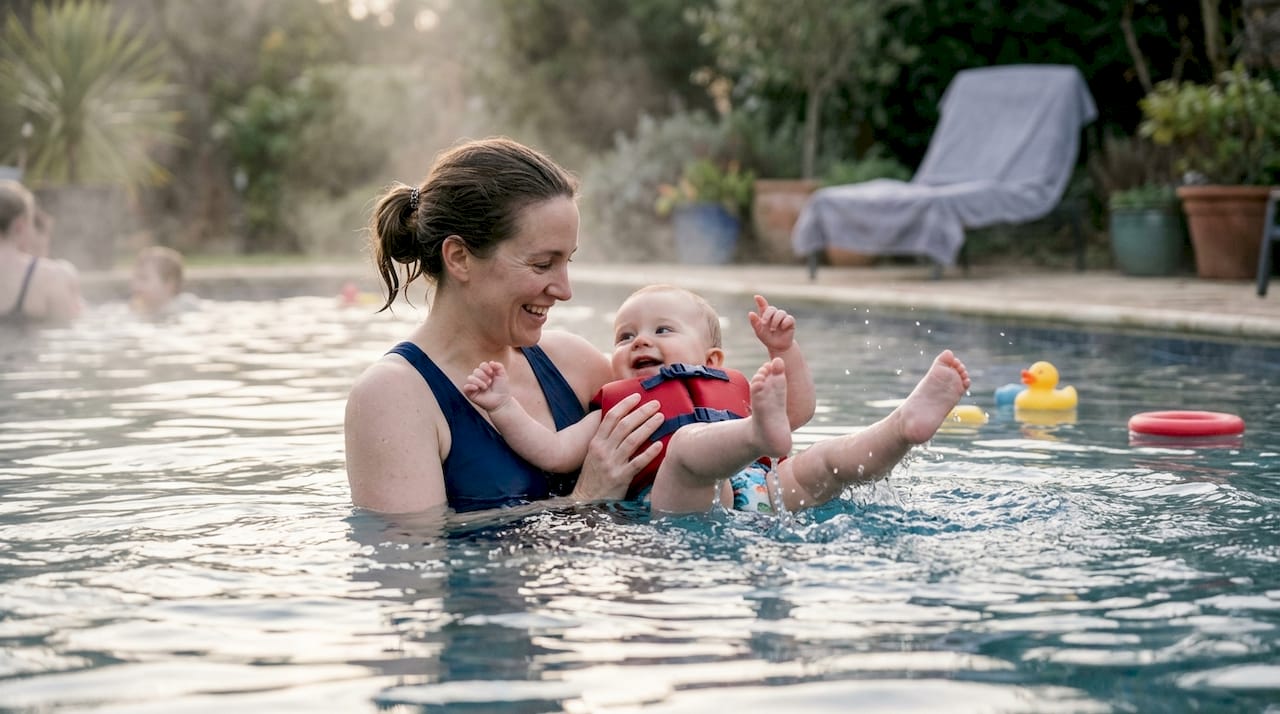
Yes. Heated, warm-water baby classes reliably support comfort, motor development, and early water confidence when the temperature, instructor training, and hygiene practices are right. The American Academy of Pediatrics recommends warmer pool water for young learners, a PRISMA systematic review of infant aquatic programs found generally positive associations with motor and sensory development, and programs like Superheroswimacademy build their curriculum around that exact combination: controlled water temperature, small groups, and instructors trained in CPR and First Aid.
That said, “heated pool benefits baby” claims only hold up under a few conditions. Here’s what actually matters:
Comfort that supports learning. Warm water keeps babies relaxed instead of tense from cold, freeing up attention for actual skill-building.
Motor development gains. Multiple studies link regular water sessions to improvements in gross motor skills, grasping, and balance.
Early water confidence. Babies who feel safe and warm in the water tend to engage more, cry less, and build positive associations with swimming.
One caveat worth stating up front: babies with a current fever, open skin infections, recent diarrhea, or certain immune conditions should sit out classes until a pediatrician clears them.
Key Takeaways
Heated, warm-water baby classes support comfort, motor development, and water confidence when temperature stays in the recommended range and instructors are properly trained.
Point | Details |
Temperature range matters most | Keep instructional pools between 86 and 90°F per AAP guidance to prevent shivering and support learning. |
Motor gains are real but modest | Studies show measurable improvements in gross and fine motor skills after several consistent sessions, not one class. |
Skip class during illness | Avoid swim lessons with a current fever, diarrhea in the past two weeks, or open skin infections. |
Instructor training is non-negotiable | Confirm CPR, First Aid, and infant-specific certification before enrolling in any program. |
Superheroswimacademy applies these standards locally | Its heated-pool classes in Palm Beach and Broward counties pair small groups with CPR and First Aid certified instructors. |
Always confirm any health-specific concerns, like ear tubes, immune conditions, or recent illness, with your pediatrician before starting swim lessons.
Table of Contents
Why Heated Pools Help Babies Learn and Stay Calm
Water changes how a baby’s body works, and that’s the whole point. Buoyancy takes the weight of gravity off tiny limbs, letting infants kick, reach, and rotate in ways they can’t yet manage on a mat or in a crib. A baby who can barely roll over on land might paddle both legs rhythmically in the water, because the water is doing some of the postural work their muscles haven’t caught up to yet.
Water also adds gentle resistance. Every kick and arm pull pushes against something, and that feedback loop helps a developing nervous system calibrate motor control. It’s a slower, softer version of what resistance training does for older kids and adults, except babies get the sensory input just from moving through water at all.
Temperature is where things get more delicate. Infants regulate body heat far less efficiently than older children or adults, largely because they have less insulating fat and a higher surface-area-to-body-mass ratio. Water that feels comfortably cool to a parent can chill a baby within minutes. Practical guidance from swim educators notes that pools below roughly a cool temperature often provoke shivering and restricted movement in young children, while water in the mid to high 80s supports relaxed, natural movement patterns. When a baby is cold, their body prioritizes conserving heat over exploring or learning anything new. Warm water removes that competing priority entirely.
Pro Tip: Watch the baby’s hands and lips, not the thermometer. Pale or bluish lips, clenched fists, or a hunched, tucked-in posture are early signs the water is too cold, even if the pool “feels warm enough” to you standing poolside.
What Research Shows About Motor and Cognitive Gains
The developmental case for baby swim classes isn’t just anecdotal. A systematic review covering 18 eligible studies on formal aquatic activities in infants under 36 months found these programs are generally safe and associated with gains in gross and fine motor skills, visual motion perception, and cognitive flexibility, when physiological parameters like temperature and exposure time are monitored.
A more granular look comes from a non-randomized pilot study of infants aged 6 to 10 months. Babies who took part in regular aquatic courses scored higher on reflexes, grasping ability, fine-motor quotient, and total-motor quotient than infants who didn’t, based on standardized motor assessments. A separate quasi-experimental study of 30 babies aged 6 to 9 months in a warm-water, float-supported swim program reported statistically significant improvement in gross motor outcomes after the intervention.
None of this means a few pool sessions will turn your baby into an early walker. Sample sizes in these studies tend to be small, some designs lack randomization or a matched control group, and it’s genuinely hard to isolate swimming from other stimulation babies get at the same age, like tummy time or crawling practice at home. The honest takeaway: warm-water infant swimming appears to be a low-risk activity with a real, if modest, developmental upside. Expect small, incremental motor-skill improvements over several weeks of consistent sessions, not a dramatic leap after one class.
How Warm Water Builds Bonding and Confidence
Cold, stressed babies don’t make eye contact, and they definitely don’t play. Warm water lowers that stress response almost immediately, which opens the door to the social side of swim class that often gets less attention than the physical benefits.
When a baby isn’t fighting the cold, they’re more available for connection. Caregivers who hold, rock, and guide their infant through gentle water movement are essentially building a shared positive experience, one that pairs physical closeness with a novel sensory environment. That repeated pairing is a big part of why babies often develop genuinely positive associations with water rather than fear of it, according to insights from warm-water swim educators on how thermal comfort supports relaxation in infants.
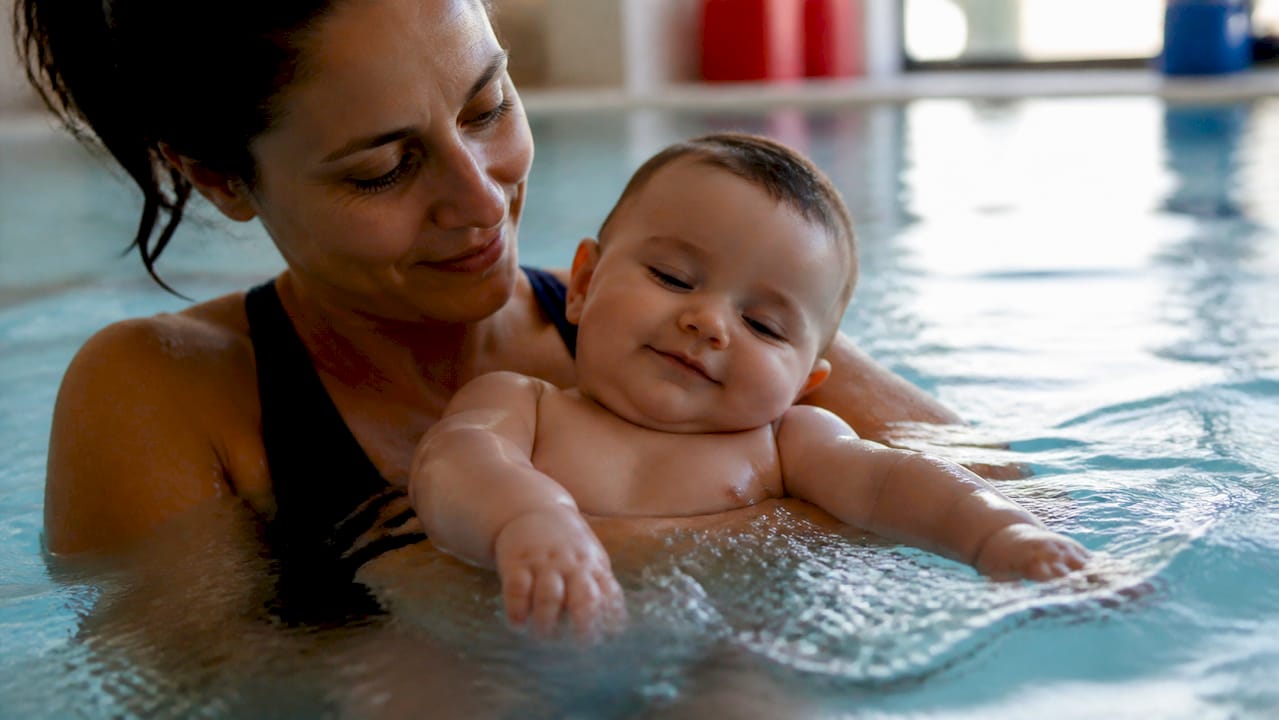
The benefits run in both directions. Parents who bring their baby to a well-run heated class often report feeling more confident in the water themselves, and less anxious about their child’s safety around pools generally. That comfort tends to carry over well beyond the classroom, into pool parties, beach trips, and family vacations.
Signs a baby is genuinely comfortable and engaged during a session:
Calm, steady breathing rather than gasping or breath-holding out of tension
Relaxed limbs instead of stiff, curled-up posture
Responsive social cues, like smiling, cooing, or tracking a caregiver’s face
Willingness to be gently moved through the water without crying
Group classes add another layer entirely. Being near other babies, even ones too young to “play” in any traditional sense, introduces early social exposure that group swim settings support well.
What Temperature and Health Precautions Matter Most?
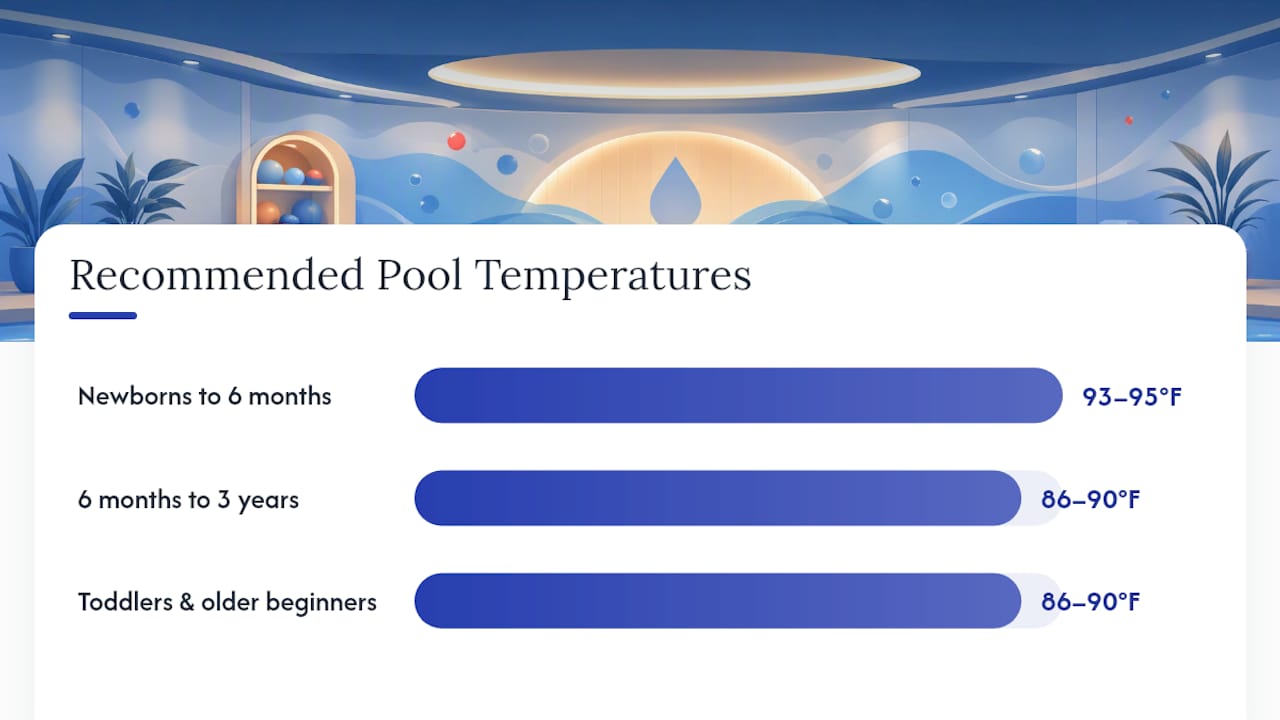
Temperature isn’t a minor detail in baby swim classes, it’s close to the whole safety framework. The American Academy of Pediatrics recommends warmer pool water, typically in the 86–90°F range, for young children who are learning to swim, because that range reduces thermal stress and lets babies focus on skill-building instead of just staying warm. Some specialized baby-only facilities run even warmer, with practitioner guidance citing pools closer to 93–95°F for very young infants to mimic womb-like conditions, though the AAP’s 86–90°F range remains the standard benchmark for instructional programs.
Age Group | Recommended Pool Temperature | Source |
Newborns to 6 months (specialized infant settings) | 93–95°F | Practitioner guidance, Aquanat |
6 months to 3 years (typical instructional classes) | 86–90°F | American Academy of Pediatrics |
Toddlers and older beginners | 86–90°F | WaterWiseKids educational guidance |
Age matters just as much as temperature. Most pediatric guidance treats 6 months as a reasonable starting point for formal parent-and-baby classes, largely because that’s when babies have better head and neck control. Healthychildren notes that swim lessons are valuable for children but should be paired with close supervision and sensible expectations about what a baby can actually learn at each stage. Newborns can still be introduced to gentle, supervised water exposure in specialized settings, but that’s a different context from a structured lesson program.
Health precautions deserve equal weight. Skip class if your baby has:
A current fever or recent illness
Diarrhea within the past two weeks (a real risk factor for waterborne outbreaks in pools)
Open cuts, rashes, or active skin infections
Ear infections or ear tubes without pediatrician clearance for water exposure
Chlorine exposure and ear infections are the two most common parent concerns, and both are manageable with basic post-swim habits. Dry ears thoroughly with a soft towel after every session, tilt the head to each side to let water drain, and apply a gentle, fragrance-free moisturizer to skin that seems dry or irritated after chlorinated water exposure. Call a pediatrician if you notice persistent redness, tugging at the ears, or a rash that doesn’t clear within a day or two.
What Happens During a Typical Baby Swim Class
A parent-and-baby class usually runs 30 to 45 minutes, and the structure tends to follow a predictable rhythm: a calm warm-up to get the baby acclimated to the water, a stretch of supported movement and floating practice, a play-and-skills segment where specific techniques get introduced, and a cooldown to end on a relaxed note.
Within that window, instructors typically work toward a handful of early milestones, though pacing varies by baby:
General water comfort (getting used to splashes and being held in water), often introduced from the first sessions
Supported back floats, usually introduced somewhere between 6 and 12 months
Bubble blowing and breath control, often around 9 to 15 months
Gentle face submersion progressions, typically introduced once a baby shows comfort with the earlier skills, often past 12 months
Caregiver involvement is standard for this age group. A parent or guardian is almost always in the water directly supporting the baby, not watching from the pool deck. Class sizes tend to stay small, often four to six baby-and-caregiver pairs per instructor, and most programs recommend one to two sessions per week for several consecutive weeks to see measurable progress rather than a single trial class. A baby who starts the season needing full support just to float on their back might, over eight or ten sessions, hold a relaxed float with only a hand under their head, a small but genuinely trackable milestone.
How to Choose a Safe, Heated Baby Swim Program
Not every “baby swim class” is built the same, and the differences matter more than most parents realize until something goes wrong. Prioritize these criteria when evaluating a program:
Consistent, monitored pool temperature in the 86–90°F range for instructional classes, not just a warm pool “most of the time”
Instructor certification in CPR and First Aid, along with training specific to infant swim instruction, not just general lifeguarding
Small caregiver-to-infant ratios, ideally no more than five or six pairs per instructor
A written, structured curriculum with clear progression milestones, not an improvised “let’s see how it goes” approach
A visible emergency plan and an on-site lifeguard separate from the instructor teaching the class
Ask providers directly:
“What is your pool’s actual temperature range during baby classes?”
“What certifications do your instructors hold, and how often are they renewed?”
“What’s your caregiver-to-infant ratio, and does it ever grow for larger sessions?”
“What’s your cleaning and water-testing protocol, and how often is it checked?”
“Can I observe or try a trial class before committing to a package?”
Red flags worth walking away from: inconsistent water temperature that changes noticeably session to session, large or chaotic classes with more than six or seven pairs per instructor, no written safety policy you can actually read, and vague or evasive answers about water-quality testing. Programs like Superheroswimacademy’s survival-focused curriculum build these safeguards into the structure from day one rather than treating them as optional extras. A trial class is the single best diagnostic tool available to a parent: watch how instructors handle a crying baby, how closely they monitor water temperature, and whether the caregiver-to-child ratio holds steady even when the pool gets busy.
Choosing any early-childhood program, water-based or otherwise, benefits from the same due diligence. A general safety checklist for evaluating childcare programs covers many of the same fundamentals: clear staff credentials, sensible ratios, and transparent safety policies.
What Does the Research Actually Prove?
The honest research summary is this: the evidence supports real benefits, but it isn’t airtight proof of dramatic developmental change. The PRISMA systematic review found aquatic programs are generally safe for infants and associated with motor, sensory, and cognitive-flexibility gains across the studies it examined. That same review found aquatic therapy has even been used in neonatal and preterm care settings to support physiological stability, weight gain, and better sleep cycles when closely monitored, evidence that the water itself, at the right temperature, is doing something physiologically real.
A pilot study of infants aged 6 to 10 months found measurable motor-score advantages in the swimming group compared to controls.
A separate study of 30 babies aged 6 to 9 months found statistically significant gross-motor improvement after a warm-water swim program.
Both studies involved relatively small samples, and neither fully rules out the influence of other stimulation the babies received outside the pool.
Limitations note: Small sample sizes, inconsistent study designs, and a lack of large-scale randomized controlled trials mean researchers can’t yet claim swimming alone causes these gains. What the evidence does support is a reasonable, low-risk conclusion: warm-water baby classes appear to be a safe developmental stimulus when temperature and hygiene practices are followed, not a guaranteed shortcut to advanced milestones.
Why Warm-Water Classes Deserve Their Reputation
Most parents ask the wrong first question. They ask “will this make my baby swim faster or walk sooner,” when the better question is “will this make my baby feel safe in water for the rest of their life.” That distinction shapes everything about how a class should be run.
Instructors who prioritize temperature control and small groups aren’t being precious about comfort for its own sake. A relaxed baby is a baby who can actually absorb a skill, whether that’s a supported float or the beginnings of breath control. A stressed, cold baby is just surviving the class, not learning from it. That’s the whole argument for keeping caregiver-to-infant ratios tight and pool temperatures consistent rather than treating them as nice-to-haves.
The research on motor and cognitive gains is real but modest, and no responsible instructor should oversell it. What matters more, in practice, is that a baby who’s had a genuinely positive, warm, well-supervised water experience early on tends to approach pools, lakes, and beaches later in childhood with curiosity instead of fear. That’s not a small outcome. It’s arguably the whole point of starting this young in the first place, safety habits and comfort that outlast any single motor-skill milestone.
Ready to Try a Heated, Safety-First Baby Swim Class?
If you’re weighing whether to enroll your baby in a warm-water program, the research points toward yes, with the right conditions. Superheroswimacademy runs small-group and private heated-pool lessons across Palm Beach and Broward counties, with instructors trained in CPR, First Aid, and a survival-focused curriculum built specifically for infants and toddlers.
If you want to see it before committing to a package, ask about a trial class or an observation visit so you can watch how instructors handle temperature, ratios, and a fussy baby in real time. You can review current class options, locations, and instructor credentials on the Superheroswimacademy home page and book a spot that fits your schedule.
Sources
This article is general information, not a substitute for advice from a qualified doctor. Consult a qualified healthcare professional about your own circumstances before acting on anything here.
Recommended
Comments