
How Swim Instructors Handle Fear: A Parent's Guide
- superheroswim
- 1 day ago
- 10 min read

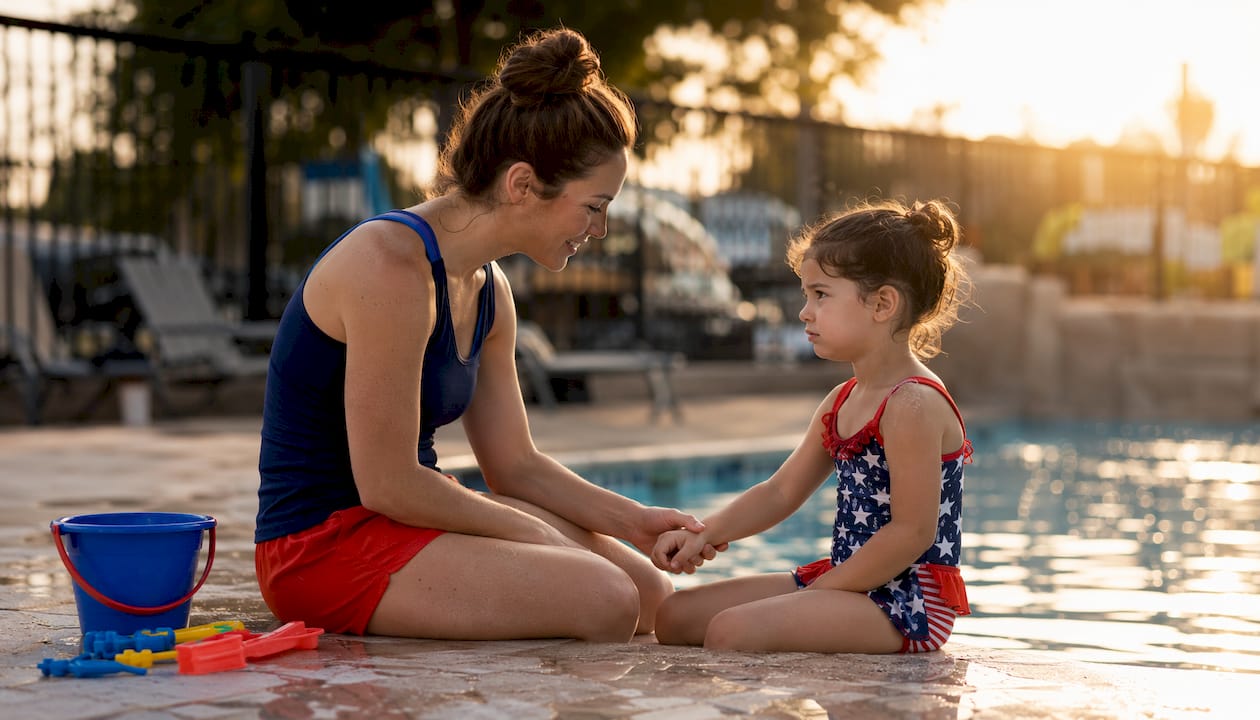
Skilled swim instructors handle fear by making emotional safety the first priority, then layering skills only once a child is calm and curious. Before any swimming technique gets introduced, a good instructor validates the child’s feelings, builds a predictable routine, and uses graded exposure to move from observation to water contact at the child’s own pace. Here is the short version parents can keep in mind:
Validate first. Acknowledge the fear out loud before asking the child to do anything.
Build a routine. Predictable lesson structure lowers anxiety faster than novelty.
Use graded exposure. Progress from watching → touching water → bubbles → supported floats → short movements.
Co-regulate. A calm instructor voice and steady posture physically help a child’s nervous system settle.
Play on purpose. Games create positive associations and give children a sense of control.
Check credentials. CPR, First Aid, and a survival-swim curriculum are non-negotiable.
Communicate with parents. Regular progress updates keep the approach consistent at home.
Table of Contents
What parents should say and do before, during, and after lessons
What a typical fear-focused lesson looks like and when to expect progress
Safety standards and instructor qualifications worth checking
Why these techniques work, and how Superheroswimacademy applies them
Superheroswimacademy: survival swim lessons built for fearful learners
Why children develop a fear of water
Fear of water rarely comes from one place. The most common triggers are novelty (the pool is loud, cold, and unpredictable), a past negative experience like an accidental submersion, and sensory sensitivity to cold temperatures, chlorine smell, or the sound of splashing. Some children also have behavioral inhibition (BI), a temperament trait that makes them more sensitive to new or threatening stimuli. For these kids, the emotional tone of a lesson matters as much as the physical steps.
When fear activates, the body’s fight-or-flight response floods the nervous system with cortisol and adrenaline. Motor learning shuts down. A child who is genuinely frightened cannot process an instructor’s directions, no matter how clearly they are given. That is why children with behavioral inhibition need instructors who slow their pacing and model calm behavior, acting as co-regulators rather than coaches pushing for the next skill.
When fear is severe, persistent across multiple sessions, or tied to a known trauma history, a referral to a pediatric psychologist or occupational therapist is worth discussing with the child’s pediatrician before continuing lessons.
How swim instructors handle fear in the water
The techniques below are not theoretical. They are what trained instructors actually do, in sequence, during a lesson with a fearful child.
Validation and language
The first words matter. Instructors trained in fear-aware methods avoid phrases like “Don’t be scared” or “There’s nothing to worry about,” because dismissing a child’s feelings breaks trust immediately. Instead, they use language that names the feeling and reassures: “I can see this feels scary. You’re safe, and we’ll go at your pace.” That single shift keeps the child willing to stay in the lesson.
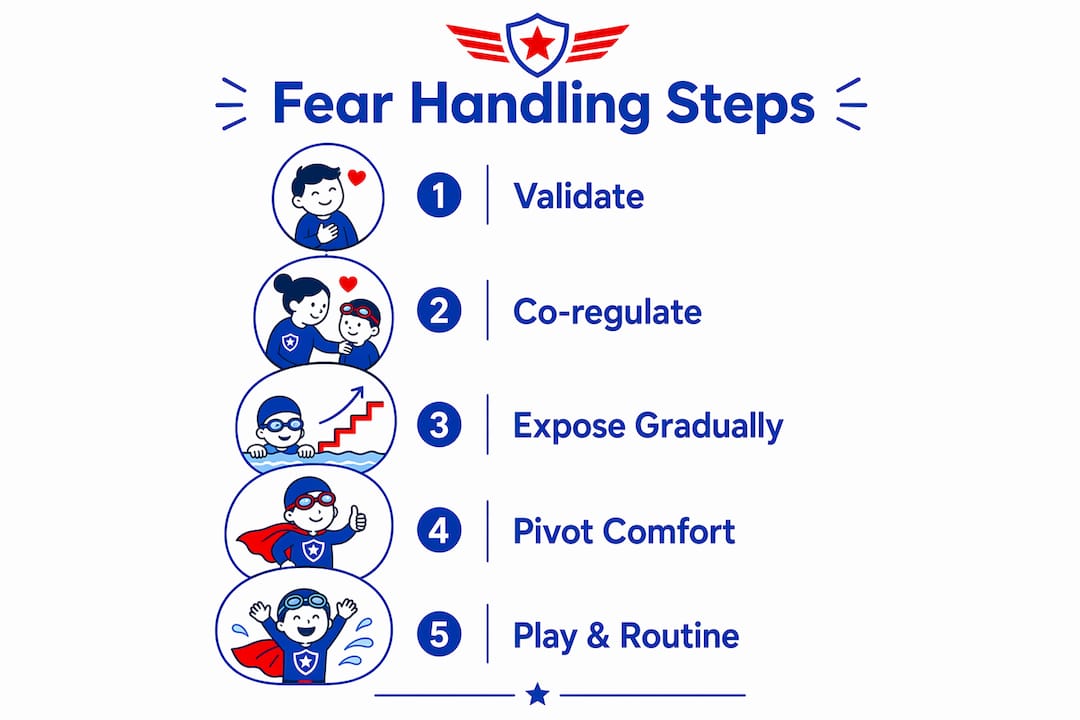
Co-regulation and modeling
Before a child enters the water, a skilled instructor models the behavior they want to see. Sitting on the deck, taking slow breaths, and demonstrating how to blow bubbles into a cup of water are all ways to build rapport and regulate the nervous system before any in-water exposure happens. A calm, steady posture from the instructor signals safety at a biological level.
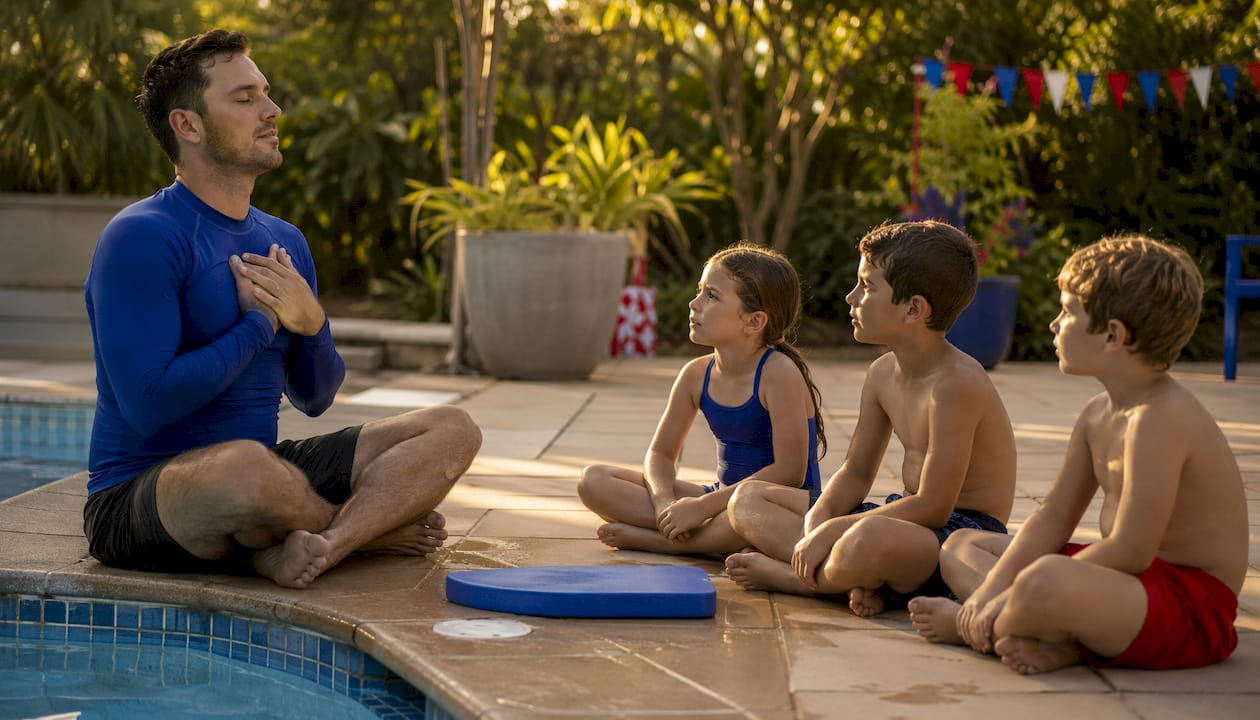
Graded exposure (the exposure ladder)
This is the backbone of fear-aware instruction. The ladder moves in small, mastered steps:
Observe the pool from the deck
Sit on the edge with feet in the water
Touch the water with hands
Blow bubbles at the surface
Enter shallow water with instructor support
Supported back float
Short independent movements
Each rung is practiced until the child is comfortable before moving up. Clinical exposure therapy follows the same progression, which is why this method produces large improvement rates across structured programs.
The pivot strategy
When a child shows fear cues (stiffening, crying, refusal), the instructor immediately pivots to a comfort activity the child has already mastered. This is not giving up. It is preserving trust so the child returns next session willing to try again. Forcing progression past a fear spike destroys that willingness.
Play and predictable routines
Games like “find the toy on the step” or “make the biggest splash with your hands” give children agency and create positive associations with water. Positive, play-based environments can accelerate skill acquisition significantly compared with drill-heavy approaches. Predictable lesson structures, where the child knows what comes next, reduce anticipatory anxiety before the lesson even starts.
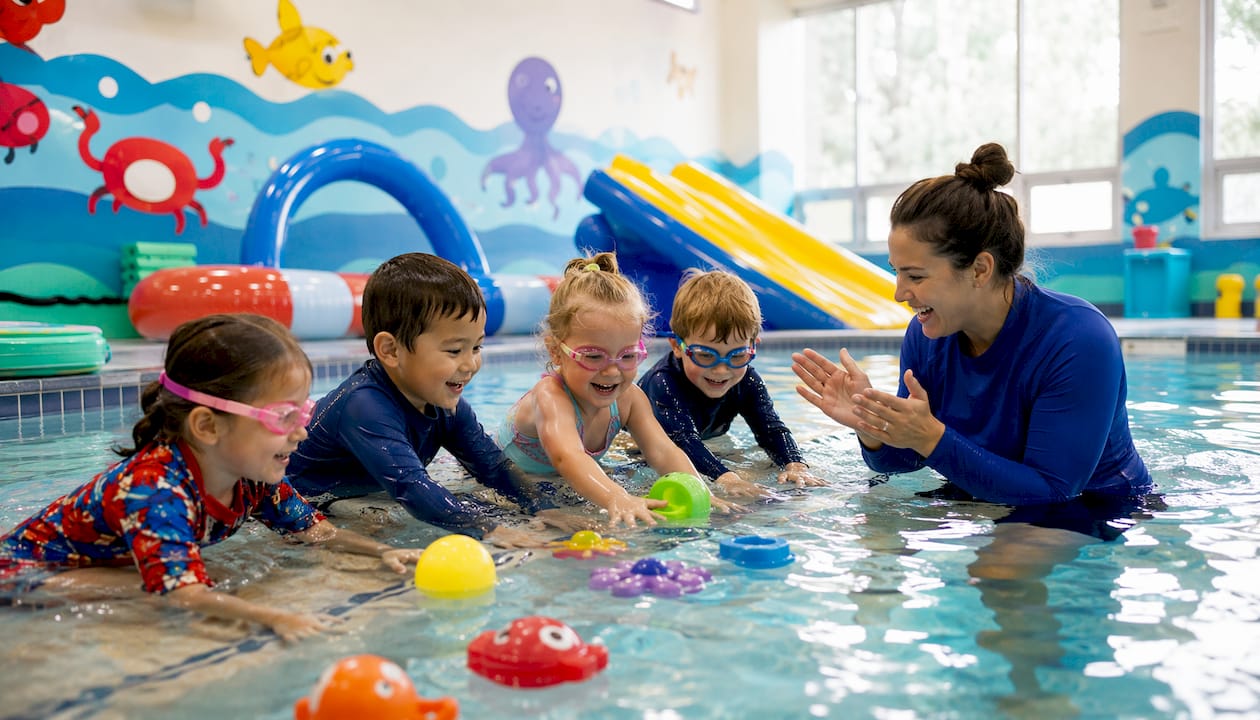
A typical 6–8 minute sequence with a fearful toddler might look like this:
Minute | Activity | Purpose |
— | Deck greeting, name a feeling | Build rapport, validate |
1–2 | Breathing exercise together | Co-regulation |
2–4 | Sit on edge, feet in water | First graded exposure step |
4–6 | Blow bubbles from the edge | Positive water contact |
6–7 | Comfort game (splash hands) | Positive association |
7–8 | Celebrate one specific win | Reinforce confidence |
Group vs. private formats
Small-group or private lessons work better for anxious children than large mixed-ability classes. A group of two or three lets the instructor monitor fear cues closely and adjust pacing without leaving other children unsupervised. Watching a peer complete a step the fearful child has not yet tried can also serve as gentle social modeling.
Pro Tip: Effective instructors distinguish between “alert fear” (heightened focus that can help a child learn) and “panic fear” (the freeze response that shuts learning down). They never push a child in panic fear. Instead, they use control and predictability to channel alert fear into curiosity.
What parents should say and do before, during, and after lessons
Parents are the most consistent part of a child’s environment, which means their behavior at the pool matters as much as the instructor’s.
Before the lesson — do this:
Tell your child what will happen in simple, positive terms: “You’re going to sit on the edge and blow bubbles today.”
Ask the instructor about any sensory triggers (cold water, noise) so they can plan accordingly.
Share any past negative water experiences during intake.
Before the lesson — avoid this:
Promising it won’t be scary (you can’t guarantee that, and broken promises damage trust).
Saying “be brave” (it implies the fear is wrong).
Arriving rushed or visibly anxious yourself.
During the lesson:
Stay calm and neutral on the deck. Children read parental anxiety instantly.
Follow the instructor’s lead on whether to stay poolside or step back. Some fearful children do better when a parent is not in their line of sight.
Resist the urge to call out encouragement mid-activity; it can break the instructor’s carefully built focus.
After the lesson:
Celebrate one specific thing: “You put your face in the water today. That was real.”
Avoid comparing progress to siblings or other children.
At-home practice can reinforce lessons: 1–2 minutes of bathtub bubbles or pouring water over the head builds the same neural pathways the instructor is working on.
Reporting useful observations to the instructor:
Note any specific triggers you observed (a loud splash, a cold shower).
Describe what the child said about the lesson afterward, positive or negative.
Mention any changes at home (illness, sleep disruption, a stressful event) that might affect behavior in the water.
What a typical fear-focused lesson looks like and when to expect progress
A well-structured lesson for an anxious child runs 20–30 minutes and follows a consistent arc: warm-up and rapport on the deck, graded exposure in the water, a skill-practice window once the child is calm, and a celebration moment at the end. The celebration is not optional. It anchors the positive memory that brings the child back next week.
Realistic progress timeline:
Sessions 1–3: Child tolerates being at the pool and makes initial water contact. This alone is a meaningful milestone.
Sessions 4–8: Child completes bubble-blowing and accepts supported floats without distress.
Sessions 8–16: Child begins short independent movements and shows positive anticipation before lessons.
Progress slows when lessons are infrequent, when the home environment reinforces fear language, or when a child has an underlying sensory processing difference. Age-appropriate expectations also matter: a two-year-old and a six-year-old process novelty very differently.
Questions to ask the instructor each month:
What is the current goal for my child, and what does mastery look like?
What is the next step in the exposure sequence?
What can we do at home this week that matches what you’re working on?
Has my child shown any fear cues I should know about?
Safety standards and instructor qualifications worth checking
Credentials are not a formality. They are the difference between an instructor who knows how to respond to a fear spike and one who forces submersion because they don’t know what else to do.
Credential | Why it matters |
CPR certification | Required for emergency response; should be current (renewed every 2 years) |
Pediatric First Aid | Covers child-specific emergencies beyond basic CPR |
Survival-swim curriculum training | Ensures the instructor knows age-appropriate safety progressions |
Background check | Standard child-safety requirement |
Regular re-certification | Keeps skills and knowledge current |
Operational trust signals to look for:
Small group sizes (2–4 children) for anxious beginners
Written progress reports or regular parent updates
Consistent instructor assignment (same instructor each session)
Clear communication about lesson goals before each session
Instructor safety protocols documented and visible
Red flags that suggest a poor fit:
Forced submersion or any “sink or swim” approach
Shame-based language (“Stop crying, everyone else can do it”)
No parent communication between sessions
Large, mixed-ability groups for children who are just starting
Inconsistent routines that leave the child unsure what comes next
Parents can find a more detailed breakdown of warning signs in swim lessons to help evaluate any program they are considering.
Why these techniques work, and how Superheroswimacademy applies them
The methods described above are not invented by swim instructors. They are grounded in clinical exposure therapy and cognitive-behavioral principles. Graded exposure combined with relaxation and breathing techniques is one of the most effective treatments for aquaphobia, with as many as 9 in 10 people improving through structured exposure-based programs. In-water instruction has an added advantage: it combines anxiety reduction with actual skill practice, so confidence and competence build at the same time.
Self-regulation strategies used by educators across disciplines, including breathing exercises and co-regulation techniques, directly parallel what trained swim instructors apply during fear-aware lessons. The research base is consistent: children learn faster when they feel safe, and instructors who model calm behavior help children’s nervous systems downregulate so cognitive instruction becomes possible.
Superheroswimacademy operationalizes these principles through instructor training in CPR, First Aid, and a proprietary survival-swim curriculum. Every instructor works with a structured exposure sequence, uses validated language scripts, and provides parents with regular progress updates so the approach stays consistent between the pool and home. With a large number of children taught in Palm Beach and Broward counties, the academy’s results reflect what the research predicts: children in emotionally safe, play-based programs build confidence faster than those in drill-heavy environments.
Using positive reinforcement to build lasting confidence
Positive reinforcement is not just praise. Done well, it is specific, immediate, and tied to effort rather than outcome. “You kept your face in the water for three whole seconds” lands differently than “Good job.” The first tells the child exactly what they did right; the second is noise.
Reward systems in swim lessons work best when they are visible and predictable. Sticker charts, milestone cards, or a simple “bubble badge” for completing the first submersion give children a concrete marker of progress. The key is that the reward follows the behavior immediately, before the child’s attention moves elsewhere.
Instructors also use student engagement strategies that tap into intrinsic motivation: letting a child choose which game to play at the end of a lesson, or asking them to “teach” a stuffed animal how to blow bubbles. These small choices restore the sense of control that fear takes away. At home, parents can mirror this by letting the child decide whether to practice bubbles in the bathtub or with a cup at the sink. The activity matters less than the child feeling like they have a say.
Key Takeaways
Skilled swim instructors make emotional safety the foundation of every lesson, using validation, graded exposure, and co-regulation before introducing any swimming skill.
Point | Details |
Validate before teaching | Acknowledge the fear out loud; dismissing it breaks trust and shuts down learning. |
Use graded exposure | Progress from deck observation to bubbles to floats, with mastery at each step before moving on. |
Check credentials | Look for current CPR, pediatric First Aid, and survival-swim curriculum training in any instructor. |
Parent consistency matters | Neutral poolside behavior and daily 1–2 minute home practice reinforce what the instructor builds. |
Superheroswimacademy’s approach | The academy applies these research-backed methods through certified instructors, small groups, and regular parent progress updates in Palm Beach and Broward counties. |
A note from the pool deck
Starting a lesson with a fearful child almost always begins the same way: not in the water. We sit on the deck together. I might blow bubbles into my own hand first, just to show it’s not a big deal, and watch to see if curiosity edges out the anxiety. Usually it does, even if only for a second. That second is everything. It tells me the child’s nervous system is open to negotiation.
When a child stiffens or starts to cry, the lesson does not push forward. We pivot to something they already know how to do, something that feels easy and safe, and we end there for the day. Parents sometimes worry that means no progress was made. The opposite is true. Ending on a win, even a small one, is what brings the child back next week ready to try the next step.
Superheroswimacademy: survival swim lessons built for fearful learners
Fearful children need more than a standard swim program. They need instructors who know the difference between a child who needs encouragement and one whose nervous system needs to downregulate first.
Superheroswimacademy was built around exactly that distinction. Every instructor completes rigorous training in CPR, First Aid, and the academy’s own survival-swim curriculum, so they arrive at each lesson with a structured plan for managing fear, not just teaching strokes. Small-group and private formats keep the instructor-to-child ratio low enough to catch fear cues early and pivot before trust breaks down. Parents receive regular progress updates with clear goals, so the approach stays consistent between the pool and your home.
With over 2,500 children taught across Palm Beach and Broward counties, the academy has a track record parents can point to. If you want your child to feel safe in the water, not just technically capable, book a lesson with Superheroswimacademy and see the approach in action.
Useful sources for parents who want to dig deeper
The sources below are reliable starting points for parents who want to understand the evidence behind fear-aware swim instruction.
Aquaphobia: Symptoms & Treatment — Cleveland Clinic: Clear clinical overview of aquaphobia, graded exposure steps, and treatment effectiveness. Good first read for parents whose child has severe water fear.
How to Overcome Fear of Water — Psychology Today: Explains validation language and deck-based rapport-building from a psychological perspective.
Overcoming Fear of the Water — Harvard Health: Practical, accessible guide to easing into water exposure; useful for parents supporting older children or adults.
Why Fear of Water Follows Adults for Life — Psychreg: Explains how untreated childhood water fear persists and what finally helps; useful context for parents deciding whether to act now.
Your Child’s Fear of Swimming Isn’t What You Think — LifeLong Aquatics: Covers behavioral inhibition and co-regulation in plain language; one of the more nuanced pieces on temperament and swim fear.
Aquaphobia Is More Common Than We Think — ABC News: Broader look at aquaphobia prevalence and specialized program formats; useful for understanding why standard group classes often fail anxious learners.
Ask any instructor you are considering which of these methods or research frameworks they follow. A confident, specific answer tells you a great deal about their training.
Recommended
Comments