
Best SwimSRQ Alternatives for Kids' Swim Lessons
- superheroswim
- 3 hours ago
- 7 min read

What are the best swimsrq.com alternatives in the United States?
The strongest alternatives to SwimSRQ are Superheroswimacademy, Goldfish Swim School, and YMCA Swim Lessons. Each brings a different mix of curriculum, pricing, and location coverage, so the right pick depends on your child’s age, your budget, and how much you value survival skills versus traditional stroke development.
Provider | Best For | Lesson Type | Pricing | Location Coverage | Instructor Qualifications |
Superheroswimacademy | Infants, toddlers, young children | Survival swim curriculum | Contact for pricing | Palm Beach & Broward counties, FL | CPR, First Aid, proprietary survival curriculum |
Goldfish Swim School | Ages 4 months and up | Traditional stroke + water safety blend | Varies by franchise location | Nationwide (franchise model) | WSI-certified, CPR/First Aid trained |
YMCA Swim Lessons | All ages, budget-conscious families | Traditional stroke progression | Affordable pricing per session (member median, private) | Nationwide | WSI/CPR credentials, many locations |
A few things stand out when you look at these side by side. Superheroswimacademy’s survival-first approach is specifically built for the youngest learners, with every instructor trained in CPR, First Aid, and the academy’s own curriculum. Goldfish Swim School blends water safety with stroke mechanics across a wide franchise network. The YMCA is the most accessible option nationally, with member pricing that consistently undercuts private academies.
Key selling points at a glance:
Superheroswimacademy: Survival swim focus for infants and toddlers; over 2,500 children taught; parents receive regular progress updates; CPR and First Aid certified instructors; infant water safety practices built into every lesson
Goldfish Swim School: Franchise locations across the country; proprietary curriculum with digital progress tracking; warm-water pools designed for young children
YMCA Swim Lessons: Low-cost entry point; USA Swimming’s Swim Lesson Provider Network standards widely met; membership includes facility access beyond lessons
Instructor certifications matter more than most parents realize when comparing similar sites to SwimSRQ. The American Red Cross and USA Swimming both point to Water Safety Instructor (WSI) credentials, current CPR training, and First Aid certification as the baseline safety indicators for any quality program. Low student-to-teacher ratios and transparent progress tracking round out what separates a good program from a great one.
Table of Contents
What types of swim lessons do SwimSRQ alternatives offer?
The two main lesson formats you’ll encounter are survival swim and traditional stroke instruction. They are not interchangeable, and choosing between them depends almost entirely on your child’s age and what outcome you’re prioritizing.
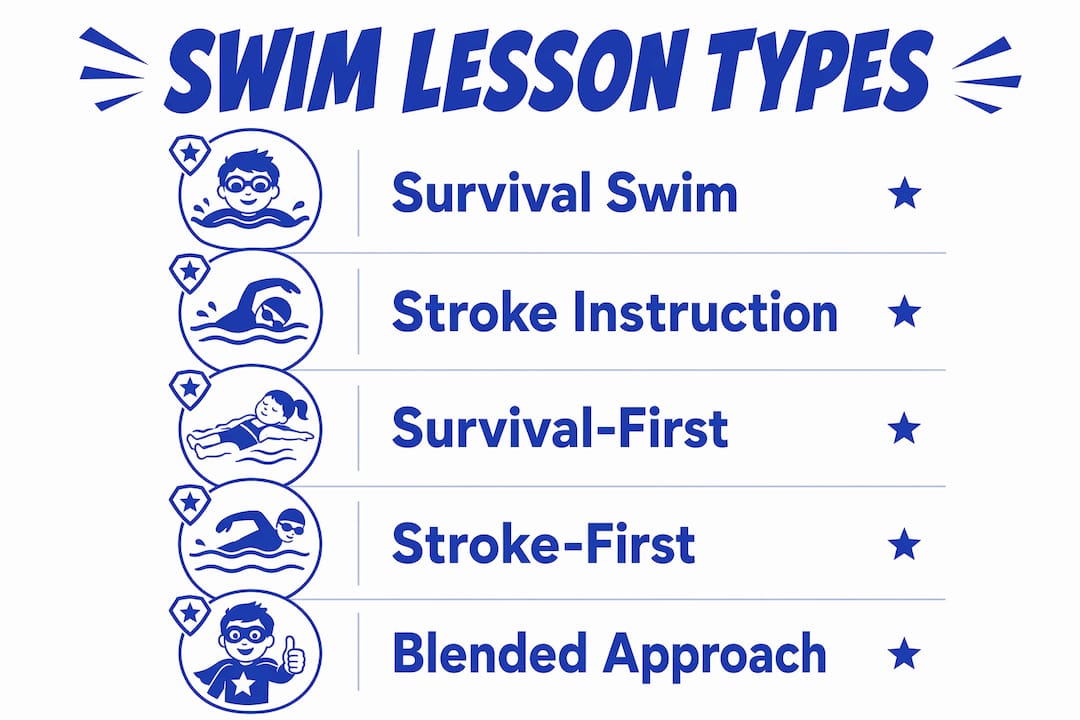
Survival swim focuses on self-rescue: teaching a child to float, roll to their back, and stay calm if they fall into water unexpectedly. This approach is recommended for infants and toddlers as foundational conditioning before formal stroke work begins. Traditional stroke instruction, by contrast, develops freestyle, backstroke, and other mechanics, and it typically becomes age-appropriate around 4–5 years old.
How the main alternatives break down by lesson type:
Superheroswimacademy: Pure survival swim curriculum for infants, toddlers, and young children; short, intensive sessions with one-on-one or very small group instruction; age-appropriate programming built into the curriculum design
Goldfish Swim School: Blends water safety fundamentals with progressive stroke development; structured levels from infant aquatics through competitive prep
YMCA Swim Lessons: Traditional stroke progression following established level frameworks; group format; some locations offer parent-child classes for infants
One thing worth knowing: survival swim and stroke lessons are not competing philosophies. The US Swim Schools Association recommends a gradual transition from self-rescue conditioning to formal strokes around ages 3–5, depending on the child’s development. A child who has solid survival skills first tends to build stroke mechanics with more confidence later.
No swim method makes a child fully safe on its own. Lessons alone cannot replace adult supervision, pool fencing, and other physical barriers. The best programs are upfront about this, and it’s a good sign when an instructor mentions it without prompting.
Pro Tip: Ask any prospective school whether their curriculum is survival-first, stroke-first, or a blend, and at what age they transition between the two. A school that can’t answer that clearly probably hasn’t thought hard enough about it.
How much do swim lessons cost at these alternatives?
Private 30-minute swim lessons nationally vary in price depending on location, with higher rates often found in major metro areas. Mobile or at-home instruction adds a premium on top of that baseline.
YMCA private lessons often offer competitive pricing for 30–35-minute sessions, making them one of the more affordable private-instruction options in many markets. Group lessons at municipal recreation departments can go lower, sometimes around $20 per session, though waitlists are common and one-on-one coaching is rare.
Typical pricing breakdown by format:
Group lessons (traditional): $10–$30 per session; most YMCA and rec department programs fall here
Private lessons (traditional): $35–$70 per 30-minute session nationally; metro areas skew toward the higher end
Survival swim programs (ISR-style): $100–$150 per week for daily sessions; a full 6-week course typically runs $600–$900 total
Mobile/at-home instruction: Starts around $62 for a 30-minute session, varying by location and instructor
Franchise academies (e.g., Goldfish Swim School): Pricing varies by location; some charge a curriculum license fee of $15–$35 per term for digital progress tracking and milestone assessments
Location is the biggest pricing variable after lesson format. An instructor in a high-demand area or a rented facility will charge more than one working out of a community pool. Some programs also require a non-refundable deposit to hold your child’s spot, which is worth asking about before you commit.
Comparing lesson venues matters beyond cost. At-home lessons eliminate travel time and often feel less intimidating for young children, but they require a suitable pool setup. Public pool programs offer structure and peer interaction but less flexibility.
Pro Tip: When evaluating packages, calculate the per-session cost rather than the total package price. A $400 package for 8 sessions is $50 per lesson; a $300 package for 5 sessions is $60. The bigger number isn’t always the better deal.
How do you choose the right swim lesson provider for your child?
Start with instructor qualifications. WSI certification and current CPR and First Aid training are the floor, not a bonus. Any school that can’t confirm these credentials for every instructor teaching your child is not worth your time, regardless of how appealing the facility looks.

After credentials, class size is the next filter. Small ratios mean your child spends more time in the water and less time waiting. For infants and toddlers especially, one-on-one or near-one-on-one instruction makes a measurable difference in how quickly skills develop.
Criteria to evaluate before enrolling:
Instructor certifications: WSI, CPR, First Aid as a minimum; ask whether certifications are current
Student-to-teacher ratio: Lower is better, especially for children under 4
Curriculum transparency: Can the school explain what your child will learn and in what sequence?
Progress tracking: Regular parent updates and clear milestone goals signal a program that takes development seriously
Facility conditions: Water temperature of 87–94°F is recommended for young children; clean, well-maintained pools matter for comfort and safety
Enrollment consistency: Continuous enrollment builds skills faster than sporadic sessions; look for programs that support ongoing participation rather than one-off packages
Parent communication is underrated as a selection criterion. A school that sends you a summary after each lesson, explains what your child worked on, and tells you what comes next is giving you something genuinely useful. One that just waves goodbye at the door is not.
Swim lessons reduce drowning risk by 88% when started between ages 1 and 4. That figure makes the selection process feel higher-stakes than picking a soccer camp, because it is.
Pro Tip: Most quality programs will let you observe or preview a class before enrolling. Use that time to watch how much of the lesson is active swim time versus waiting, how the instructor handles a nervous or reluctant child, and whether the environment feels calm and organized. What you see in a preview class is exactly what your child will experience.
Superheroswimacademy: survival swim lessons built for the youngest learners
If you’re coming from this comparison looking for a program that takes infant and toddler water safety as seriously as it gets, Superheroswimacademy is worth a close look. The academy’s survival swim curriculum is designed specifically for infants, toddlers, and young children, with every instructor trained in CPR, First Aid, and the academy’s own proven methods. That’s not a checkbox exercise; it’s the foundation the entire program is built on.
What sets Superheroswimacademy apart from a large franchise or a general YMCA program is the depth of parent engagement. Families receive clear goals and regular progress updates throughout the program, so you always know where your child stands and what comes next. With over 2,500 children taught across Palm Beach and Broward counties, the track record is real. Parents consistently report meaningful improvements in their children’s water confidence within a short period.
The program pairs a fun, encouraging environment with a genuine safety-first philosophy. That combination is harder to find than it sounds. If you’re in Palm Beach or Broward County and want a survival swim program that keeps you informed every step of the way, reach out to Superheroswimacademy to learn about current availability and enrollment.
Key Takeaways
The most effective approach to finding a SwimSRQ alternative is matching your child’s age and skill level to a provider whose curriculum, instructor credentials, and class size align with your safety priorities.
Point | Details |
Instructor credentials matter most | Require WSI certification plus current CPR and First Aid training from every instructor. |
Lesson type depends on age | Survival swim suits infants and toddlers; traditional stroke instruction fits children aged 4–5 and up. |
Pricing varies widely | Private lessons run $35–$70 per 30-minute session nationally; survival swim programs typically cost $600–$900 for a full course. |
Consistent enrollment builds skills | Ongoing programs outperform sporadic sessions; look for schools with clear progression goals and regular parent updates. |
Superheroswimacademy | Offers survival swim for infants and toddlers in Palm Beach and Broward counties, with CPR-certified instructors and regular parent progress updates. |
Recommended
Comments