
How to Be the Best Parent During In-Home Swim Lessons
- superheroswim
- Aug 8
- 13 min read

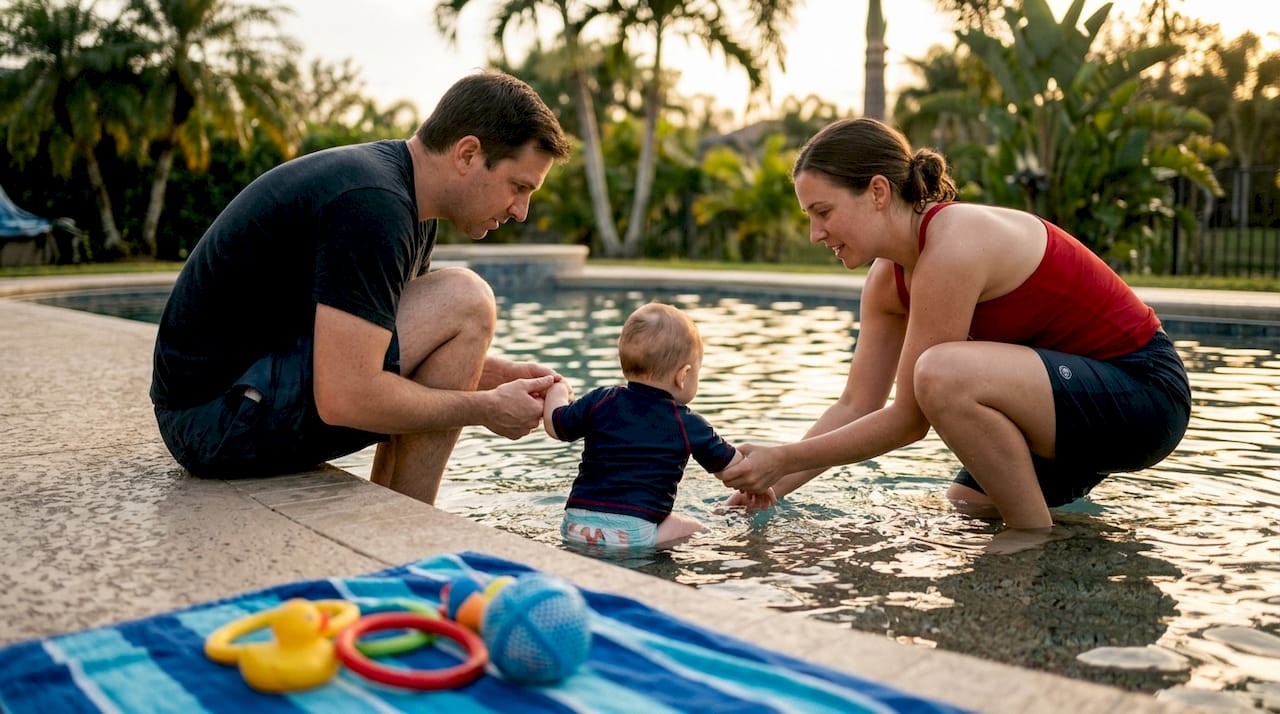
Your child’s in-home swim lesson goes better when you show up prepared. The five actions that matter most: designate yourself as the water watcher before the instructor arrives, stay within arm’s reach (touch supervision) for infants and young toddlers, shift to poolside presence for preschoolers, keep your verbal cues short and positive, prep the pool area to remove distractions, and know your emergency steps cold. That’s the short version. Here’s the full checklist you can screenshot right now:
Before each lesson:
Gate and latch the pool fence; confirm the gate is self-closing
Remove toys, floaties, and distractions from the pool deck
Have a charged phone, rescue ring, and first aid kit within reach
Review the lesson goal with the instructor (one skill per session)
During the lesson:
Stay poolside with eyes on the water, phone face-down
For infants and toddlers: maintain touch supervision unless the instructor signals otherwise
Use short praise only (“Great kick!” not a coaching correction)
Let the instructor lead; your job is emotional anchor, not co-teacher
After the lesson:
Ask the instructor one specific question: “What should we practice before next time?”
Log the skill attempted and your child’s reaction (one line is enough)
Secure the pool immediately; no unsupervised access
Pro Tip: The single highest-impact thing you can stop doing is narrating your child’s performance mid-lesson. Constant commentary (“Kick harder! No, like this!”) splits their attention between you and the instructor. Replace it with a thumbs-up and a smile. Research on parents attending swim lessons confirms that directive coaching during instruction slows progress; supportive presence accelerates it.
Key Takeaways
Active, non-directive parent involvement during in-home swim lessons improves both safety outcomes and skill acquisition when paired with consistent home practice and clear instructor communication.
Point | Details |
Water watcher is non-negotiable | One designated adult stays poolside with undivided attention during every lesson and practice session. |
Supportive presence beats coaching | Short praise and calm body language accelerate learning; technique corrections during lessons slow it. |
Short drills compound fast | Five to ten minutes of focused home practice, two to three times per week, reinforces skills between lessons for most children. Always ensure direct supervision during any in-water activity or drill. |
Age determines your role | Touch supervision for infants, poolside presence for preschoolers, and logistics support for school-age children. |
Superheroswimacademy | Private in-home lessons in Palm Beach and Broward counties train parents and children simultaneously in a one-on-one setting. |
Table of Contents
How to behave during an in-home lesson: dos, don’ts, and what to say
Age-by-age guide: what your role looks like as your child grows
Home pool safety rules and the supervision checklist you need before every lesson
How to track your child’s progress and communicate with the instructor
What the research and safety authorities say about parent involvement
Why Superheroswimacademy puts parent partnership at the center
Superheroswimacademy’s in-home lessons make parent involvement straightforward
Why your involvement in home swim lessons changes outcomes
Parental presence during in-home swim lesson involvement isn’t a courtesy — it’s a safety layer and a learning accelerator at the same time. When you’re poolside and engaged, you serve three distinct functions: physical safety anchor, emotional regulator, and practice reinforcer.
The physical piece is the most urgent. Healthychildren recommends touch supervision for infants, meaning a caregiver’s hands stay on the child unless the instructor explicitly directs otherwise. That’s not hovering; it’s the baseline for safe infant water exposure. For toddlers and preschoolers, your calm body language signals that the water is safe, which directly affects how quickly a child relaxes and starts absorbing instruction.
The emotional piece is underrated. Children read their parents’ anxiety faster than they read the instructor’s cues. A tense parent on the pool deck produces a tense child in the water. Staying visibly calm, making eye contact, and nodding during difficult moments gives your child permission to try again.
Practice reinforcement is where involvement compounds over time. A child who hears the same cue from you at bath time that they heard from the instructor at the lesson consolidates the skill faster. Short, consistent repetition between sessions matters more than lesson length.
Touch supervision reduces response time in a near-miss situation
Emotional co-regulation helps children tolerate the discomfort of learning new skills
Parent-reinforced practice between lessons accelerates skill retention
Parental presence supports instructor authority rather than competing with it
A 2024 study published in Springer Nature found correlations between parental activity levels, parental support, and children’s continued participation in swimming. Countries that expanded mandatory swim instruction alongside parental engagement programs saw measurable reductions in drowning rates. The study reported statistical significance across several parental perception subscales (p < 0.05), though sample sizes and contexts varied across the countries examined.
How to behave during an in-home lesson: dos, don’ts, and what to say
The instructor is running the session. Your role is to make that session easier, not to add a second curriculum.
Do:
Stay within the instructor’s line of sight and respond quickly to any signal
Use brief, positive language: “You’ve got this,” “Nice try,” “I see you working hard”
Model slow, calm breathing when your child looks anxious
Follow the instructor’s physical cues for when to hold, release, or step back
Ask your one post-lesson question after the session ends, not during
Don’t:
Correct your child’s technique while the instructor is teaching
Contradict or supplement the instructor’s instructions in real time
Raise your voice, express frustration, or compare your child to another swimmer
Rescue your child from a manageable challenge unless the instructor signals danger
Use the lesson time to check your phone
Scripts that work:
When your child is scared: “I’m right here. You’re safe. Let’s watch what [instructor’s name] does first.”
When your child refuses a new skill: “You don’t have to love it yet. Just try it once.”
When your child succeeds: “I saw that. You did it.” (Short. Specific. No inflation.)
Pro Tip: When the instructor signals that your child is ready to try something independently, physically step back one full step and drop your hands to your sides. Children track parent body language constantly. A visible physical retreat communicates “I trust you” more clearly than any words.
Research on parent behavior during swim instruction documents that active involvement helps learning while directive behavior interferes with it. The distinction is posture: supportive partner versus auxiliary instructor. The role of parents in swim lessons is explored in depth for parents who want a fuller breakdown by lesson type.
Age-by-age guide: what your role looks like as your child grows
Your involvement doesn’t stay constant. It shifts with your child’s developmental stage, and knowing when to step in versus step back prevents both under-supervision and over-dependence.
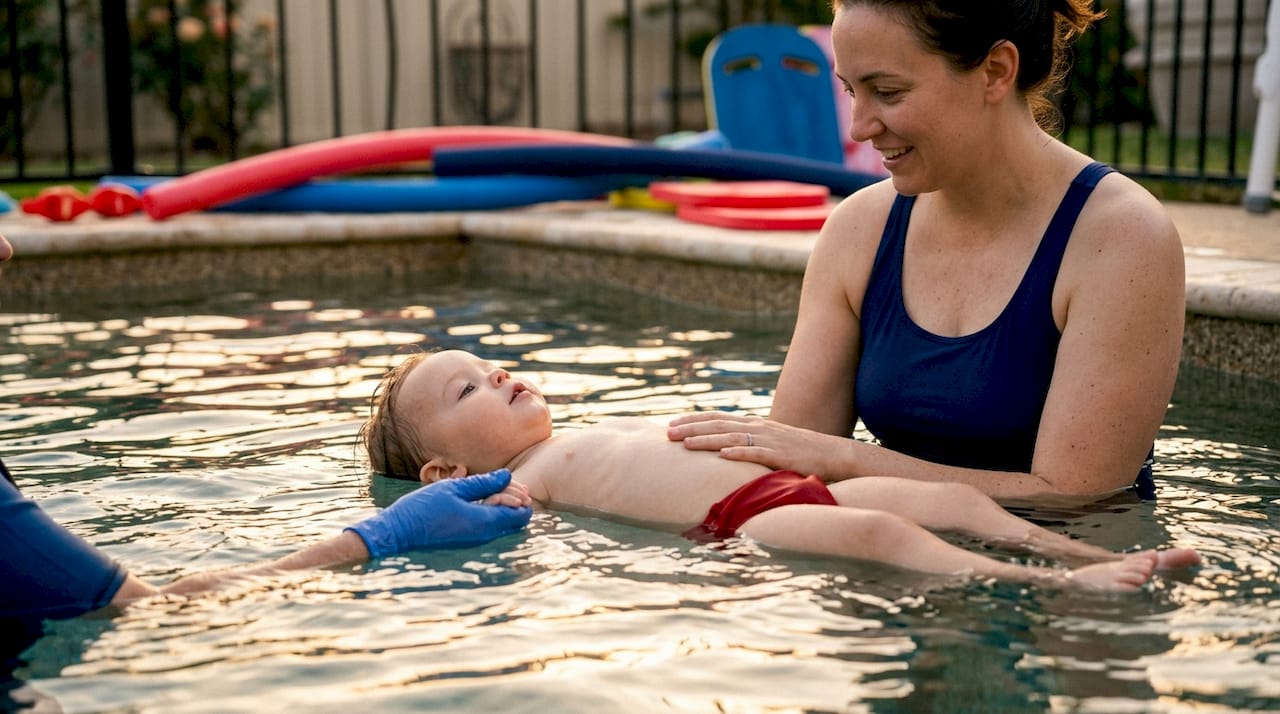
Ages 0–2 (infants and young toddlers) You are in the water or at arm’s reach at all times. Touch supervision is non-negotiable. Your job is to hold, support, and respond to the instructor’s positioning cues. Milestones at this stage include comfortable submersion, assisted back float, and calm water entry. Parent-and-child sessions are the standard format here. Instructor safety protocols for infants explain what a qualified instructor does at this stage and what they expect from you.
Ages 3–5 (preschool) You move from in-water support to poolside presence. The instructor leads; you observe and reinforce. Children at this stage are building breath control, independent floating, and basic propulsion. Your role during the lesson is emotional anchor. Between lessons, you run the short drills the instructor assigns. Common mistake at this age: jumping in to “help” when the child struggles with a new skill. Struggle is the learning.
Ages 6–8 (early school-age) Poolside presence is still valuable, but your child is developing independent water confidence. You watch, you cheer briefly, and you ask the instructor what to reinforce at home. Physical touch supervision gives way to visual supervision. This is the stage where children start signaling readiness for more independence. Watch for consistent breath control, unassisted floating, and willingness to try new entries.
Ages 9 and up Your primary role shifts to logistics and communication: scheduling consistent lessons, tracking milestones, and maintaining safety protocols. The child leads the learning. You stay informed and keep the pool environment safe. For families thinking about the next step, the transition from home lessons to swim team guide covers when and how to make that move.
Safe home practice drills you can run between lessons
Short, focused practice beats long occasional sessions. Aim for 5–10 minutes, two to three times per week. That frequency is enough to consolidate skills without fatiguing a young child or creating negative associations with water.
The YMCA’s home activities resource recommends dryland drills alongside supervised in-water practice as effective complements to formal instruction. Here’s a practical sequence:
Breath control game (bath time, 2–3 minutes): Have your child blow bubbles in the bath, counting how long they can exhale. Progress to putting their chin in the water, then their mouth. Touch supervision throughout.
Dryland kick drill (living room floor, 2 minutes): Child lies on their stomach on a towel. Practice flutter kick with straight legs and pointed toes. This builds the muscle memory that transfers directly to pool kicking.
Dryland arm stroke (standing, 1–2 minutes): Demonstrate a freestyle arm pull. Have your child mirror it. Narrate the motion: “Pull, push, recover.” Repetition on land reduces cognitive load in the water.
Assisted back float (pool, with touch supervision, 3–5 minutes): Support your child’s head and lower back. Gradually reduce pressure as they find their own balance. Never remove both hands simultaneously without the instructor’s guidance.
Wall push-off (pool, with supervision, 2–3 minutes): Child places feet on the wall, pushes off, and glides. Focus on body position, not distance. This drill reinforces the streamline position used in every stroke.
Mock recovery on the deck (dryland, 1–2 minutes): Child practices rolling from face-down to face-up on a mat. This mirrors the survival float skill and builds the movement pattern before it’s needed in water.
Pro Tip: Dryland practice is the highest-ROI drill most parents skip. Rehearsing kicks and arm movements on land builds muscle memory and cuts the cognitive load during pool drills, so your child can focus on breathing and balance instead of limb coordination.
Never practice in water without a designated water watcher present. No exceptions, no “just for a minute.” HealthyChildren.org is clear that touch supervision during close water practice remains essential even when a child appears comfortable.
Home pool safety rules and the supervision checklist you need before every lesson
Safety at a home pool requires multiple layers working together. No single measure is sufficient on its own. The NDPA’s layers of protection framework makes this explicit: fencing, supervision, flotation devices, and lessons each reduce risk, but only in combination do they create a genuinely safe environment.
Non-negotiables before the instructor arrives:
Four-sided pool fence with a self-latching, self-closing gate (minimum 4 feet high)
Gate locked and tested; no furniture or objects that could be used to climb over
Rescue ring or shepherd’s hook within immediate reach of the pool
First aid kit stocked and accessible
Phone charged and nearby (for emergencies only, not for browsing)
Emergency action plan posted or saved on your phone (include local 911, nearest hospital, and poison control)
During every lesson:
One designated water watcher with no other responsibilities
Water watcher stays within arm’s reach of the pool edge
No alcohol, no distractions, no divided attention
Instructor’s CPR and First Aid certification confirmed before the first lesson
Emergency basics every parent should know:
Shout for help, then enter the water only if trained to do so
Reach or throw before you go (use the rescue ring first)
Begin CPR immediately if the child is unresponsive and not breathing normally
Call 911 before starting CPR if you are alone; otherwise have someone else call
The CDC’s drowning prevention guidance endorses this layered approach: supervision, barriers, life jackets for non-swimmers, and swim lessons work together. Poolsafely provides printable checklists for pool fencing standards and water watcher protocols that you can post poolside.
For a full walkthrough of in-home swim safety for parents, including pool gate checks and supervision duties, Superheroswimacademy has a dedicated guide. Preparing the physical space is covered step by step in the backyard pool lesson prep checklist.
Common parental mistakes that slow progress or create risk
Most of these mistakes come from good intentions. Knowing the pattern makes it easier to catch yourself.
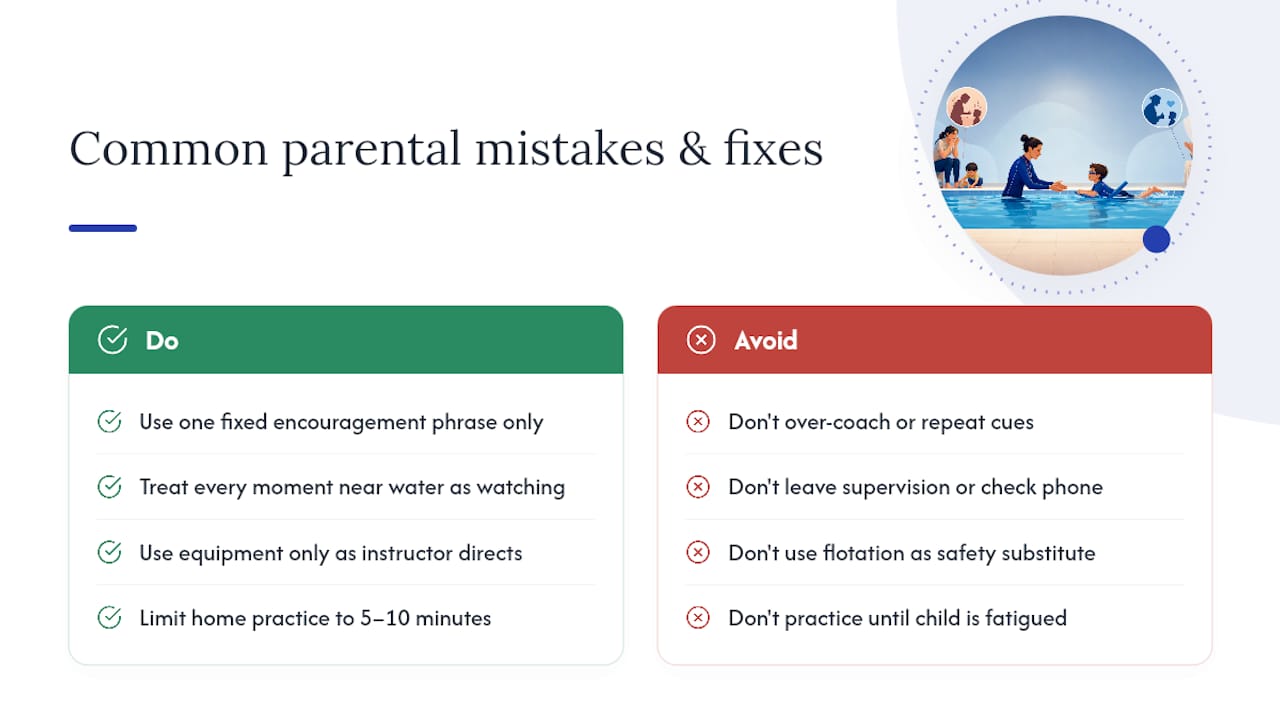
Over-coaching during the lesson. You see your child struggling and want to help. You call out technique corrections, demonstrate the skill yourself, or repeat the instructor’s cue in slightly different words. The result: your child doesn’t know whose voice to follow. Fix: pick one phrase of encouragement before the lesson starts and use only that.
Inconsistent supervision. A lesson is in progress, so you assume the instructor is watching everything. You step inside for a moment, check your phone, or start a conversation with another adult. Drowning happens in seconds and in silence. Fix: treat every moment your child is near water as a water watcher moment, regardless of who else is present.
Using floatation devices as a safety substitute. Arm floaties and swim rings give children (and parents) a false sense of security. They are not life-saving devices; they are play aids. A child who relies on floaties hasn’t learned to manage their own buoyancy. Fix: use appropriate swim equipment as the instructor directs, not as a replacement for supervision or skill.
Practicing to the point of fatigue. More time in the water feels productive. A tired, frustrated child in the water is a safety risk and learns nothing. Fix: keep home practice sessions to 5–10 minutes and stop before the child asks to stop.
Interrupting instructor flow. Asking questions mid-drill, redirecting your child’s attention, or physically intervening during a skill attempt breaks the instructional sequence. Fix: hold all questions until after the session. One focused question at the end is worth more than five interruptions during.
Scenario: A parent sees their 4-year-old hesitate at a back float attempt. They lean in and say, “Just relax, you did it yesterday, remember?” The child turns toward the parent, loses body position, and the instructor has to restart the drill. The fix: the parent catches their own impulse, gives a small nod instead, and lets the instructor handle the hesitation. The child tries again on the instructor’s cue and succeeds.
How to track your child’s progress and communicate with the instructor
Tracking doesn’t need to be complicated. A two-column weekly log works well: one column for the skill the instructor worked on, one column for your observation of how your child responded. One line per session is enough to spot patterns over time.
Sample weekly tracker:
Skill practiced | Parent observation |
Assisted back float | Relaxed after 2nd attempt; still tenses shoulders |
Breath control / bubble blowing | Comfortable; held exhale for 3 seconds |
Wall push-off and glide | Bent knees on push-off; needs more practice |
Questions to ask after each lesson:
“What skill should we reinforce before next time?”
“Did you notice any fear or hesitation I should know about?”
“Is there anything in our home setup that would help the next session?”
“Are we on track with the milestones you’d expect at this stage?”
Before enrolling in any program, ask the instructor directly for their CPR and First Aid certifications, their curriculum framework, and their emergency action plan. Research on swim program quality recommends that parents verify these credentials before the first lesson, not after. A qualified instructor will answer these questions without hesitation.
Schedule a brief check-in every three to four weeks to review progress against milestones. If your child has plateaued or regressed, that’s the moment to request a lesson plan adjustment, not to wait and hope the next session fixes it. Booking and scheduling best practices cover how to structure consistent lessons so progress compounds rather than stalls.
For parents managing other caregiving responsibilities alongside lessons, a babysitter information sheet that includes emergency contacts, pool access rules, and supervision instructions is a practical tool to have ready whenever someone other than you is present during a lesson or practice session.
What the research and safety authorities say about parent involvement
The evidence base for parental involvement in swim safety is consistent across sources, even where individual studies have limitations.
Top-line findings:
The CDC identifies supervision, barriers, life jackets, and swim lessons as complementary layers of drowning prevention. No single measure is sufficient alone.
The NDPA frames this as a “layers of protection” model, where each layer reduces risk independently and all layers together produce the greatest reduction.
HealthyChildren.org recommends that parents act as the water watcher and maintain touch supervision for infants, reinforcing that parental presence is a clinical recommendation, not just a preference.
Study summaries:
Study | What it measured | Main finding | Limitation |
Springer Nature 2024 | Parents’ perceptions of enrolling children in swim courses; multi-country data | Parental support and activity levels correlated with children’s continued participation; countries with expanded instruction saw drowning rate reductions | Varied sample sizes across countries; perception-based survey data |
IJARE / BGSU | Parent behavior during swim lessons; qualitative practitioner literature | Directive coaching during lessons interferes with instruction; supportive presence improves outcomes | Qualitative design; practitioner-reported rather than controlled trial |
The study reported statistical significance in several parental perception subscales (p < 0.05), but the design relies on survey data and cross-country comparisons, which limits causal claims. The IJARE findings are practitioner-based and qualitative. Both point in the same direction: engaged, non-directive parents produce better outcomes than absent or over-involved ones.
Small-sample and qualitative studies are worth reading but shouldn’t be treated as definitive proof. The stronger signal comes from the convergence across CDC guidance, NDPA frameworks, and pediatric recommendations, all of which point to the same set of behaviors.
Why Superheroswimacademy puts parent partnership at the center
Parent partnership isn’t a feature Superheroswimacademy added to its program. It’s the structural premise. Every in-home lesson is designed so that the instructor coaches the child and coaches the parent simultaneously, because a child who practices the right skills between sessions progresses faster than one who only sees the instructor once a week.
With over 2,500 children taught across Palm Beach and Broward counties, the pattern is consistent: parents who understand their role, stay calm poolside, and run short reinforcement drills between sessions report the fastest visible progress. Every Superheroswimacademy instructor holds CPR and First Aid certification and is trained in the academy’s own survival swim curriculum, so parents can ask direct questions about emergency protocols and get real answers.
The private, in-home setting makes this collaboration easier. There’s no group dynamic to manage, no waiting for other children to finish their turns. The instructor’s attention is on your child, and the parent coaching happens in real time, in your actual pool, with your child’s specific hesitations and strengths in view.
Superheroswimacademy’s in-home lessons make parent involvement straightforward
Knowing what to do as a parent during swim lessons is one thing. Having an instructor who actively shows you how to do it, in your own backyard pool, is another.
Superheroswimacademy’s private in-home lessons in Palm Beach and Broward counties are built around exactly this: one instructor, one child, one parent learning alongside them. You get a tailored lesson plan, real-time coaching on your own involvement, flexible scheduling that fits your week, and an instructor who arrives CPR and First Aid certified and ready to answer your safety questions directly. No generic group curriculum, no guessing what to practice at home. After each session, you know the next drill, the next milestone, and the next safety check.
Parents who want to go deeper on the home practice side can also access online courses that teach the same drills and parent coaching frameworks used in private sessions. To book a private in-home lesson or learn more about what a first session looks like, visit Superheroswimacademy and request your first session today.
Sources
These sources are worth saving or bookmarking. Each one covers a specific piece of the parent involvement and water safety picture.
This article is general information, not a substitute for advice from a qualified doctor. Consult a qualified healthcare professional about your own circumstances before acting on anything here.
Recommended
Comments