
Location Convenience and Swim Lessons: a Parent's Guide
- superheroswim
- May 28
- 8 min read

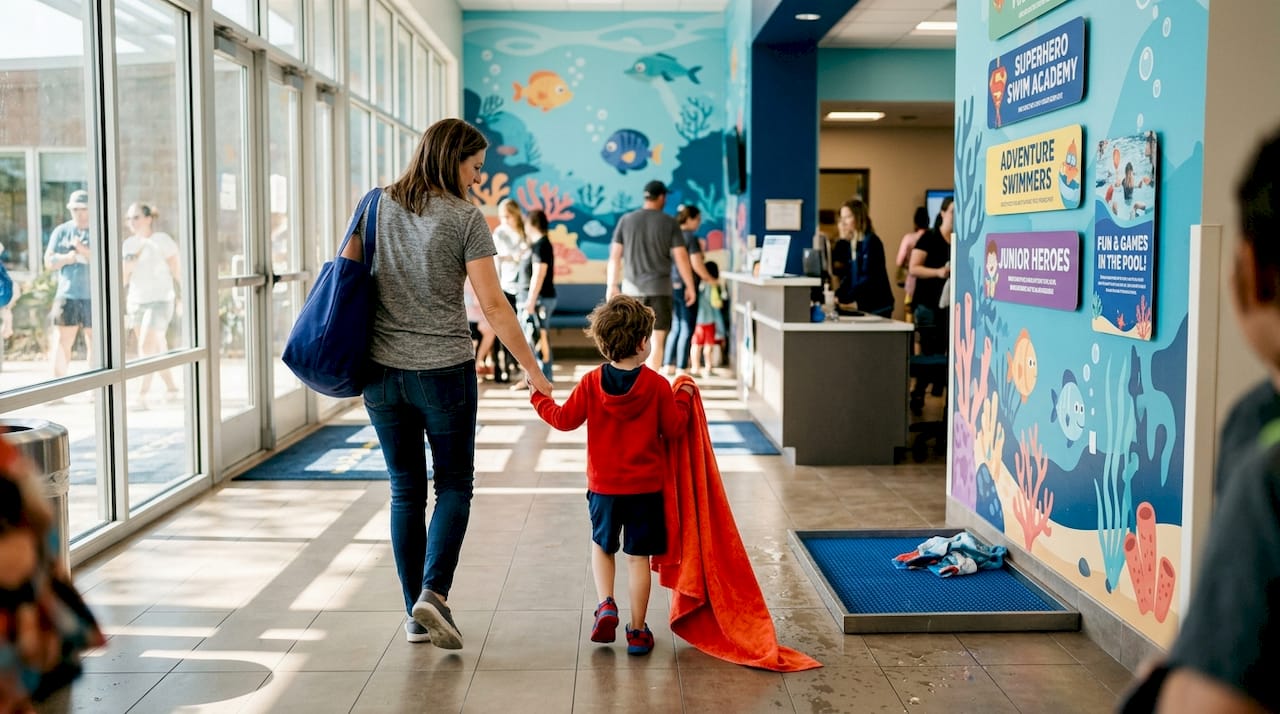
Most parents searching for swimming lessons near me focus on price, instructor credentials, and pool safety. Location convenience barely makes the checklist. That’s a mistake with real consequences. The role of location convenience in swim lessons goes far beyond saving a few minutes of driving. It directly shapes how often your child shows up, how steadily they progress, and whether they actually develop the water safety skills that matter. This guide breaks down why proximity to your swim school is one of the most practical decisions you’ll make for your child’s safety and confidence.
Table of Contents
Key takeaways
Point | Details |
Attendance drives outcomes | Consistent attendance builds water confidence faster than any single lesson method or technique. |
Location affects your budget | Nearby swim classes cut indirect costs like fuel, parking, and missed work that add up quickly. |
Year-round access matters | Seasonal closures cause skill regression in young children, making local indoor programs a safer choice. |
Observation boosts child comfort | Facilities where parents can watch lessons increase child engagement and trust in the water. |
Proximity supports involvement | Parents who live close to their child’s swim school attend more consistently and stay more engaged in progress. |
The role of location convenience in swim lesson success
The relationship between where swim lessons happen and how much your child actually learns is more direct than most parents realize. Local lessons reduce travel time and stress, which makes it easier to build a steady routine and track real progress. When a 20-minute class requires a 45-minute round trip, families start skipping when life gets busy. And with young children, skipping even two or three sessions in a row can undo weeks of progress.
Stress plays a bigger role than people admit. A child who arrives frazzled from a long car ride is not the same learner as one who walked in calm and familiar with the surroundings. Rushed drop-offs and tired parents create an anxious atmosphere, and anxious children do not learn water skills well. Convenient swim class locations remove that friction before it starts.
Shorter commutes mean children arrive calm and ready to engage
Familiar neighborhoods reduce first-lesson anxiety for toddlers and infants
Parents are more likely to attend every session when the location is close to home or school
Consistent attendance prevents the “relearning phase” that sets children back after gaps
Consistent routines build water confidence over time rather than in isolated bursts, and small class sizes with low student-to-instructor ratios give children better feedback at each session.
Pro Tip: When evaluating swim schools, map the location against your most frequent daily route. A school that sits between home and daycare is one you will actually use every week.
Indoor, year-round locations and water safety
One factor that separates genuinely safe swim education from convenience-only choices is year-round indoor access. Seasonal community programs often close in fall, cutting off skill development at exactly the wrong time. Children who spend three to four months away from the water regress. They lose confidence. They forget breathing techniques. And when summer comes back around, their families restart from scratch.
Indoor pools solve that problem structurally. They operate regardless of weather or season, so your child builds skills in a continuous line rather than a start-stop pattern. The physical environment matters too. Pool temperatures between 87 and 94°F are ideal for infant and toddler comfort, and well-maintained local facilities are far more likely to hold that standard than large outdoor public pools.
Feature | Indoor year-round school | Seasonal or outdoor program |
Availability | 12 months per year | Typically 3 to 5 months |
Pool temperature control | Consistent, child-friendly warmth | Variable, often too cold for infants |
Skill continuity | Uninterrupted progression | Frequent regression after closures |
Parent observation | Dedicated viewing areas | Often limited or unavailable |
Weather dependency | None | High impact on scheduling |
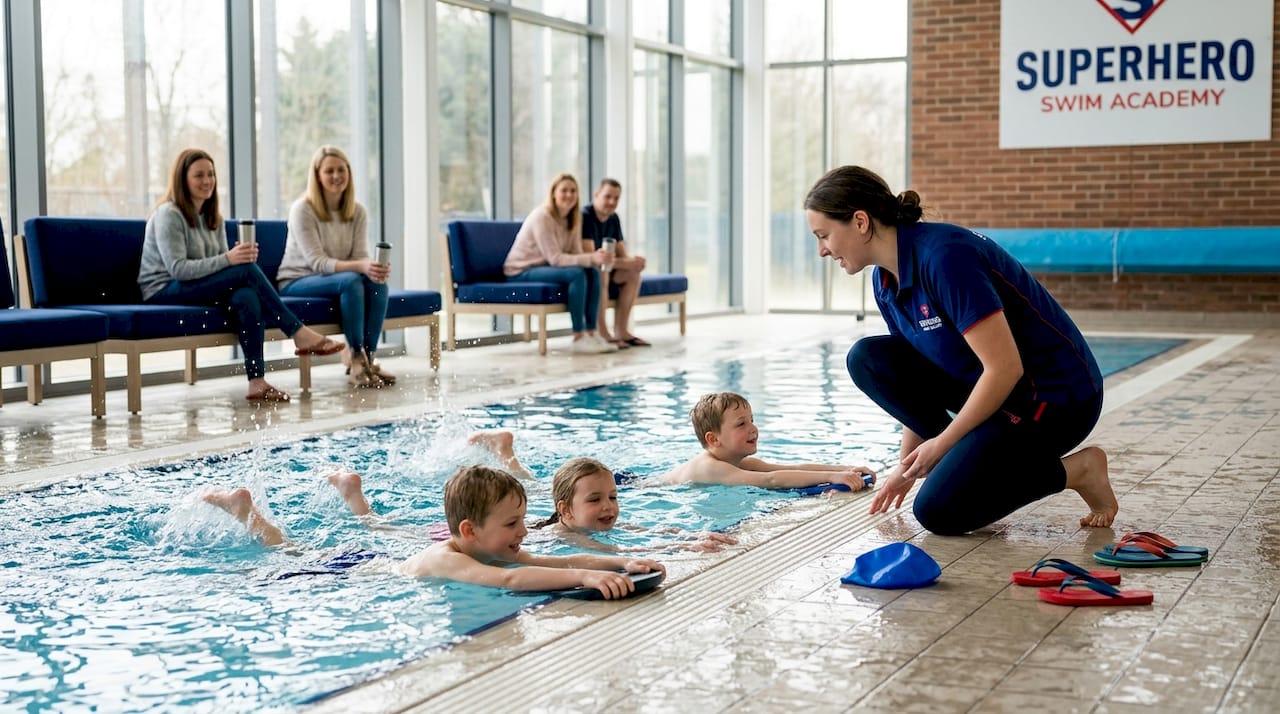
There is also the parent observation factor. Facilities designed for family presence increase parental confidence in safety and instruction quality. When your child sees you watching from a viewing area, their comfort and engagement go up noticeably. This is especially true for children under four years old, where separation anxiety is a real learning barrier.
Pro Tip: Before enrolling anywhere, ask specifically whether parents can observe lessons in person. Schools that say no without a good reason deserve extra scrutiny.
Year-round access in indoor facilities supports continuous water safety education in a way that seasonal programs structurally cannot. If you are looking at swim lessons in Lake Worth or surrounding Palm Beach communities, that year-round access question should be near the top of your list.
Financial and lifestyle benefits of nearby swim classes
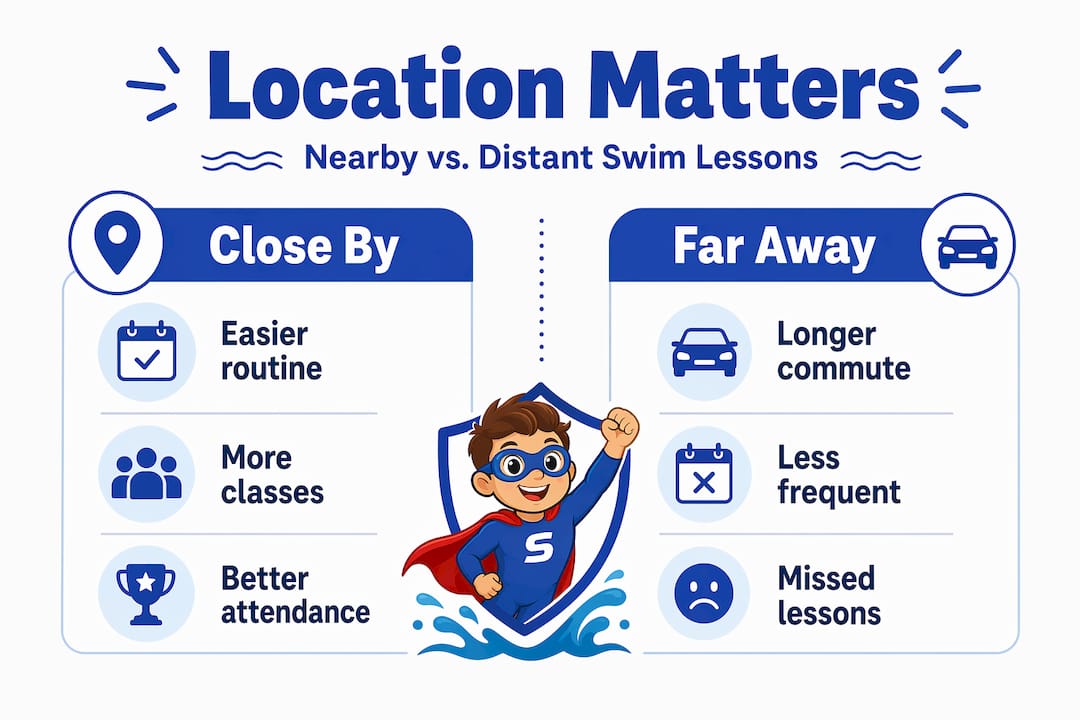
Parents tend to calculate swim lesson costs by looking at the tuition line. But that number only tells part of the story. Nearby lessons save families money on fuel, parking, and the indirect time costs that pile up over a year of weekly sessions. If you are driving 30 minutes each way twice a week, that is over 50 hours of travel time annually. That time has real value.
The lifestyle benefits run deeper than the financial ones. Lessons that fit into family schedules reduce stress and improve long-term commitment, which is exactly what young children need to reach mastery. When a swim school is near your commute or school pickup route, it stops feeling like an extra errand and becomes part of a natural weekly rhythm.
Fuel and parking savings add up to hundreds of dollars annually for distant schools
Shorter travel windows allow you to fit makeup sessions into your schedule without reorganizing your whole day
Local schools often build community familiarity, making it easier to swap schedules with other families
Reduced transit stress means your child arrives with more mental energy for learning
Understanding the full cost of personalized swim lessons means looking beyond the price per class and factoring in what you spend to get there consistently.
How to evaluate convenient swim schools near you
Choosing swim lessons near you based on proximity alone is not enough. You need the location to check several boxes at once for it to actually serve your child’s safety and development. Here is a practical framework for assessing your options.
Map it to your routine. The best location is one that sits along a path you already travel. Schools near home, daycare, or your work commute eliminate the feeling of a special trip and make consistent attendance realistic.
Confirm year-round availability. Ask directly whether the school runs lessons through fall and winter. If they close seasonally, your child’s progress will stall regardless of how great the instruction is during open months.
Check pool temperature and facility condition. Water maintained in the 87 to 94°F range is ideal for young children. Cold water creates discomfort that makes children resistant to the water and resistant to learning.
Ask about class size and student-to-instructor ratios. Small group lessons with a 4:1 ratio offer the personalized feedback young swimmers need. Large classes save money upfront but cost progress in the long run.
Visit before you commit. Walk the facility. Observe a class if possible. Parents observing lessons near home report higher confidence in safety and instruction quality. Trust that instinct.
Beyond the checklist, pay attention to how staff interact with children during and between lessons. Do instructors know each child’s name? Do they communicate progress to parents? A school that is both conveniently located and genuinely invested in your child’s development is the combination that produces safe, confident swimmers over time.
Look for flexible scheduling that accommodates makeup classes without penalties
Confirm that instructors hold CPR and First Aid certifications as a baseline requirement
Read community reviews specific to your neighborhood, not just the school’s overall rating
Ask whether siblings or multiple children can be scheduled back-to-back to minimize your total time at the facility
If you are in Palm Beach or Broward County, resources like the local swim classes guide for Lake Worth offer a concrete starting point for comparing nearby programs.
Why I think parents undervalue location when choosing swim lessons
I have worked with thousands of families across Palm Beach and Broward counties, and I see the same pattern repeatedly. Parents spend weeks researching instructor credentials and curriculum philosophy, then enroll at a school 40 minutes from home because it had the best online reviews. Six weeks later, attendance has already dropped.
Location convenience is not a soft preference. It is a structural commitment device. When getting to lessons is easy, families show up. When it is complicated, they do not. And in swim education for young children, showing up consistently is the single biggest predictor of safety outcomes.
What I have found actually works is treating proximity as a non-negotiable filter before evaluating anything else. Narrow your options to schools within a realistic travel window first. Then compare quality, safety protocols, and instructor training within that set. You will almost always find a high-quality option nearby if you look with the right criteria.
I have also noticed that convenience builds routine that is critical for long-term skill retention. It reduces cancellations, keeps children emotionally steady, and keeps parents engaged. Families who treat swim lessons as a non-negotiable weekly habit produce children who are genuinely safer around water. Location makes that habit possible.
— SUPERHERO
Swim lessons near you with Superheroswimacademy
If you are ready to stop searching and start enrolling, Superheroswimacademy was built with exactly this in mind.
Serving Palm Beach and Broward counties, Superheroswimacademy offers year-round indoor survival swim lessons for infants, toddlers, and young children with warm pools, small class sizes, and instructors trained in CPR, First Aid, and a proven survival swim curriculum. Every instructor goes through the academy’s own rigorous training program so that safety and skill development go hand in hand. Parents receive regular progress updates and are encouraged to observe lessons, so you are never left wondering how your child is doing. With over 2,500 children taught and multiple accessible locations across Palm Beach and Broward, Superheroswimacademy makes it straightforward to find a location that fits your schedule and your neighborhood. Visit the website to explore locations, scheduling options, and what makes this program a trusted choice for families throughout South Florida.
FAQ
Why does swim lesson location affect my child’s learning?
Closer locations make consistent attendance realistic, and regular attendance is the single biggest factor in steady skill development and water confidence. Children who attend every week build muscle memory and trust in the water far faster than those with gaps in attendance.
How far is too far for swim lessons for young children?
There is no universal rule, but a commute that takes more than 20 to 25 minutes each way tends to create enough friction that families skip sessions when schedules get tight. Map your options against your daily routine and prioritize any school that fits naturally into a trip you already make.
Are year-round indoor swim schools better for water safety?
Yes. Seasonal program closures contribute to skill stagnation and increased water risk in young children. Indoor programs with year-round schedules allow for uninterrupted skill progression, which is especially critical in the early stages of survival swim training.
What should I look for beyond just a nearby location?
Check pool temperature, class size, year-round availability, and whether parents can observe lessons. A 4:1 student-to-instructor ratio is a good standard for young children, alongside verified CPR and First Aid instructor certification.
Can convenient locations really save our family money?
Absolutely. Nearby swim lessons cut indirect costs including fuel, parking, and time, which adds up to hundreds of dollars per year for families who drive long distances to weekly sessions. Proximity also makes it easier to attend makeup classes, which means you get full value from the tuition you pay.
Recommended
Comments