
Self-Rescue Swimming for Parents: Teach Safety First
- superheroswim
- 6 days ago
- 8 min read

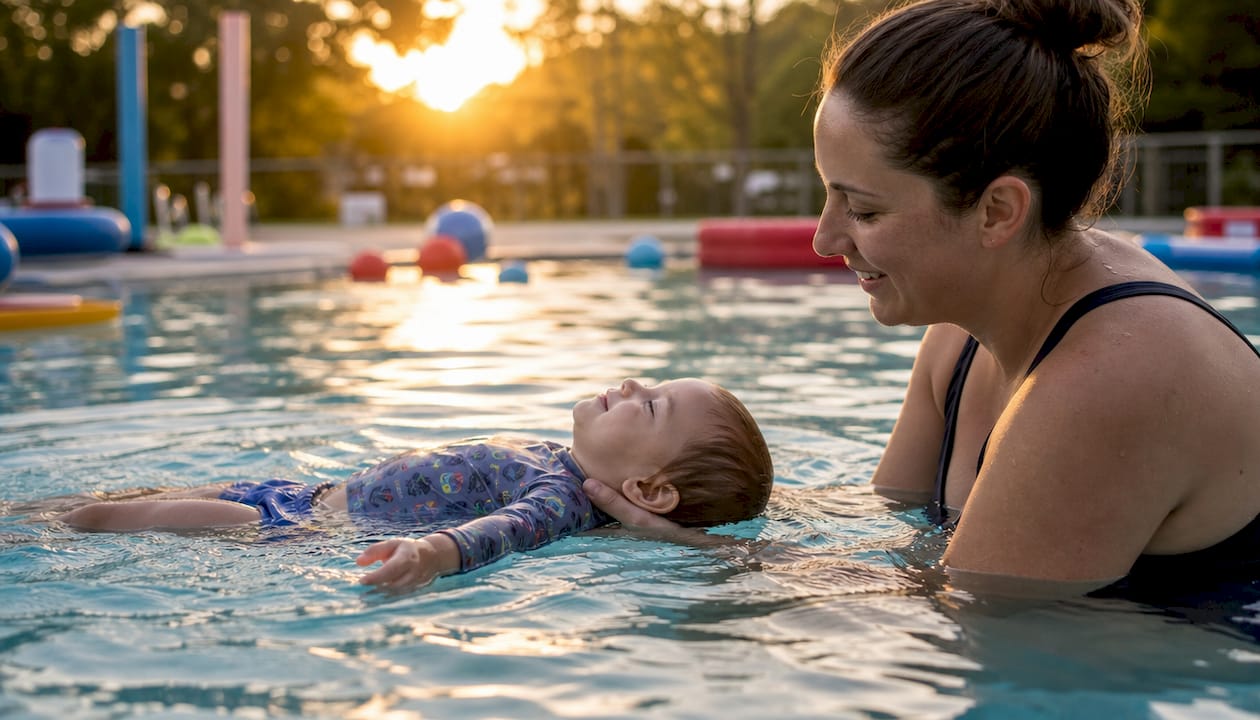
Self-rescue swimming teaches a child what to do in the first seconds after an unexpected fall into water: roll to their back, float, breathe, and move toward safety. If your child is between 6 months and 6 years old, enrolling them in a qualified survival swim program is one of the most concrete steps you can take toward drowning prevention — but lessons work best as one layer in a broader safety plan, not as a standalone guarantee.
Core skill: Roll-to-back float, maintain position, and use the Swim–Float–Swim sequence to reach safety
Typical age window: Roughly 6 months through age 6, with skills matched to developmental stage
Supervision caveat: The CDC confirms that even children who have completed swim lessons require close, constant adult supervision within arm’s reach
Superhero Swim Academy offers exactly this kind of structured, survival-first instruction for families in Palm Beach and Broward counties.
Table of Contents
What does self-rescue swimming actually teach your child?
Self-rescue swimming, sometimes called survival swimming or infant aquatics, is not about learning the freestyle stroke. The goal is a specific emergency skillset: the moment a child enters water unexpectedly, they know how to find air, stabilize, and move toward safety.
CAST Water Safety Foundation describes the core sequence as finding air first, rolling to a back float, resting and breathing, then swimming toward an exit point. That sequence matters because a panicked child who cannot get face-up will exhaust themselves in seconds.
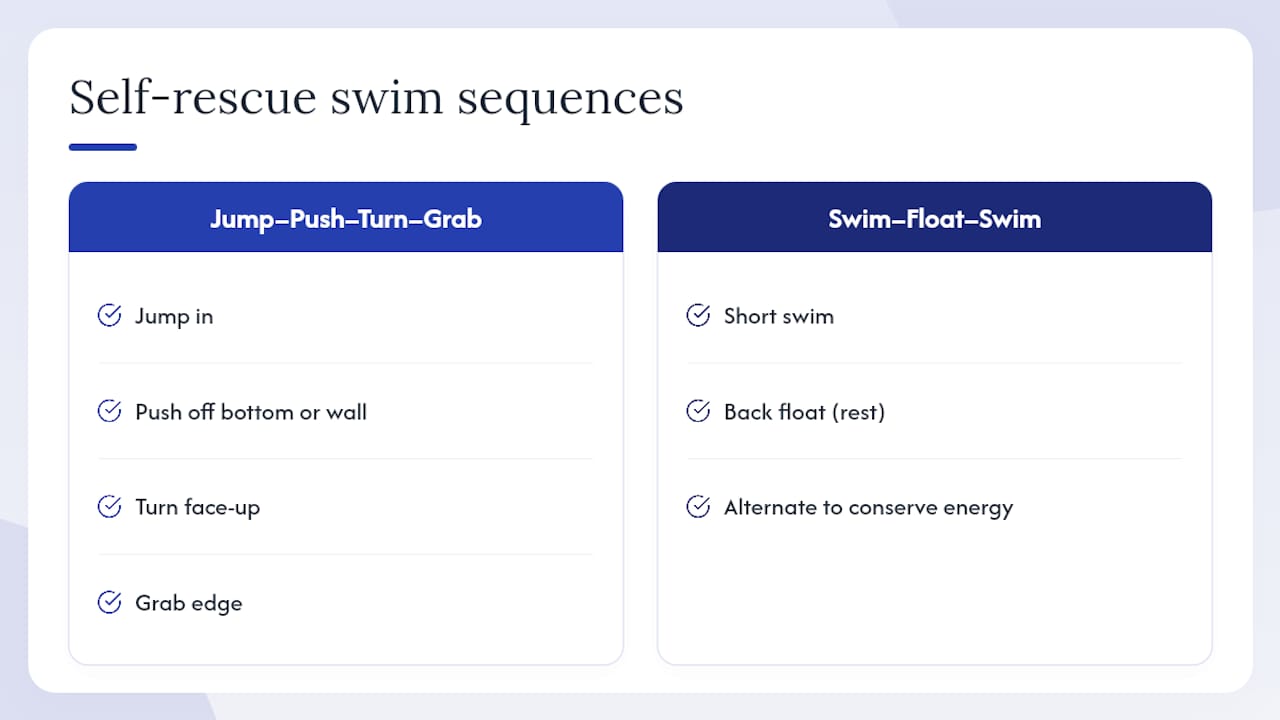
Two foundational scripts appear across most quality programs. Jump–Push–Turn–Grab is the entry-level sequence: a child who falls in pushes off the bottom or wall, turns face-up, and grabs an edge. Swim–Float–Swim, as WaterWiseKids explains, is an energy-management strategy where a child alternates short swims with back floats to cover distance without exhausting themselves. Think of it as a repeatable rhythm rather than a single burst of effort.
One detail that surprises many parents: quality programs include clothed practice. A child who can float in a swimsuit may struggle in jeans and a t-shirt. Simulating real-world conditions, including unexpected entry and everyday clothing, is what separates survival instruction from recreational swim class.
What skills does your child learn, and how do instructors measure progress?
Survival swim programs follow a staged progression. Here is what that typically looks like from beginner through survival-ready:
Beginner stage
Tolerates water on face without panic
Rolls from front to back with instructor support
Holds a back float for a few seconds with minimal assistance
Intermediate stage
Rolls to back independently after a front-entry
Maintains a back float for several seconds without support
Kicks toward an edge or step while on back
Survival-ready stage
Completes a full Swim–Float–Swim cycle for a short distance, depending on age and size
Performs a clothed entry and returns to float position
Reaches a wall, step, or shallow area independently
Mastery checks are concrete, not subjective. An instructor should be able to tell you exactly how long your child held a float, whether they completed a clothed entry, and what the next measurable goal is. Vague progress reports (“she did great today”) are a red flag. Skills also fade without reinforcement, so a child who passes a survival check in March needs practice and periodic refreshers to hold those skills through summer.
A personalized coaching approach tracks each child’s progression against defined benchmarks rather than a generic class calendar.
What age should your child start, and how do you know they’re ready?
Most survival swim programs accept children starting around 6 months old. The rationale is developmental: even pre-walking infants can learn a roll-to-back float, which is the single most critical emergency skill. Here is a rough breakdown by age:
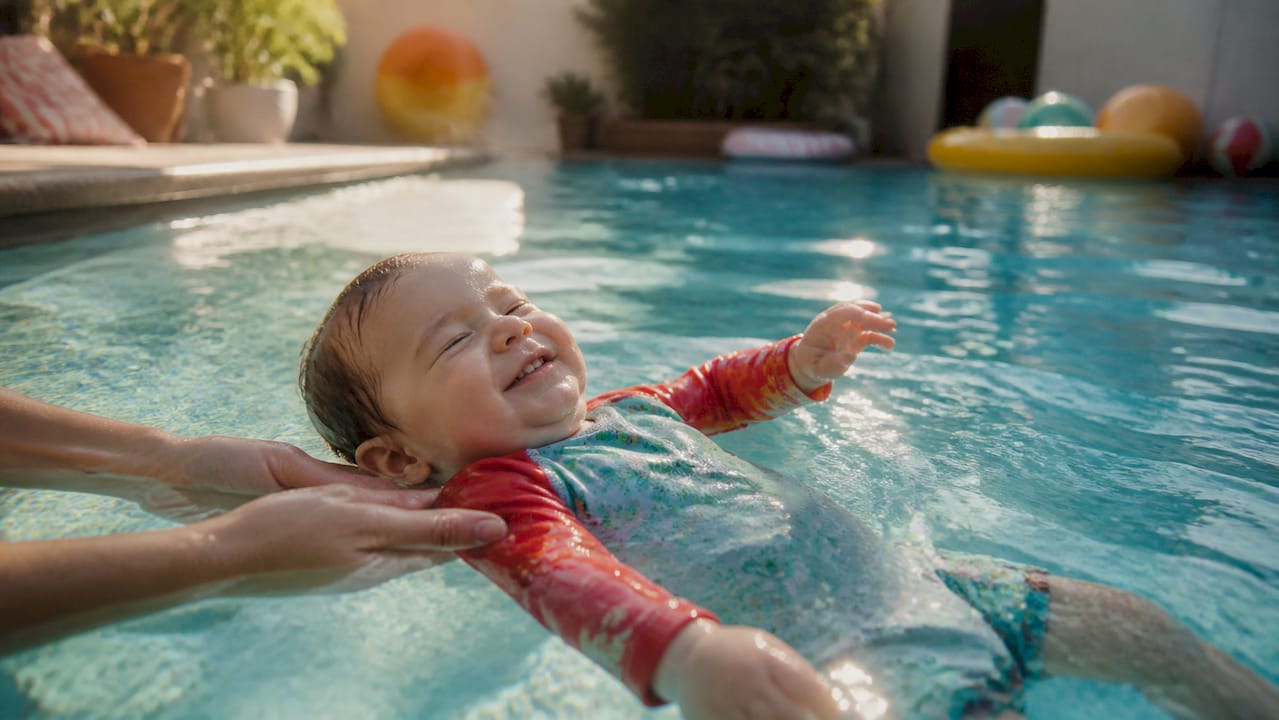
6–9 months: Focus is almost entirely on roll-to-back and breath control. Sessions are very short. The child is not expected to swim independently.
9–18 months: As core strength develops, children begin holding floats longer and tolerating more water on the face. Some begin a basic Swim–Float–Swim pattern.
After walking (roughly 12–18 months): Upright balance changes how children move in water. Programs adjust technique accordingly. Children at this stage often progress faster because they have more body awareness.
Ages 2–6: Children can learn full Swim–Float–Swim sequences, clothed entries, and edge-reaching skills. Progress becomes more measurable and parents often see visible competency within a few weeks of consistent lessons.
If your child has a developmental delay, sensory processing difference, or physical disability, ask the program directly about instructor experience with those needs. A qualified instructor adjusts cues, pacing, and entry methods rather than applying a one-size script. Parental patience matters here too: a child with sensory sensitivities may need several sessions just to tolerate water on their face before any survival skill can be introduced.
How are lessons structured, and how long does it take?
Survival swim programs look very different from a Saturday group class at the community pool. The table below reflects the typical format used in quality infant and toddler survival programs.
Short, frequent sessions typically outperform longer, less frequent ones for this age group, as repetition is key to making emergency responses automatic.
Initial competency, meaning a child can complete a roll-to-back float and hold it independently, often appears within two to four weeks of daily lessons. Full Swim–Float–Swim proficiency typically takes longer, depending on the child’s age and starting comfort level.
Maintenance lessons are not optional extras. Children’s bodies change rapidly, and a float technique that worked at 18 months may need recalibration at age 3. Many programs recommend seasonal refreshers or short top-ups after major developmental milestones. A well-structured swim curriculum builds those checkpoints in from the start.
What can lessons guarantee, and what can’t they?
This is the question every parent deserves a straight answer to: swim lessons reduce drowning risk. They do not eliminate it.
The American Red Cross frames this as a layers-of-protection model. No single layer is enough on its own:
Supervision: An adult within arm’s reach, watching actively, without distractions
Barriers: Pool fencing with a self-latching gate, door alarms, and covered drains
Life jackets: U.S. Coast Guard–approved life jackets for open water, boating, and lakes. Not floaties.
Swim lessons: Formal instruction in survival skills, maintained over time
On that last point about floaties: the CDC is explicit that arm bands and inflatable toys are not safety devices. They can slip off and create a false sense of security. A child who relies on floaties has not learned to float independently, which is the opposite of what survival swimming builds.
Natural water adds another layer of risk. CDC guidance on lakes, rivers, and oceans notes that currents, water quality, and limited visibility make open-water situations significantly more dangerous than a controlled pool. Life jackets and heightened supervision are non-negotiable in those environments, regardless of a child’s skill level.
Pro Tip: Practice “touch supervision” at the pool: stay within arm’s reach of your child at all times, phone face-down, and designate one adult as the dedicated watcher. Drowning is silent and fast — it does not look like the movies.
How do you choose a qualified self-rescue instructor?
Credentials matter more here than in most children’s activities. You are trusting someone with your child’s life-safety skill development.
Must-haves when evaluating a program:
CPR and First Aid certification for every instructor (see why this matters)
A documented survival-swim curriculum with staged progression goals
Experience with infants and toddlers specifically, not just school-age children
Private 1:1 lesson delivery, especially for children under 3
Measurable progress milestones communicated to parents regularly
Red flags to walk away from:
No documented instructor certification or vague answers about training
Group-first format for infants (one instructor cannot safely manage multiple non-swimmers under 2)
Progress described only in terms of “comfort” with no measurable skill benchmarks
Pressure to skip maintenance lessons once initial competency is reached
Six questions worth asking before you book:
What survival-swim certification does your instructor hold?
How do you handle a child who panics or refuses to enter the water?
What is the instructor-to-child ratio for my child’s age group?
How will you communicate progress to me, and how often?
Do you include clothed practice and simulated real-world entries?
What does your maintenance lesson schedule look like after initial competency?
Instructor qualifications are the single strongest predictor of whether a program will actually deliver survival-ready skills.
How Superheroswimacademy teaches self-rescue skills
Superheroswimacademy has taught over 2,500 children in Palm Beach and Broward counties using a survival-first curriculum built around the same principles described throughout this article. Every instructor holds CPR and First Aid certification and completes the academy’s own documented survival swim training before working with children independently.
Lessons are delivered in a private 1:1 format, which is the standard for infant and toddler survival instruction. Sessions are short and focused, typically around 10 minutes for the youngest learners, with daily frequency during the initial learning phase. Parents receive regular progress updates tied to specific, measurable goals, not general impressions.
The academy also offers parent-and-child sessions, concierge instruction at your home pool, and online courses for parents who want to reinforce skills between lessons. Instructor certification programs are available for professionals entering the field.
A typical infant enrolled at Superheroswimacademy moves from initial water tolerance to an independent roll-to-back float within the first weeks of daily lessons, with Swim–Float–Swim competency developing as strength and confidence build.
What the most important points come down to
Self-rescue swimming gives children a repeatable emergency script, not just water confidence. Lessons reduce drowning risk meaningfully, but only when paired with active supervision and physical barriers.
Point | Details |
Core skill to look for | Roll-to-back float and Swim–Float–Swim sequence, practiced in real-world conditions including clothing |
Best age to start | From around 6 months; earlier enrollment builds the habit and the skill before children are mobile near water |
Supervision rule | Adult within arm’s reach, watching actively, at all times — lessons do not replace this |
Lesson format that works | Private 1:1, short daily sessions initially, with measurable goals and regular parent updates |
Instructor must-haves | CPR/First Aid certified, documented survival-swim curriculum, experience with infants and toddlers |
Superheroswimacademy | Offers private 1:1 survival lessons in Palm Beach and Broward counties, with over 2,500 children taught and CPR-certified instructors |
The thing parents underestimate about water safety
Most parents who research self-rescue swimming are already doing the right thing. The worry is real, and it should be. What I see parents underestimate, though, is how quickly a survival skill fades without reinforcement. A child who floated beautifully at 18 months may struggle at age 3 if lessons stopped. Bodies change, buoyancy changes, and the neural pathways that make a skill automatic need repetition to stay sharp.
The other thing worth saying plainly: supervision is not a backup plan. It is the primary plan. Lessons make supervision easier because a child who panics less gives you more time to respond. But no lesson replaces an adult who is watching, close, and undistracted.
If you are in Palm Beach or Broward and want to get started, infant drowning prevention resources can help you think through the full safety picture before your first lesson.
Survival swim lessons in Palm Beach and Broward counties
Private 1:1 survival swim lessons for children who need real skills, not just water time. Superheroswimacademy serves families across Palm Beach and Broward counties with a concrete advantage over a general swim school: every lesson is built around emergency competency first, delivered by CPR and First Aid certified instructors who track measurable progress and report back to you after every session.
Services include private in-home lessons, parent-and-child sessions, small group classes in heated pools, and concierge instruction for families who want flexibility. Online courses are available for parents who want to reinforce skills at home, and instructor certification programs serve professionals entering the field.
Over 2,500 children taught. Every instructor certified. Every lesson goal-driven. Book a lesson with Superheroswimacademy and get your child started on the skills that actually matter near water.
This article is general information, not a substitute for advice from a qualified doctor. Consult a qualified healthcare professional about your own circumstances before acting on anything here.
Sources
Recommended
Comments