
Short Format Swim Lessons: What Parents Need to Know
- superheroswim
- 5 days ago
- 8 min read

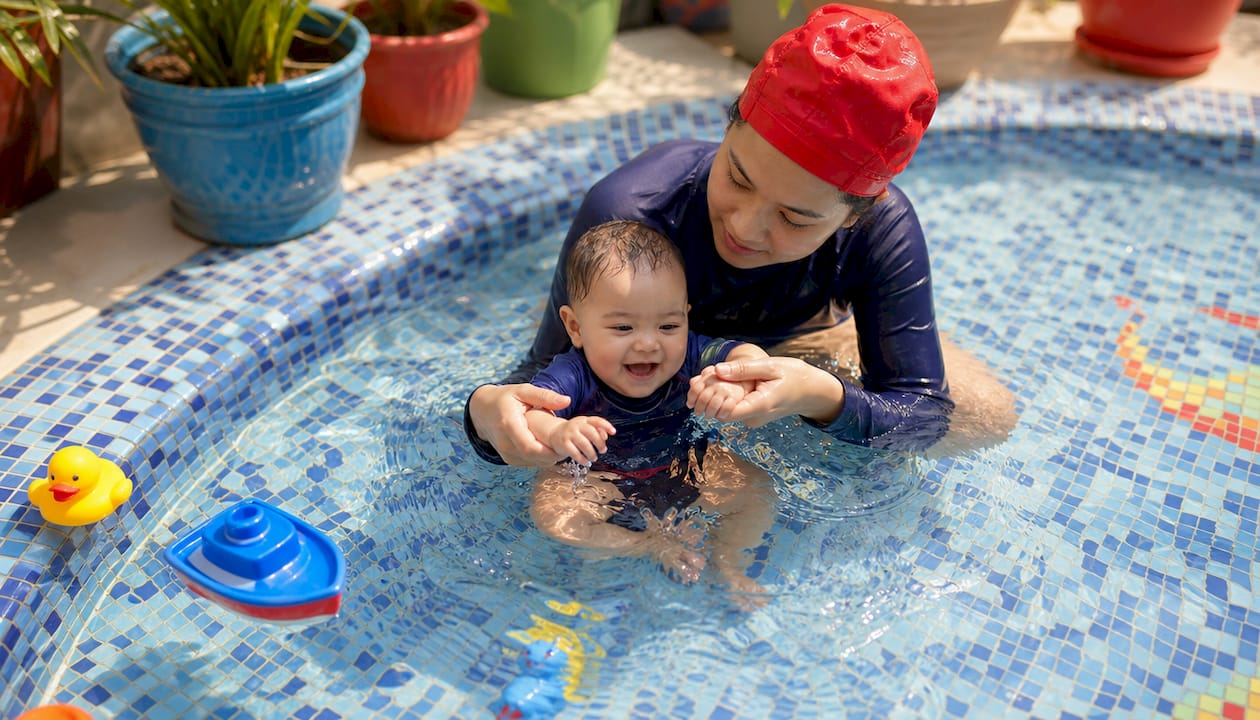
A short format swim lesson is defined as a 10–15 minute session held 4–5 times per week over a 4–6 week program, designed to build survival swimming skills through daily repetition rather than extended weekly exposure. This structure is not a trimmed-down version of a traditional class. It is a distinct teaching method built around how young children actually learn motor skills. Parents searching for effective swim lesson formats for busy schedules will find that this approach delivers faster skill retention with less physical strain on infants and toddlers. Superheroswimacademy has built its entire curriculum around this model, having taught over 2,500 children in Palm Beach and Broward counties using this intensive, safety-first format.
What is a short format swim lesson, and how does it work?
A short format swim lesson runs 10–15 minutes per session and repeats 4–5 days per week over a 4–6 week period. The goal is not stroke refinement or water play. The goal is survival. Instructors focus on self-rescue sequences, most notably the swim-float-swim technique, where a child learns to swim to a surface, roll onto their back to float and breathe, then continue swimming to safety.
The science behind this structure comes from motor learning research. Daily repetition creates stronger survival reflex consolidation than longer, infrequent sessions where skills fade between classes. Think of it like learning to ride a bike. Practicing for 10 minutes every day builds muscle memory far faster than one long session on Saturday. For infants and toddlers, that principle is even more pronounced because their nervous systems are actively forming new movement patterns.
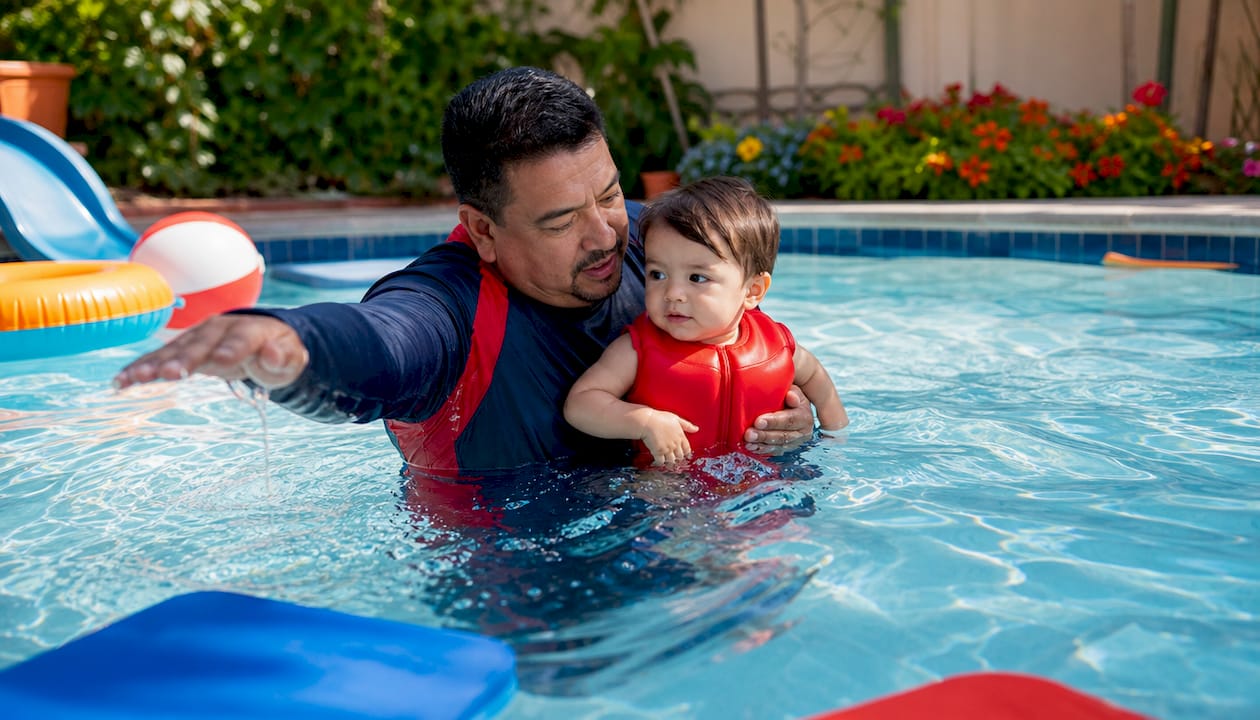
Practitioners note that 10–15 minute daily lessons leverage neuro-muscular repetition that traditional formats focused on water comfort or stroke mechanics simply cannot replicate. The short duration is not a limitation. It is the mechanism.
How short-format lessons differ from traditional swim classes
Standard weekly swim lessons typically last 30 minutes and meet once or twice per week. That structure works well for older children learning stroke technique, but it was not designed with infant physiology in mind. The 30-minute weekly format balances attention span and thermal tolerance for children who can already follow verbal instructions and regulate their body temperature more effectively.
Short-format swimming classes differ in three critical ways:
Duration: Sessions run 10–15 minutes instead of 30, protecting against thermal fatigue and physical exhaustion.
Frequency: Classes meet 4–5 times per week instead of once or twice, compressing the learning curve significantly.
Objective: The focus is survival and self-rescue, not stroke development or recreational comfort.
The table below shows the core structural differences at a glance.
Feature | Short-format lessons | Standard weekly lessons |
Session length | 10–15 minutes | 30 minutes |
Frequency | 4–5 times per week | 1–2 times per week |
Primary focus | Survival and self-rescue skills | Stroke technique and water comfort |
Typical program length | 4–6 weeks | Ongoing or semester-based |
Best age range | Infants and toddlers | Toddlers through school-age children |
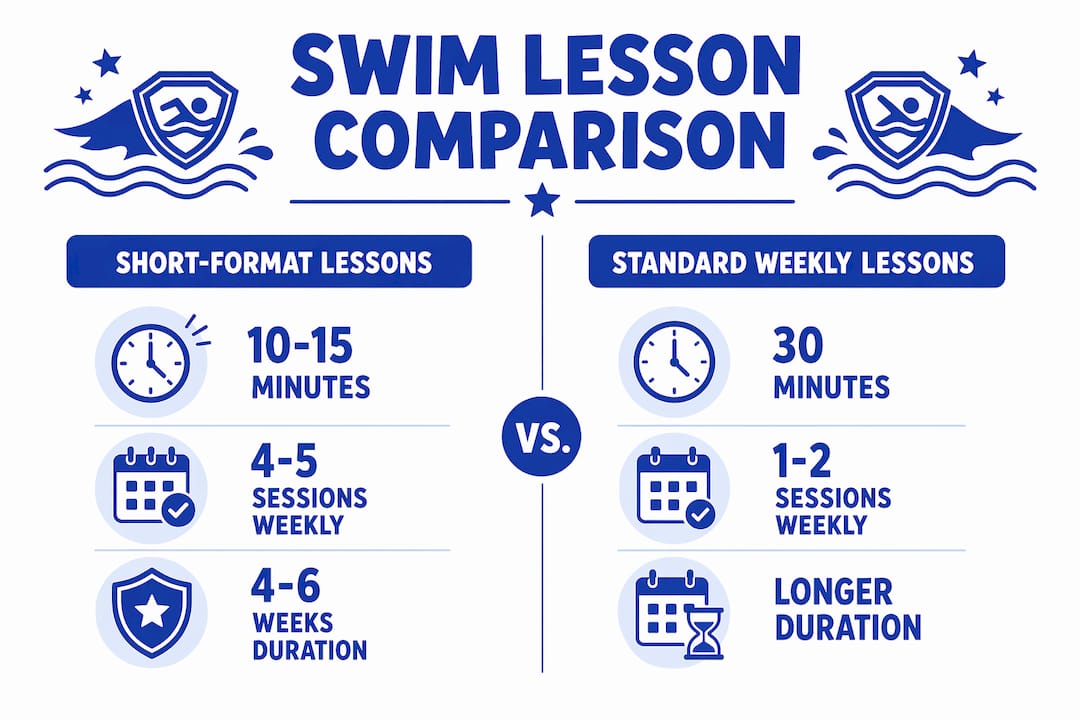
Experts advise parents to prioritize lesson frequency and structure over length, noting the 30-minute standard is not a rigid rule but an age-appropriate default. For very young children, shorter and more frequent is the stronger model.
What are the benefits of short swim lessons for infants and toddlers?
Short swim lessons produce faster results for young children because the brain consolidates motor skills during rest periods between sessions. When a toddler practices the same survival sequence five days in a row, each repetition reinforces the neural pathway laid down the day before. A once-weekly class gives that pathway six days to weaken before the next reinforcement arrives.
The physiological benefits are just as significant as the cognitive ones. Short lessons protect against hypothermia and fatigue better than longer sessions. Even in a heated pool, small children lose core body heat rapidly. A 10-minute session ends before that heat loss becomes a problem. A 30-minute session in the same pool can leave an infant cold, uncomfortable, and unable to focus.
Children taught through short, frequent lessons also tend to reach skill milestones faster. Survival sequences like swim-float-swim are typically mastered within 24–28 lessons, which maps directly onto a 4–6 week short-format program. That timeline is difficult to achieve with once-weekly classes.
Additional advantages of short format swimming classes include:
Reduced frustration: Repeated success in short bursts builds confidence more effectively than extended, fatiguing sessions.
Positive associations: Children end each session before exhaustion sets in, which supports a healthier relationship with water over time.
Parental engagement: Frequent sessions give parents more opportunities to observe progress and ask instructors questions.
Safety outcomes: Children who complete the full program develop reliable self-rescue reflexes, not just familiarity with water.
Pro Tip: Look for programs where instructors hold CPR and First Aid certification. A survival swim curriculum is only as safe as the instructor running it.
The American Academy of Pediatrics confirms that swim lessons are a crucial safety layer but do not replace the need for constant adult supervision. Short-format programs teach children to survive an accidental fall into water. Adult supervision prevents that fall from happening in the first place.
Common misconceptions about quick swimming lessons
The most common mistake parents make is measuring progress by how much their child enjoys the lesson. Short-format survival swim programs are not designed to be play sessions. They are designed to build life-saving reflexes. A child who cries during class but correctly executes a float-and-recover sequence is making real progress.
Parents should measure progress by skill consistency in survival sequences rather than by water play enjoyment. Initial resistance is normal and expected. Children’s adaptation to the water, the instructor, and the physical demands of swimming causes temporary distress that fades as the program continues.
Here are the four most common misconceptions parents bring into short-format programs:
“My child should love every lesson.” Adaptation involves discomfort. Crying during early sessions does not mean the program is wrong for your child.
“Progress means splashing and smiling.” Real progress is technical. Watch for consistent execution of the swim-float-swim sequence, not general water enthusiasm.
“Missing a day or two won’t matter.” Interruptions in the schedule reduce muscle memory consolidation. Completing the full 4–6 week program without gaps is critical to retaining skills.
“Shorter lessons mean less learning.” The opposite is true. The short duration is the reason the method works, not a compromise.
Pro Tip: Before enrolling, ask the program director how they communicate progress to parents. Clear milestone tracking between sessions is a sign of a well-structured curriculum.
Short, frequent lessons reduce frustration and build confidence through repeated success rather than extended, fatiguing sessions. The discomfort parents observe in early classes typically gives way to competence and calm within the first two weeks of consistent attendance.
How to choose and fit short-format lessons into a busy family schedule
Choosing the right program starts with three non-negotiable criteria: instructor qualifications, curriculum focus, and session frequency. An instructor should hold current CPR and First Aid certification at minimum. The curriculum should center on survival skills, not recreational swimming. And the program should meet at least four days per week to deliver the repetition that makes the format effective.
Scheduling five sessions per week sounds demanding, but most short-format programs run early morning or late afternoon slots specifically for working families. The swim lesson frequency required by this model is a feature, not a burden. Parents who treat it like a medical appointment rather than an extracurricular activity tend to complete programs at much higher rates.
Practical tips for fitting short-format classes into a full family calendar:
Block the weeks in advance. Treat the 4–6 week program as a fixed commitment before enrollment, not something to fit around other activities.
Choose a location close to home or work. A 10-minute lesson at a pool 40 minutes away creates unnecessary friction. Proximity matters for consistency.
Prepare your child before each session. A light snack 30–60 minutes before class and dry clothes ready at poolside reduce post-lesson stress for everyone.
Reinforce water safety at home. Teach children that pools, bathtubs, and open water require adult supervision at all times. In-home swim safety habits reinforce what instructors teach in the water.
Ask about makeup policies before enrolling. Programs with flexible makeup options protect your investment if illness or travel interrupts the schedule.
Short-format lessons are most appropriate for children from infancy through age four, when survival reflexes are most effectively trained and before formal stroke instruction becomes the priority. Early childhood education settings that incorporate water safety into their broader curriculum, such as programs at facilities like Elmhurst Premier Childcare, reflect the same principle: repetition and structure in early childhood produce lasting skills. The age-appropriate swim instruction window for survival swimming is narrow, and short-format programs are built to use it well.
Key Takeaways
Short-format swim lessons are the most effective structure for building survival skills in infants and toddlers because daily repetition consolidates motor memory faster than any weekly format can.
Point | Details |
Session structure | Lessons run 10–15 minutes, 4–5 days per week, over a 4–6 week program. |
Core skill focus | Programs teach survival sequences like swim-float-swim, not recreational stroke technique. |
Physiological design | Short sessions prevent thermal fatigue and physical exhaustion in young children. |
Progress measurement | Track skill consistency in survival sequences, not a child’s enjoyment or mood during class. |
Program completion | Skipping sessions breaks muscle memory consolidation; completing the full schedule is critical. |
What I’ve learned teaching survival swimming to young children
Parents often come to me expecting their child to love the water from day one. That expectation sets them up for unnecessary worry. The children who make the fastest progress are not the ones who splash happily in the first week. They are the ones whose parents show up every single day, even when the child cries, even when the schedule is tight.
What I have observed over years of working with infants and toddlers is that the short-format model works precisely because it does not give the brain time to forget. A child who practices a float on Monday still remembers it on Tuesday. By Friday, that float is becoming a reflex. Miss three days in a row, and you are essentially starting over. That is not a flaw in the child. That is how motor learning works at this age.
The detail parents most often overlook is supervision. Short-format lessons build real, measurable survival skills. But a child who has completed a full program still needs a watchful adult within arm’s reach near any body of water. Swim lessons and supervision are not interchangeable. They are layers of the same safety system. I tell every parent: the lesson teaches your child what to do if they fall in. Your eyes on them prevent the fall.
— SUPERHERO
Superheroswimacademy’s short-format programs for busy families
Superheroswimacademy offers survival swim lessons in Palm Beach and Broward counties built on the exact short-format model this article describes: brief, frequent sessions taught by instructors certified in CPR, First Aid, and the academy’s own survival swim curriculum.
Every child who enrolls receives a structured progression with clear milestones, and parents receive regular updates so they can track real skill development between sessions. With over 2,500 children taught, the results speak for themselves. Families looking for swim lessons near them can find current locations across both counties. Parents who prefer to start with foundational knowledge before enrolling can also access Superheroswimacademy’s online swim courses to understand the curriculum before their child’s first session. Visit Superheroswimacademy to see current program availability.
FAQ
What is a short format swim lesson?
A short format swim lesson is a 10–15 minute session held 4–5 times per week over 4–6 weeks, focused on teaching infants and toddlers survival and self-rescue skills like swim-float-swim through daily repetition.
How do short swim lessons compare to standard 30-minute classes?
Standard lessons run 30 minutes once or twice per week and focus on stroke development. Short-format lessons prioritize survival skills and use daily frequency to build muscle memory faster in very young children.
Is it normal for my child to cry during short-format swim lessons?
Yes. Initial resistance and crying are a normal part of the adaptation phase. Parents should measure progress by their child’s technical skill consistency, not by how much the child enjoys each session.
How many lessons does it take to see results?
Children typically master survival sequences like swim-float-swim within 24–28 lessons, which aligns with a complete 4–6 week short-format program attended consistently without interruption.
Do swim lessons replace adult supervision near water?
No. The American Academy of Pediatrics states that swim lessons are a critical safety layer but do not eliminate the need for constant adult supervision. Lessons and supervision work together as complementary defenses.
Recommended
Comments