
Why Infant Swim Lessons Start Early: a Parent's Guide
- superheroswim
- May 27
- 8 min read

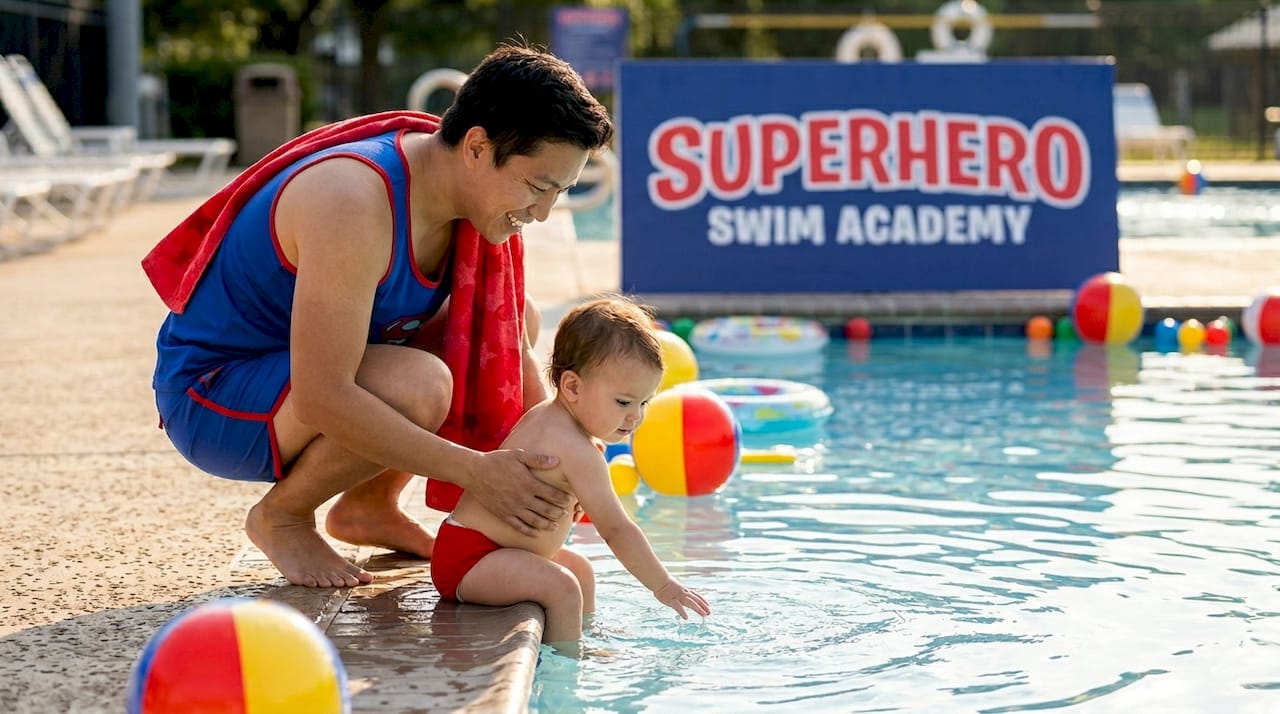
Many parents assume infant swim lessons exist to teach babies to swim independently. That belief, while understandable, misses the real reason why infant swim lessons start early. The first years of a child’s life are when water familiarity, motor patterns, and physical confidence take root. Starting lessons at the right time sets a foundation that grows with your child over years, not weeks. This guide breaks down what the experts actually recommend, what early lessons look like in practice, and how to make swimming one part of a smarter water safety plan.
Table of Contents
Key takeaways
Point | Details |
Start after age 1 | The American Academy of Pediatrics recommends formal swim lessons once a child turns 1 year old. |
Early lessons build comfort | Infant lessons focus on water familiarity and bonding, not independent swimming strokes. |
Lessons don’t replace supervision | Adult supervision and pool barriers must always accompany swim lessons as safety layers. |
Expect gradual progress | Skill development in young swimmers is non-linear and takes consistent practice over years. |
Use a layered safety approach | Combine lessons, pool fencing, safety rules, and close supervision for the strongest protection. |
Why early swim lessons matter: the expert timeline
One of the most common questions parents ask is when to start swim lessons. The answer from the American Academy of Pediatrics is clear. The AAP recommends formal lessons starting at age 1, because this is when children become mobile enough that drowning risk increases significantly. Drowning is a leading cause of accidental death among children ages 1 to 4, which makes this window both urgent and critical.
There is an important distinction most parents don’t realize: there is no evidence that lessons before age 1 reduce drowning incidents. Babies under 12 months lack the physical coordination and cognitive development to respond to water emergencies, even after lessons. This is not a reason to skip early water exposure entirely. It is a reason to understand what those early lessons are actually designed to accomplish.
Here is what expert guidance consistently emphasizes for the first years of swim education:
Physical readiness matters. Infants need enough neck strength and muscle control to safely participate in water activities.
Emotional readiness counts too. A child who is distressed by water will not absorb skills as effectively as one who approaches it with curiosity.
Layers of protection are non-negotiable. No lesson, at any age, replaces a watchful adult or a locked pool gate.
“Swim lessons are one important layer of protection, but they should never be seen as a substitute for close adult supervision.” — American Academy of Pediatrics guidance via HealthyChildren.org
The goal of early lessons is not to produce a swimmer by the child’s second birthday. It is to start the relationship between your child and water on the best possible terms.
Benefits of early swim lessons beyond drowning prevention
Understanding the benefits of early swim lessons means looking past the safety headlines. Yes, water safety is the primary driver. But parents who enroll infants in structured water programs often report meaningful gains that have nothing to do with stroke technique.
Early swim lessons help infants develop spatial awareness, body coordination, and comfort with physical challenge. Being supported in water activates a baby’s balance systems in ways that land-based play simply cannot replicate. These motor benefits carry over into everyday movement milestones.
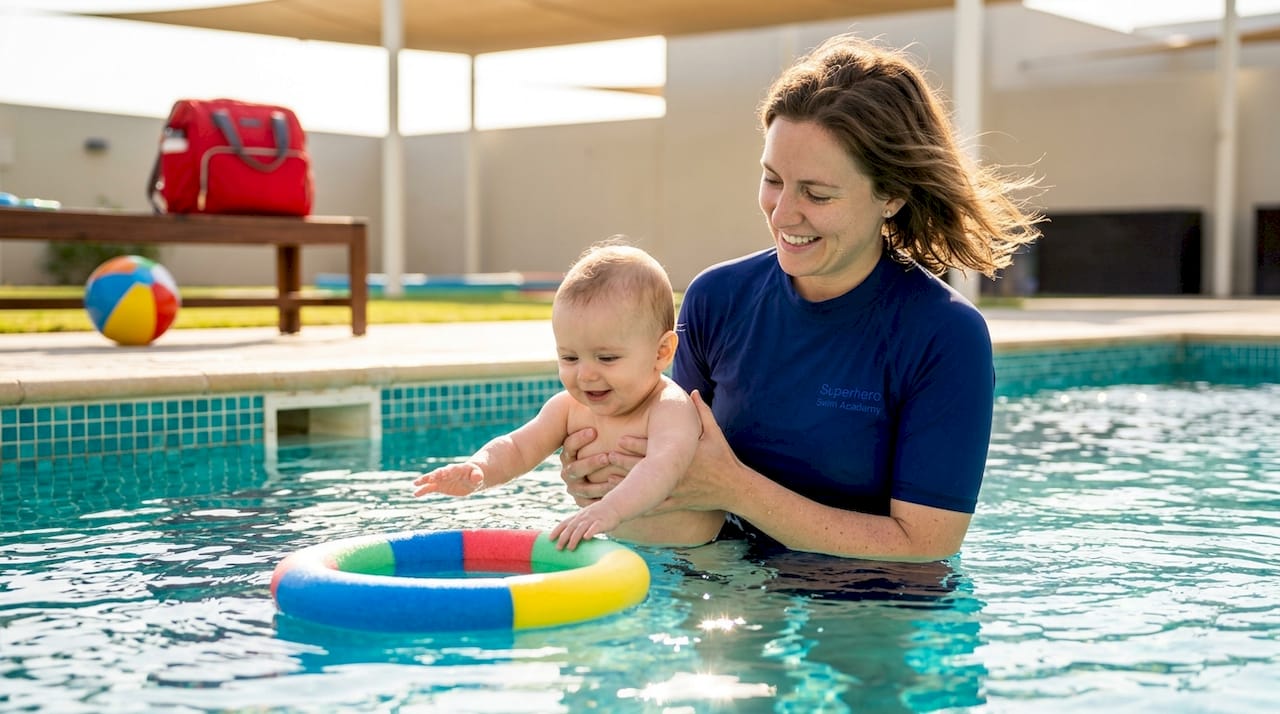
There is also the bonding factor. Parent-infant swim classes are specifically designed to strengthen the caregiver-child relationship. Getting in the water together, making eye contact, responding to each other’s cues, these interactions build trust. Water familiarization promotes bonding and positive associations with swimming that can last a lifetime.
Consider what happens when a child grows up fearful of water. That fear is harder to reverse at age 6 than it is to prevent at age 1. Early exposure, done gently and positively, shapes how a child feels about swimming for decades.
Pro Tip: If your infant seems resistant or fearful during early lessons, do not push through distress. Speak to your instructor about pacing the sessions differently. Fear responses that are ignored early can become deeply ingrained avoidance behaviors later.
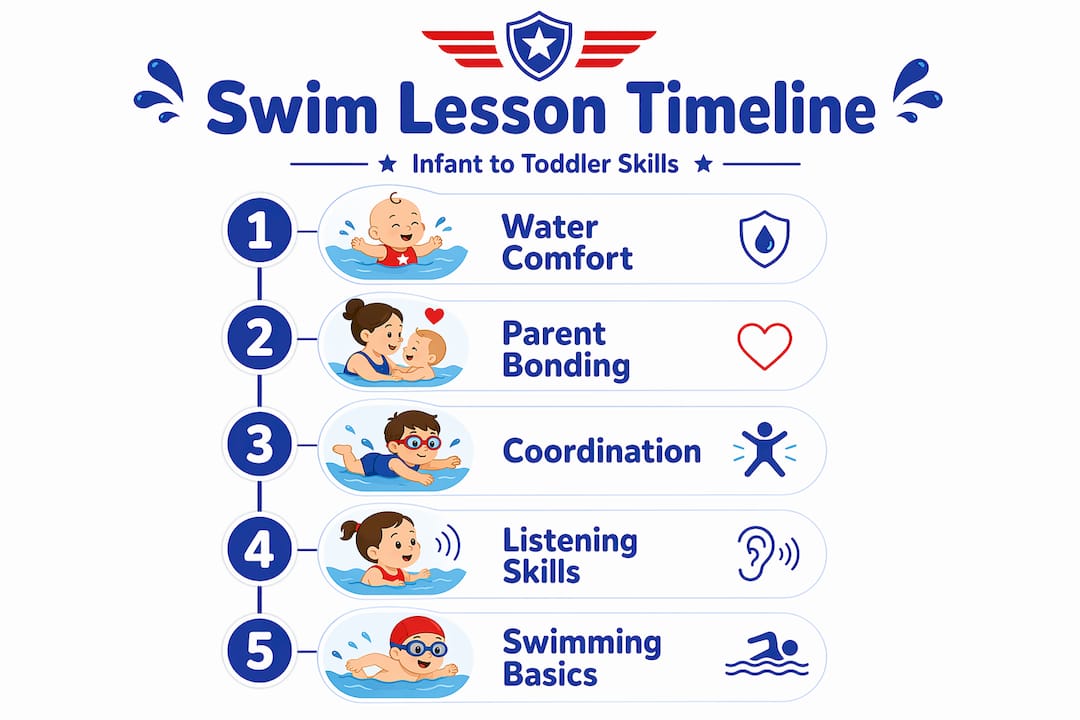
The structured learning environment of a swim class also introduces something underrated: the concept of listening to an adult in a non-home setting. Infants begin to understand that pool-side instructions have meaning. That listening habit becomes a safety asset as children grow older and start swimming more independently.
What early swim lessons actually look like
Parents sometimes show up to an infant swim class expecting to watch their baby do laps. The reality is both more modest and more meaningful than that. Early swim lesson skills focus on foundational water safety rather than formal strokes. Here is the typical progression for lessons starting around age 1:
Water entry and exit. Learning how to safely get in and out of the pool, including practicing reaching for the pool edge.
Breath control introduction. Simple activities that teach infants to hold their breath when water touches their face.
Floating practice. Supported back floats build comfort with being horizontal in water, a critical survival skill.
Responding to cues. Children learn to stop, listen, and respond to instructor or caregiver prompts.
Reaching for the wall. Practicing how to move toward the pool edge is one of the earliest real survival behaviors.
Here is an honest comparison of what to expect at different infant swim lesson ages:
Age range | Typical focus | What parents see |
6 to 12 months | Water exposure and comfort | Baby tolerates and enjoys water play with caregiver |
12 to 18 months | Entry, exit, floating, cues | Baby begins responding to simple instructor direction |
18 to 24 months | Edge reach, breath intro | Baby starts reaching for wall and practicing holds |
2 to 3 years | Building on all prior skills | Child begins more structured sequences with instructor |
Progress can feel invisible for weeks, and then suddenly your child does something that shows all the repetition is landing. Swim skill development is gradual and non-linear, especially in the first year. The lesson is not wasted when a baby cries through part of it. The exposure still counts.
Common pitfalls when starting swim lessons early
Starting lessons early is a smart decision. Starting them with the wrong expectations can unravel that decision faster than you think.
The most common trap is expecting swimming competence too soon. Parents often overestimate their infant’s swimming readiness. When progress feels slow, some families pull back from lessons or stop entirely during the toddler years. That dropout pattern is one of the most preventable problems in early swim education.
A few pitfalls to actively avoid:
Treating swim lessons as drowning insurance. Lessons reduce risk. They do not eliminate it. A child who can float and reach for the wall still needs an adult within arm’s reach every time they are near water.
Stopping lessons after a good phase. Stopping lessons too early can stall skill development right before a child hits a major readiness window, often around age 4.
Choosing lessons based on cost alone. Instructor quality, class size, and program structure matter more than finding the lowest price. Learning how to vet an instructor before you enroll saves you frustration later.
Skipping lessons during seasonal gaps. Water skills fade without practice. Taking the winter off every year adds cumulative regression that families often don’t notice until summer starts.
Pro Tip: Set lesson attendance goals the same way you set pediatrician appointments. Treat them as non-negotiable health checkpoints, not optional enrichment activities.
Water safety works best when it is treated as a year-round commitment, not a summer project.
Building a layered water safety strategy
Swim lessons are the most visible part of water safety. They are not the whole picture. Real protection comes from stacking multiple layers, each one catching what the others might miss.
Here is what a layered water safety plan looks like in practice:
Touch supervision. This is the layer most parents underestimate. Touch supervision means staying within arm’s reach of a young child near water at all times, not watching from across the yard with a phone in hand.
Pool fencing. A four-sided fence with a self-latching gate around a home pool is one of the most proven structural barriers available.
Water safety rules. Teach children that they never enter the pool without an adult present. Start this rule as early as possible and enforce it consistently.
Emergency response knowledge. Every caregiver in your child’s life should know CPR. This is not optional. It is part of caring for a child who is around water.
Consistent lesson enrollment. Structured swim programs build water awareness and safety rules alongside physical skills.
Safety layer | What it does | Who is responsible |
Swim lessons | Builds physical skills and water comfort | Qualified instructor and parent |
Active supervision | Prevents emergencies in real time | Parent or caregiver |
Pool fencing | Creates physical barrier to unsupervised access | Homeowner or facility |
CPR training | Provides emergency response capability | All adults in the child’s life |
Water safety rules | Sets behavioral expectations around water | Parent and consistent enforcement |
The importance of swim education as a life skill grows stronger when it is surrounded by these other protections. No single layer works on its own.
My honest take on early infant swim lessons
I’ve worked with thousands of families at Superhero Swim Academy, and the pattern I see most often is this: parents come in either expecting too little or expecting too much. The ones expecting too little think they should wait until their child “is ready.” The ones expecting too much think a few lessons will make their toddler water-safe by summer.
What I’ve learned is that the truth sits in between. Early swim lessons are genuinely valuable. They are not magic. The families who see the strongest results are the ones who show up consistently, stay engaged during sessions, reinforce water rules at home, and treat lessons as the start of a years-long commitment rather than a seasonal fix.
I’ve also seen what happens when parents treat lessons as a substitute for supervision. It is the most heartbreaking mistake in this space, and it is preventable. No single method prevents drowning. The lessons build the foundation. Your presence and vigilance protect the child who is still building it.
My advice: start lessons at or around age 1 as the AAP recommends, choose an instructor with real safety training, and never let a good lesson day lower your guard at the pool. The combination of early aquatic skills and consistent adult attention is what actually moves the needle on water safety.
— SUPERHERO
Ready to take the next step with Superhero Swim Academy?
At Superheroswimacademy, every infant and toddler lesson is built around the survival swim curriculum that has helped over 2,500 children become safer, more confident swimmers in Palm Beach and Broward counties. Every instructor is trained in CPR, First Aid, and our own proven program, so you know your child is in qualified hands from lesson one.
Parents receive regular progress updates and clear goals so you always know where your child stands. Whether you are searching for lessons near you or want to explore flexible online courses that fit your schedule, Superheroswimacademy has a pathway designed for your family. Visit Superhero Swim Academy to explore programs and take the first real step toward raising a safer swimmer.
FAQ
When should infants start swim lessons?
The American Academy of Pediatrics recommends starting formal swim lessons after a child’s first birthday, when increased mobility raises drowning risk most significantly.
Can swim lessons prevent drowning in babies under 1?
There is no evidence that swim lessons before age 1 reduce drowning incidents. Lessons for infants under 12 months focus on comfort and bonding rather than survival responses.
What skills do infant swim lessons teach?
Early lessons typically cover safe water entry and exit, supported floating, reaching for the pool edge, and responding to instructor cues. These are foundational survival skills, not formal strokes.
How long does it take to see progress in infant swim lessons?
Progress is gradual and non-linear. Some children show visible improvement within weeks, while others take months of consistent sessions. Stopping lessons too early is one of the biggest barriers to long-term skill development.
Do swim lessons replace the need for supervision?
No. Swim lessons are one layer of water safety. Active touch supervision, pool fencing, and CPR-trained adults must always accompany lessons to create real protection for young children near water.
Recommended
Comments