
Why Qualified Swim Instructors Matter for Child Safety
- superheroswim
- 6 days ago
- 8 min read

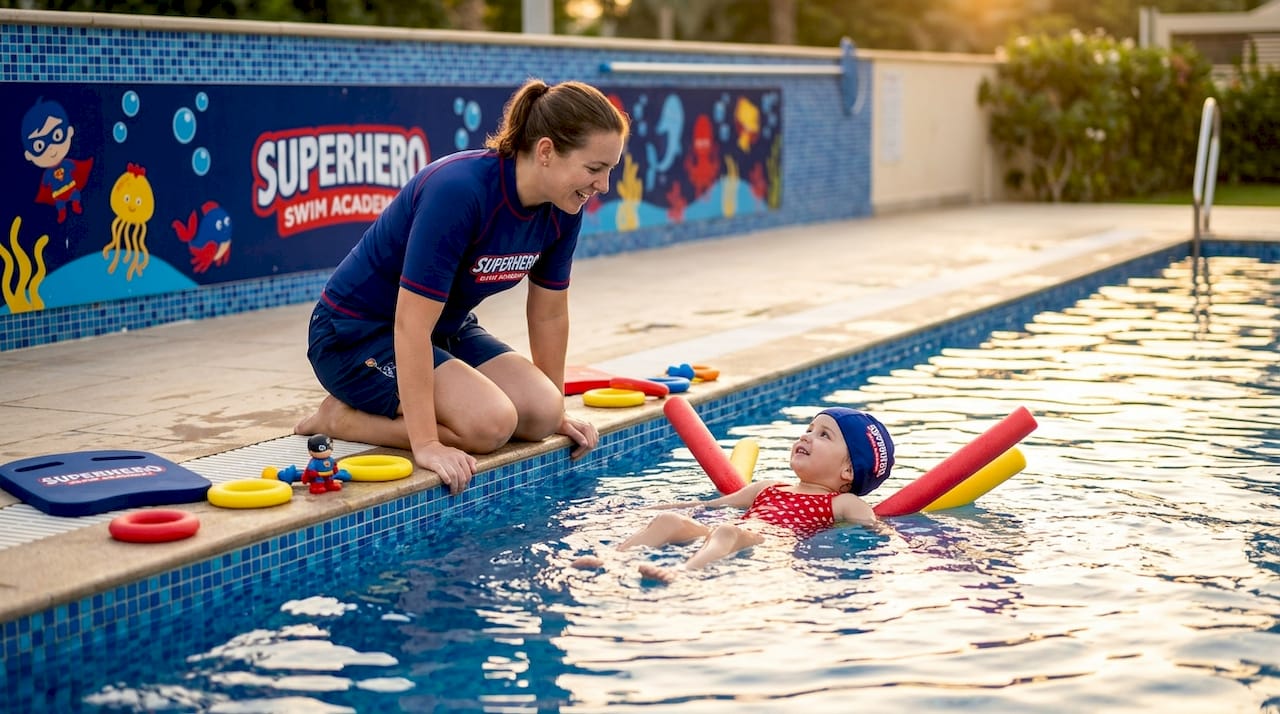
A qualified swim instructor is defined as a certified professional trained not only to teach swimming technique but also to recognize water distress, respond to emergencies, and enforce safety behaviors that protect children’s lives. For parents enrolling a child in swim lessons, understanding why qualified swim instructors matter is the difference between a lesson that builds real safety and one that only builds false confidence. Drowning is the leading accidental death for children under four in the United States. That single fact makes instructor certification not a preference but a requirement. The American Academy of Pediatrics (AAP), the CDC, and HealthyChildren.org all point to qualified instruction as a frontline drowning prevention tool.
Why qualified swim instructors matter more than you think
Most parents picture a swim instructor as someone who teaches a child to kick and breathe. The reality is far more demanding. A certified instructor’s duties blend active coaching with constant safety monitoring, distress recognition, and emergency action readiness. That combination requires formal training that casual swim teaching simply does not provide.
What certification actually covers
Recognized qualifications, such as the STA Level 2 Swimming Teacher award, require instructors to demonstrate competence in teaching methodology, poolside supervision, and emergency response before they ever lead a class. The STA’s updated standards are designed to unify instructor competence across the sector so that employers and parents can trust a qualification on sight. At Superheroswimacademy, every instructor completes CPR, First Aid, and the academy’s own survival swim curriculum before teaching a single child.
Certification covers skills that go well beyond stroke mechanics:
Silent submersion recognition: Children can slip underwater without splashing or calling out. Qualified instructors are trained to spot this within seconds.
Active distress monitoring: Watching for fatigue, panic, or disorientation during drills, not just at the end of a lap.
Emergency response protocols: Knowing exactly how to act when a child needs help, including when to enter the water and when to call for backup.
Inclusive teaching adaptation: Adjusting methods for children with different learning needs, anxiety levels, or physical abilities.
Pro Tip: When vetting an instructor, ask specifically which emergency certifications they hold and when those certifications were last renewed. A current CPR card is a non-negotiable baseline.
A common misconception is that any strong swimmer can teach children safely. Swimming ability and teaching ability are separate skills. Safety supervision is a third skill entirely. Qualified instructors hold all three.
How certified instructors reduce drowning risk beyond stroke skills
Stroke technique gets a child from one end of the pool to the other. Safety behavior keeps a child alive when no adult is watching. Qualified instructors teach reflex-like habits such as always asking permission before entering water and never swimming alone. These behaviors become automatic through repetition, which is exactly how certified instructors structure their lesson plans.
A systematic review published in 2025 found that water safety training improves children’s knowledge and behaviors around water and may reduce drowning mortality. The key variable was pedagogy. Instructors who applied evidence-informed teaching methods produced better safety skill acquisition than time in the pool alone. This means the quality of instruction, not just the quantity of lessons, determines how safe a child becomes.
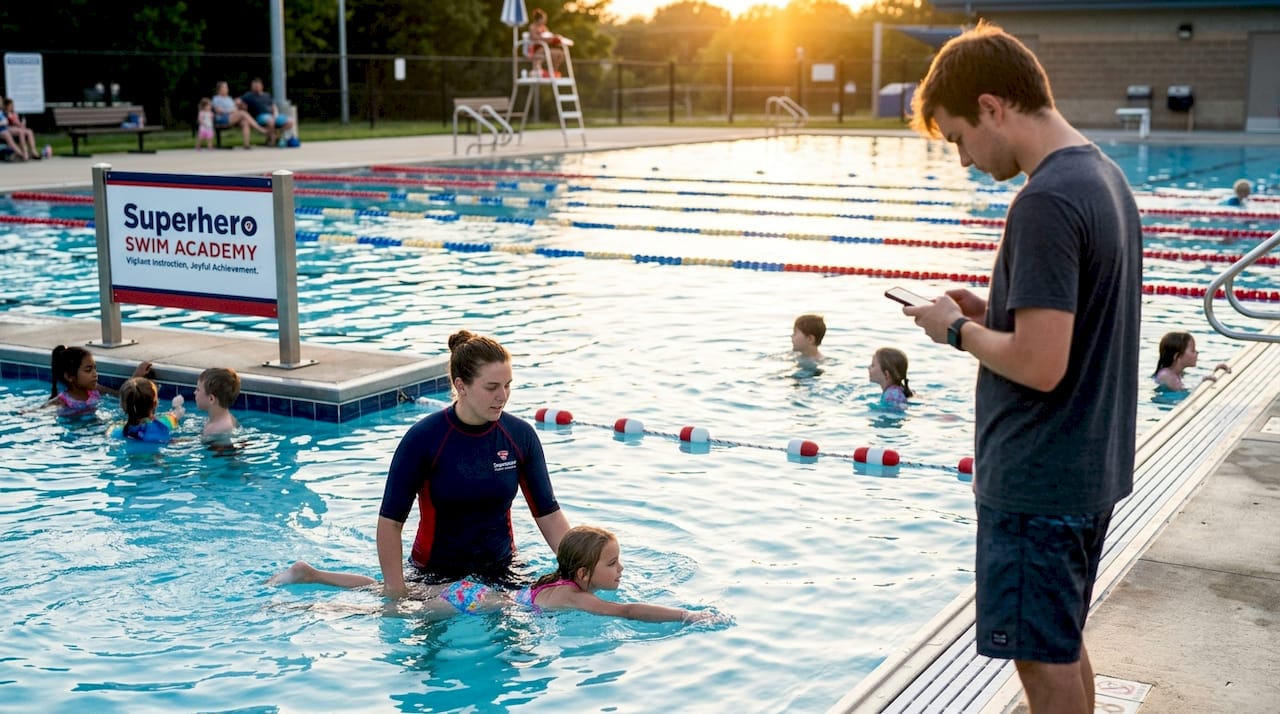
During lessons, qualified instructors also maintain what the AAP calls “touch supervision.” This means being within arm’s reach of young children in the water, not watching from the pool deck.
“Supervision is not passive watching from a distance. For infants and toddlers, it means being physically close enough to intervene instantly.” — HealthyChildren.org (AAP)
Parents play a role here too. The AAP is clear that swim lessons do not replace adult supervision. Even during a certified lesson, a parent’s active physical presence near the water adds a second layer of protection. Knowing what in-home swim safety involves helps parents understand exactly what their role looks like during and after lessons.
Key safety behaviors that certified instructors build into every lesson:
Entering the pool only with adult permission
Floating on the back as a self-rescue position
Calling for help rather than attempting to rescue another swimmer
Recognizing pool edges, drains, and depth markers as hazards
Why early instruction by certified teachers is critical for infants and toddlers
Drowning is the leading accidental death for children under four. That statistic carries a specific implication: the window for early intervention is short, and the stakes are highest precisely when children are least able to protect themselves. Certified instructors who specialize in infant and toddler swimming understand developmental readiness and teach age-appropriate safety responses from the very first lesson.
One of the most dangerous misconceptions parents hold is that a child who is comfortable in water is a child who is safe in water. Certified instructors are trained to correct this misunderstanding directly. Comfort without skill creates false confidence. A toddler who loves splashing in the bathtub has no instinct to float, call for help, or reach for a wall if they fall into a pool.
Age Group | Key Safety Skill Taught | Why It Matters |
Infants (6 to 12 months) | Back float and breath control | Buys time for adult rescue |
Toddlers (1 to 3 years) | Wall grab and water exit | Reduces panic and submersion time |
Preschool (3 to 5 years) | Self-rescue float and swim to wall | Builds independent emergency response |
Early school age (5 to 7 years) | Stroke technique plus safety rules | Combines skill and behavior for real-world safety |
Early lessons also build water familiarity in a controlled, supervised setting. Children who start young with certified instructors develop a healthy respect for water rather than either fear or recklessness. For parents considering when to start, the guide to early infant swim lessons at Superheroswimacademy explains the developmental science behind starting before age one.
Pro Tip: Look for programs that set specific, measurable goals for each lesson rather than vague “water comfort” objectives. Concrete milestones like “child can float unassisted for 10 seconds” are signs of a structured, certified curriculum.
Qualified vs. non-certified instructors: what the difference looks like in practice
The gap between a certified instructor and an uncertified one is not just a piece of paper. It shows up in how lessons are structured, how emergencies are handled, and how much a parent can trust what their child is learning.
Regulated qualifications standardize teaching competence and safety protocols across the entire instructor workforce. When a qualification is recognized and regulated, it means the instructor has been assessed against consistent, evidence-based standards. An unregulated or informal instructor may be an excellent swimmer with good intentions and still lack the training to recognize silent submersion or respond correctly in an emergency.
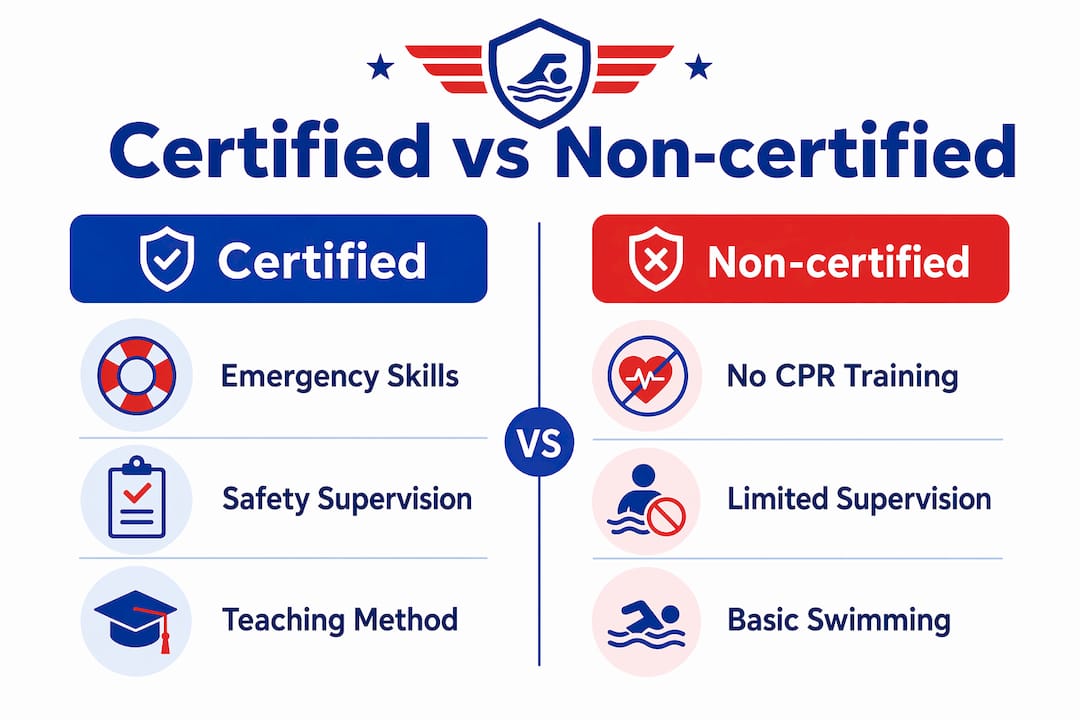
Factor | Qualified instructor | Non-certified instructor |
Emergency response | CPR and First Aid certified, trained in water rescue | No formal emergency training |
Distress recognition | Trained to spot silent submersion and fatigue | Relies on visible signs only |
Teaching methodology | Evidence-based, age-appropriate curriculum | Informal, experience-based only |
Safety rule enforcement | Structured protocols for pool entry and behavior | Inconsistent, instructor-dependent |
Parent confidence | Verifiable credentials and regulated standards | No external verification available |
The risk with non-certified instruction is not just lower skill outcomes. It is the absence of a safety net. A certified instructor who spots a child in distress has a practiced response. An uncertified instructor is improvising. For parents who want to vet an in-home swim instructor before booking, checking for current CPR certification, a recognized teaching qualification, and a structured curriculum are the three non-negotiable checkpoints.
Key takeaways
Qualified swim instructors reduce drowning risk by combining certified teaching methodology, active safety supervision, and emergency preparedness in every lesson.
Point | Details |
Certification goes beyond strokes | Qualified instructors are trained in distress recognition, silent submersion, and emergency response. |
Early lessons save lives | Drowning is the leading accidental death for children under four; certified early instruction addresses this directly. |
Pedagogy determines outcomes | Evidence-informed teaching methods produce better safety skill acquisition than pool time alone. |
Touch supervision is non-negotiable | Parents must stay within arm’s reach during lessons, especially for infants and toddlers. |
Credentials are verifiable | Regulated qualifications give parents a concrete way to confirm instructor competence before lessons begin. |
What I’ve learned after teaching over 2,500 children to swim
Parents sometimes ask me whether certification really makes a difference or whether it is just a formality. My honest answer is that I have seen what happens when it is missing, and it is not a formality.
The most dangerous moment in a swim lesson is not when a child is struggling visibly. It is the two seconds before anyone realizes a child is in trouble. Qualified instructors are trained to catch those two seconds. That training comes from structured programs, not from years of recreational swimming or good intentions.
I also see a pattern with parents who choose informal instruction because it is cheaper or more convenient. Their children often develop water comfort without water safety. They splash happily, they enjoy the pool, and they have no idea what to do if they go under unexpectedly. That gap is exactly what certified instruction is designed to close.
One more thing I want parents to know: your presence matters even when a qualified instructor is in the water. The AAP’s guidance on touch supervision exists because drowning does not wait for an instructor to turn around. Stay close, stay engaged, and treat the lesson as a team effort between you, your child, and the instructor.
— SUPERHERO
Swim lessons your child can trust at Superheroswimacademy
Superheroswimacademy was built on one principle: every child who enters the water deserves an instructor who is trained to keep them safe. Every instructor at the academy holds current CPR and First Aid certification and completes the academy’s own survival swim curriculum before teaching. The program has guided more than 2,500 children toward safer, more confident swimming in Palm Beach and Broward counties. Parents receive clear lesson goals and regular progress updates so they always know exactly what their child is learning and why. Whether you are enrolling an infant or a school-age child, find a location near you or explore the full range of certified swim programs available today.
FAQ
What makes a swim instructor “qualified”?
A qualified swim instructor holds recognized certifications in teaching methodology, CPR, and First Aid, and is trained to recognize water distress and respond to emergencies. Regulated qualifications like the STA Level 2 Swimming Teacher award provide a verifiable standard that parents and employers can check.
At what age should children start swim lessons with a certified instructor?
The AAP supports swim lessons for most children starting at age one, and some programs like Superheroswimacademy work with infants as young as six months. Early certified instruction teaches age-appropriate survival skills during the highest-risk developmental window.
Can a strong swimmer teach children safely without certification?
Swimming ability does not equal teaching ability or safety supervision competence. Certified instructors are specifically trained in distress recognition, emergency response, and evidence-based pedagogy, skills that recreational swimming experience does not provide.
How do qualified instructors prevent drowning during lessons?
Certified instructors maintain active poolside supervision, practice touch supervision for young children, and are trained to spot silent submersion within seconds. They also teach reflex-like safety behaviors such as floating on the back and always swimming with a buddy.
How can parents verify an instructor’s qualifications before enrolling?
Ask for the instructor’s current CPR and First Aid certification dates, the name of their teaching qualification, and whether that qualification is regulated by a recognized body. A structured, goal-based curriculum is an additional sign of professional training.
Recommended
Comments