
Why Swim Lesson Packages Save Time for Busy Parents
- superheroswim
- Jul 17
- 8 min read


Swim lesson packages are pre-paid sets of lessons that lock in your child’s schedule, cut per-session costs, and deliver faster skill results than booking one lesson at a time. The American Academy of Pediatrics endorses consistent, structured swim instruction as a core safety measure, and research shows that formal swim lessons can reduce drowning risk in young children by up to 88%. That number means one thing clearly: consistency saves lives, and packages make consistency easy. Understanding why swim lesson packages save time starts with recognizing that bundled lessons remove the weekly decision-making, protect your preferred time slot, and put your child on a faster path to water safety.
Why swim lesson packages save time more than single bookings
The biggest time drain in single-session booking is not the lesson itself. It is the weekly cycle of checking availability, registering, paying, and hoping your preferred slot is still open. Prepaid packages cut that administrative loop entirely. You book once, and your child’s spot is protected for the full package duration.
Parents who manage busy family schedules know that every repeated task compounds. Rescheduling one lesson might take five minutes. Doing that 20 times over a school year costs nearly two hours of mental energy and calendar management. Packages eliminate that friction at the source.
The swim lesson efficiency gain is not just about convenience. It is structural. When your child’s lesson is already on the calendar every Tuesday and Thursday, attendance becomes a habit rather than a weekly negotiation. Habit-driven attendance is the single most reliable predictor of a child reaching swim competence on schedule.
How consistent scheduling in packages accelerates skill development
Children attending lessons twice weekly reach basic swimming competence in 50% less calendar time than children attending once weekly, using only 20–30% more total lessons. That means 30 lessons over 15 weeks outperforms 35–40 lessons spread over 35–40 weeks. The child learns faster, and the parent’s total time commitment is shorter.
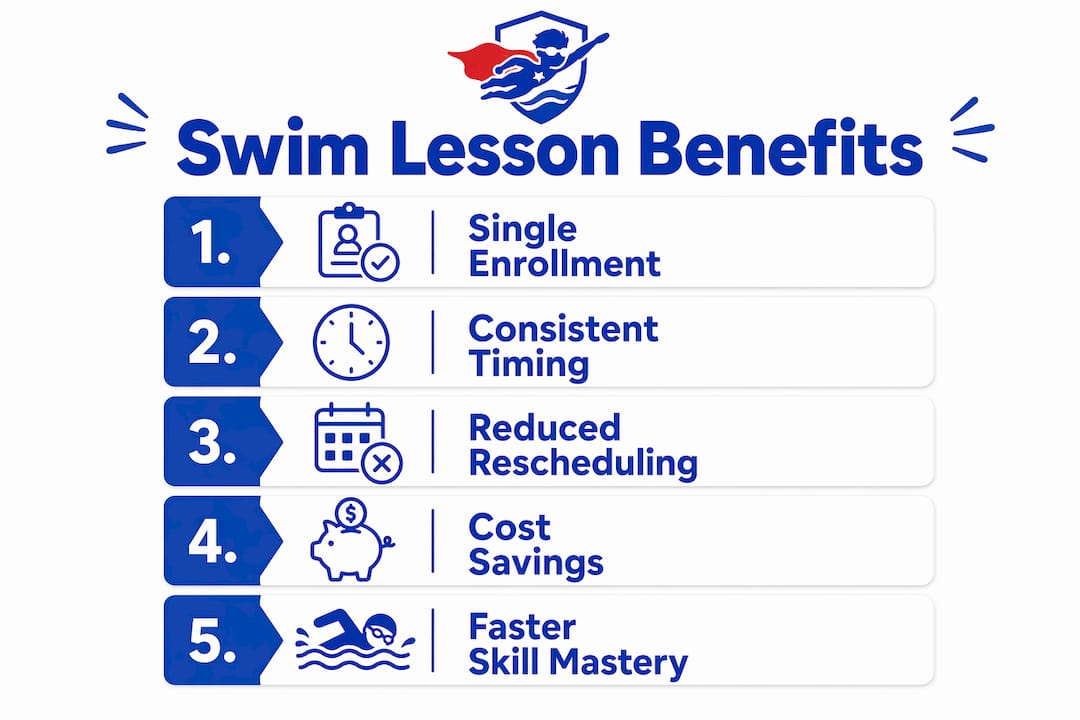
Motor learning science explains why. Young children’s brains consolidate physical skills during sleep. Short, frequent practice sessions give the nervous system more consolidation cycles than one long weekly lesson. Distributed practice produces better skill retention in young swimmers than longer, infrequent sessions, and 30-minute lessons match both a child’s attention span and their thermal tolerance in the water.
Packages protect this frequency. Without a package, a single scheduling conflict, a holiday, or a full class can push a lesson back by two or three weeks. Those gaps matter. Breaks longer than 4–8 weeks lead to measurable skill regression in young swimmers. Package enrollment holds your slot so your child keeps moving forward.
Pro Tip: When evaluating a package, count the lessons per week, not just the total number of lessons. A 20-lesson package spread over 10 weeks delivers faster results than the same 20 lessons spread over 20 weeks.
Key benefits of consistent package scheduling include:
Protected time slots that prevent gaps caused by seasonal demand
Predictable weekly routines that reduce a child’s anxiety about the water
Faster motor skill consolidation through repeated short sessions
Fewer total calendar weeks to reach swim safety milestones
Reduced parental effort spent on rebooking and schedule management
Do swim lesson packages actually cost less?
Purchasing a swim lesson package reduces per-session cost by 10% to 30% compared to paying for individual lessons. The exact discount depends on the volume purchased, the instructor level, and the program location. A larger package typically unlocks a deeper discount.
The more useful calculation is “total cost to proficiency.” This means adding up every dollar you spend until your child reaches a defined skill level. Evaluating total cost to proficiency rather than per-lesson rate often reveals that packages with a higher upfront cost produce a lower total investment because the child reaches competence faster and needs fewer lessons overall.
Single-session booking feels cheaper in the moment. Over a full year of swim education, it rarely is. The combination of higher per-lesson rates, scheduling gaps that cause regression, and the extra lessons needed to recover lost ground adds up quickly.
Factors that influence how much you save with a package:
Volume purchased: Larger packages carry steeper per-lesson discounts
Instructor type: Certified survival swim instructors often deliver faster results, reducing the total lessons needed
Lesson frequency: Twice-weekly packages reach milestones faster, lowering total spend
Location and program: Programs in high-demand areas like Palm Beach and Broward counties fill quickly, making package enrollment more valuable for slot protection
Lesson format: Private packages require fewer sessions to mastery; group packages offer lower per-lesson rates with peer learning benefits
How do packages fit better with busy family schedules?
Single-session booking puts the scheduling burden on you every single week. You check the calendar, find a slot, register, and pay. Then you do it again next week. For parents managing school pickups, sports practices, and work schedules, that recurring task is a real cost.
Swim lesson bundles solve this by moving scheduling from a weekly task to a one-time decision. You choose your days and times at enrollment, and those slots belong to your child for the package duration. That single decision replaces dozens of micro-decisions across the school year.
Year-round or near-year-round packages offer an additional advantage. Near-year-round scheduling with planned short breaks of one to three weeks blends consistency with family flexibility. Your child retains skills through the year, and you keep the preferred time slot without losing it to another family during a seasonal gap.
Pro Tip: If your family travels regularly, ask your program about makeup lesson policies before purchasing. Many packages allow a limited number of makeup sessions, which preserves your investment without disrupting your child’s progress.
Packages also reduce the mental load of swim lesson time management. When the lesson is already scheduled and paid for, it moves from “something I need to arrange” to “something that just happens.” That shift in how parents think about lessons is small but meaningful across a full year.
What lesson format inside a package works best?
The format of lessons within a package changes how fast a child progresses and how motivated they stay. Private lessons give one instructor’s full attention to one child. That focus accelerates technical skill development and is especially effective for children who need extra confidence in the water. Private lesson packages require fewer sessions to reach mastery, which makes them cost-effective when you calculate total cost to proficiency.
Group lessons work differently. Children learn by watching each other attempt skills, succeed, and try again. This peer modeling is a genuine learning mechanism, not just a social bonus. Group lessons enhance motivation through peer modeling, and that observational learning accelerates progress in ways that private instruction alone cannot replicate. The same dynamic appears in other group learning formats for young children, including group music classes for toddlers, where social observation drives skill acquisition faster than isolated practice.
A mixed approach captures both benefits. Many families start with a private package to build foundational water safety skills, then transition to a group package to build confidence and social motivation. The right choice depends on the child’s age, temperament, and current skill level.
A numbered framework for choosing the right package format:
Assess water comfort first. Children with strong water anxiety benefit most from private packages where the instructor can move at the child’s pace.
Match lesson length to age. Children under five do best with 30-minute lessons. Longer sessions reduce focus and increase cold-water fatigue.
Check lesson frequency best practices for your child’s age group. Twice-weekly packages are the standard recommendation for children ages two through six.
Consider a mixed package. Some programs offer packages that combine private and group sessions, giving children technical instruction and peer motivation in the same enrollment period.
“The most effective swim packages are not the longest or the most expensive. They are the ones that match lesson frequency and format to how young children actually learn: in short, repeated bursts with peers and a consistent instructor.”
Key Takeaways
Swim lesson packages save time because they replace weekly scheduling decisions with a single enrollment, protect lesson slots, and put children on a faster path to water safety through consistent, frequent instruction.
Point | Details |
Packages cut scheduling time | One enrollment replaces dozens of weekly registration tasks across a full year. |
Twice-weekly lessons reach goals faster | Children achieve swim competence in 50% less calendar time with twice-weekly lessons versus once-weekly. |
Packages lower total cost | Per-session savings of 10%–30% plus faster mastery reduce the total investment to reach proficiency. |
Slot protection prevents regression | Package enrollment holds preferred time slots and prevents skill-eroding gaps of four or more weeks. |
Format choice shapes outcomes | Private lessons accelerate technical skill; group lessons add peer motivation. Mixing both maximizes results. |
What I’ve learned after teaching over 2,500 children to swim
Parents often ask me whether a package is really worth it, or whether they should just try a few single lessons first. My honest answer is that the “try a few first” approach almost always costs more time and money in the end.
Here is what I see repeatedly: a child starts with two or three single lessons, makes good progress, then misses three weeks because the family couldn’t get a slot. By the time they return, the child has regressed. The parent pays for recovery lessons before any new skills are added. The total lesson count climbs, and so does the total cost.
Packages prevent that cycle. When a child’s slot is protected and the lessons run on a consistent schedule, the progress is visible and steady. Parents report noticing real improvements within a short period, not because the lessons are magical, but because the frequency is doing exactly what motor learning science predicts it will do.
The parents who get the most from swim education are the ones who treat it like a school subject, not a drop-in activity. A package is the structural commitment that makes that mindset real. It removes the weekly decision, protects the investment, and keeps the child moving forward.
— SUPERHERO
Swim lesson packages at Superheroswimacademy
Superheroswimacademy serves families across Palm Beach and Broward counties with survival swim packages designed for infants, toddlers, and young children. Every instructor holds CPR and First Aid certification and follows the academy’s proven survival swim curriculum.
Parents receive regular progress updates so they always know where their child stands and what comes next. With over 2,500 children taught, Superheroswimacademy has built a track record of measurable results in a short time. Explore swim lesson packages to find the schedule and format that fits your family, and give your child the water safety foundation they need.
FAQ
Why do swim lesson packages save time compared to single sessions?
Packages replace weekly scheduling, registration, and payment tasks with a single enrollment decision. That one-time commitment protects your child’s lesson slot and removes recurring administrative effort across the full package period.
How many lessons per week should a young child have?
Twice-weekly lessons are the research-backed standard for children ages two through six. Children attending twice weekly reach basic swim competence in 50% less calendar time than those attending once weekly.
Do swim lesson packages cost less per lesson?
Packages typically reduce the per-session cost by 10% to 30% compared to single-session rates. Larger volume packages and programs with high instructor expertise tend to offer the steepest discounts.
What happens if my child misses a lesson in a package?
Most programs offer a limited number of makeup sessions within a package period. Ask about the makeup policy before enrolling to understand how absences are handled without losing the value of your investment.
Are private or group packages better for young children?
Private packages accelerate technical skill development through one-on-one instruction. Group packages add peer modeling, which boosts motivation and observational learning. A mixed approach, starting private then moving to group, often delivers the best overall results.
Recommended
Comments