
How to Document Infant Swim Development Milestones
- superheroswim
- Aug 5
- 11 min read

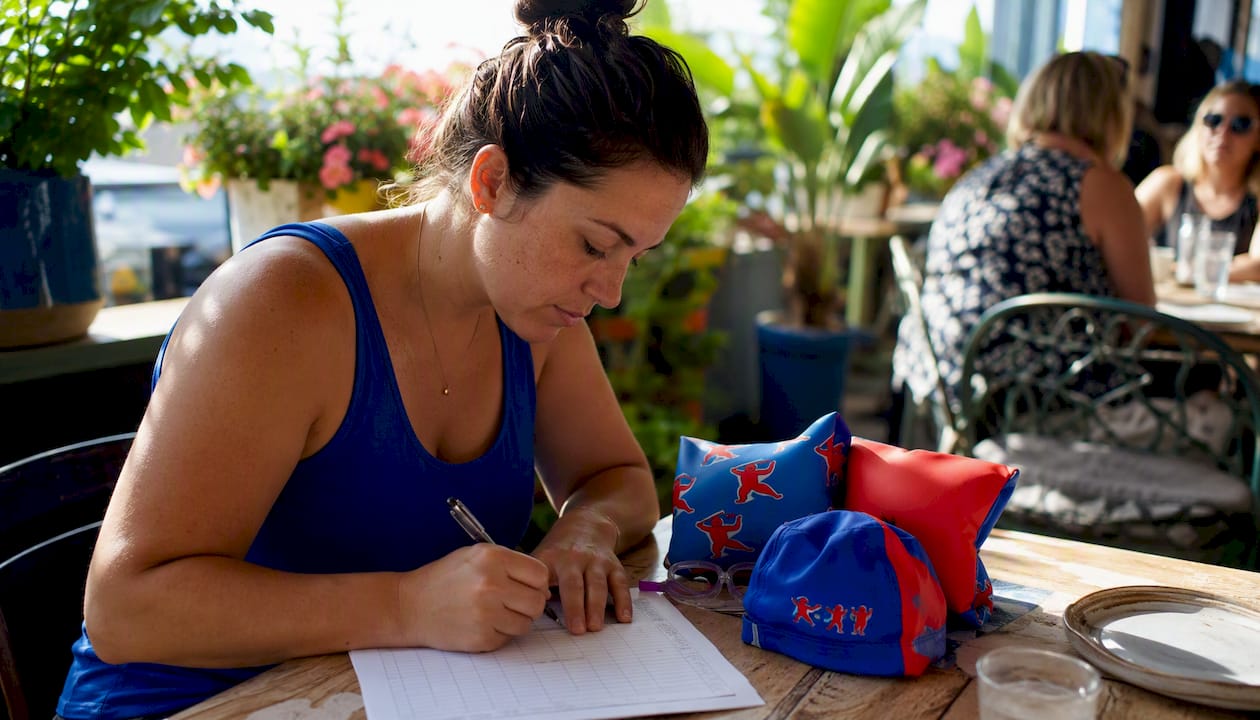
To document infant swim development milestones effectively, record the observable behavior, the exact date and time, the pool environment, who was present, and one objective metric — such as seconds afloat or number of successful rolls — every single session. That combination turns vague impressions into data instructors can actually use.
Impressions fade. “She did great today” tells you nothing six weeks from now. Objective notes like “rolled front-to-back on first cue, face clear for 4 seconds, 2 out of 3 attempts” give you a baseline, show real progress over time, and flag regressions before they become setbacks. Three organizations anchor the evidence behind this approach: the American Academy of Pediatrics (AAP), which frames swim lessons as one protective layer among several; the Infant Swimming Resource™ (ISR), which defines survival-first skill anchors for infants; and Superheroswimacademy, which builds parent engagement and progress reporting into every lesson package.
What to log at minimum, every session:
Observable behavior: Describe the action in plain terms (“floated on back unassisted,” “blew bubbles on cue”).
Objective metric: Time in seconds, number of successful attempts out of total tries, or distance in feet.
Environment: Pool type (indoor/outdoor, heated), water temperature if known, and lesson format (private, group, parent-and-child).
Who was present: Instructor name and credentials, parent/caregiver name.
Short note: Any deviation from the norm — startle response, refusal, exceptional calm.
Table of Contents
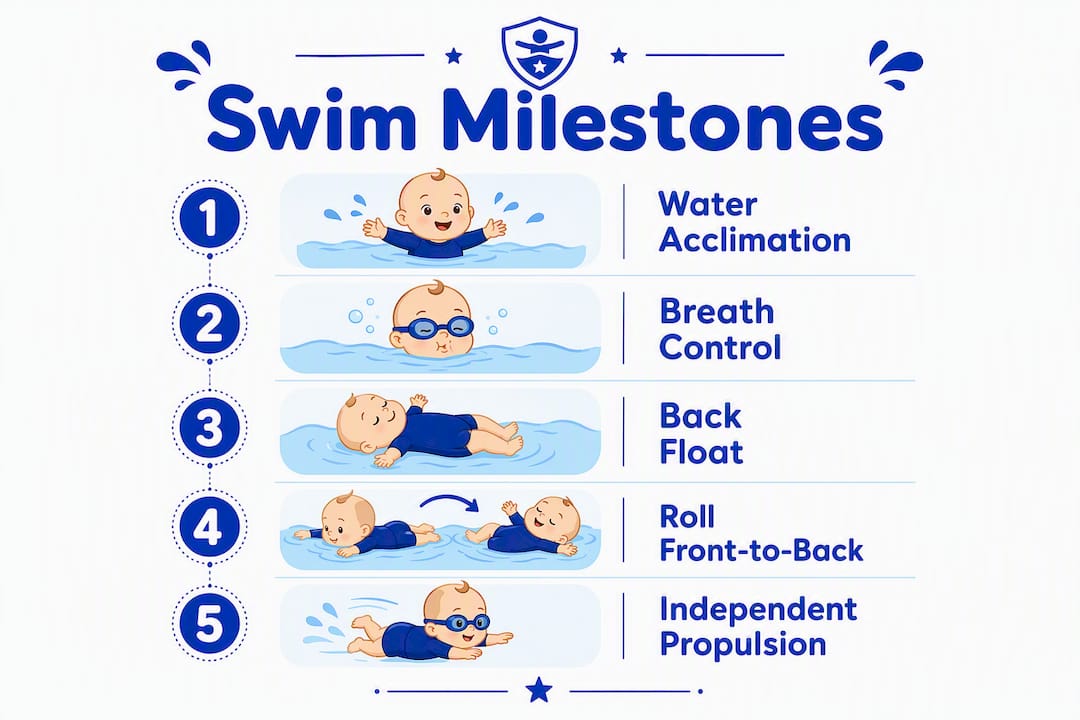
Age bands and what to log at each stage
Infant swimming development does not follow a single clock. The timeline below reflects typical observable ranges, not rigid deadlines. Lesson consistency, instructor quality, and a child’s individual temperament all shift when skills appear. Use these bands as a logging baseline, not a report card.
Age Band | Typical Observable Skills | What to Log |
— | Water acclimation, calm response to water on face, supported float with head control | Date of first water contact, reaction (calm/startle), seconds of supported float, head position |
6 to 12 months | Breath awareness (holds breath briefly), supported back float, early submersion tolerance | Duration of supported float, submersion tolerance (seconds), cue response (yes/no), number of attempts |
12 to 24 months | Assisted roll front-to-back, brief independent back float, basic kick | Roll success rate (X of 3 attempts), seconds of independent float, kick cadence (continuous/intermittent) |
24 to 48 months | Independent back float, roll-to-breathe on cue, early propulsion toward edge | Float duration (seconds), roll-to-breathe on first vs. second cue, distance propelled (feet), edge reach (yes/no) |
The AAP recommends that many children can begin lessons around age 1, while noting that swim lessons alone are not sufficient protection for very young children. Supervision remains non-negotiable at every age.
ACFASP consensus research reinforces that individual developmental markers — balance, voluntary breath control, and the ability to follow simple instructions — are better readiness signals than age alone. Aquatic skills can be acquired across a wide window from roughly 18 to 60 months, with meaningful individual variability throughout. That range is why logging specific behaviors matters more than logging age.
A few things that shift timelines parents often overlook:
Lesson frequency: Weekly lessons produce faster consolidation than bi-weekly or seasonal-only schedules.
Instructor quality: A progression-based curriculum with personalized feedback shortens the gap between first attempt and reliable performance.
Temperament: A child who startles easily may spend more sessions in the acclimation band before moving forward — that is normal and worth noting in the log.
For a deeper look at how structured curricula move children through these bands, the swim curriculum guide for parents breaks down what progression-based instruction actually looks like session to session.
Core skills to track and the subtle signs that show progress
Breath control and submersion response
The observable behavior: the child holds breath or blows bubbles when face enters water, without gasping or distress. Log whether the response is voluntary (on cue) or reflexive, how many seconds the breath is held, and whether the response is consistent across three separate sessions.
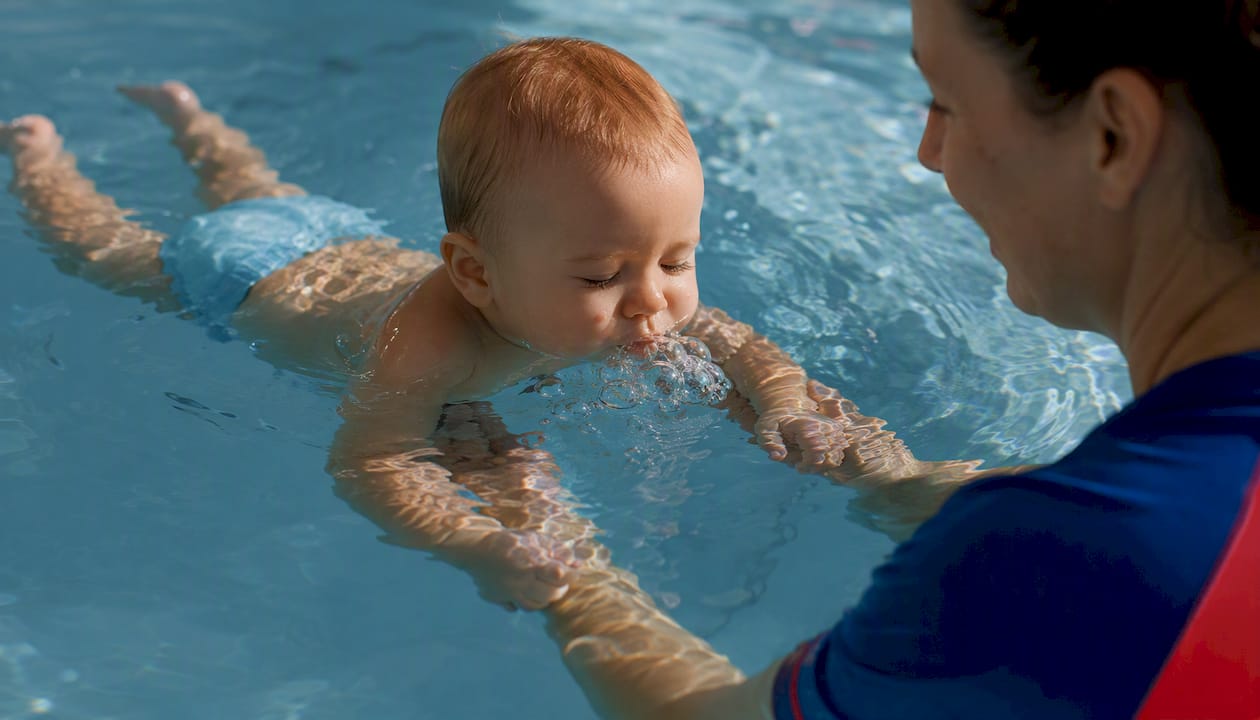
Subtle indicators before full mastery: blinking rather than squinting when water touches the face, reduced startle response to water on the forehead, and willingness to lean forward toward the water.
Supported and independent back float
Survival-first programs treat the passive roll-back-to-float as the single most life-saving infant milestone. Forward propulsion comes later, once trunk strength and walking-stage coordination develop. Log the duration of the float in seconds, the degree of support (full hand under back, fingertip only, unassisted), and whether the child’s ears are submerged and face is clear.
Subtle indicators: relaxing the neck rather than lifting the head, arms drifting to the side rather than grabbing, and reduced leg sinking over successive sessions.
Roll front-to-back
Log: roll initiated on first cue vs. second cue, time from initiation to face-clear position, and success rate across three attempts in one session. A child who completes the roll on the first cue in 2 of 3 attempts is not yet at the “does reliably” threshold—aim for 3 of 3 across two separate sessions before marking it mastered.
Independent propulsion and swim-to-edge
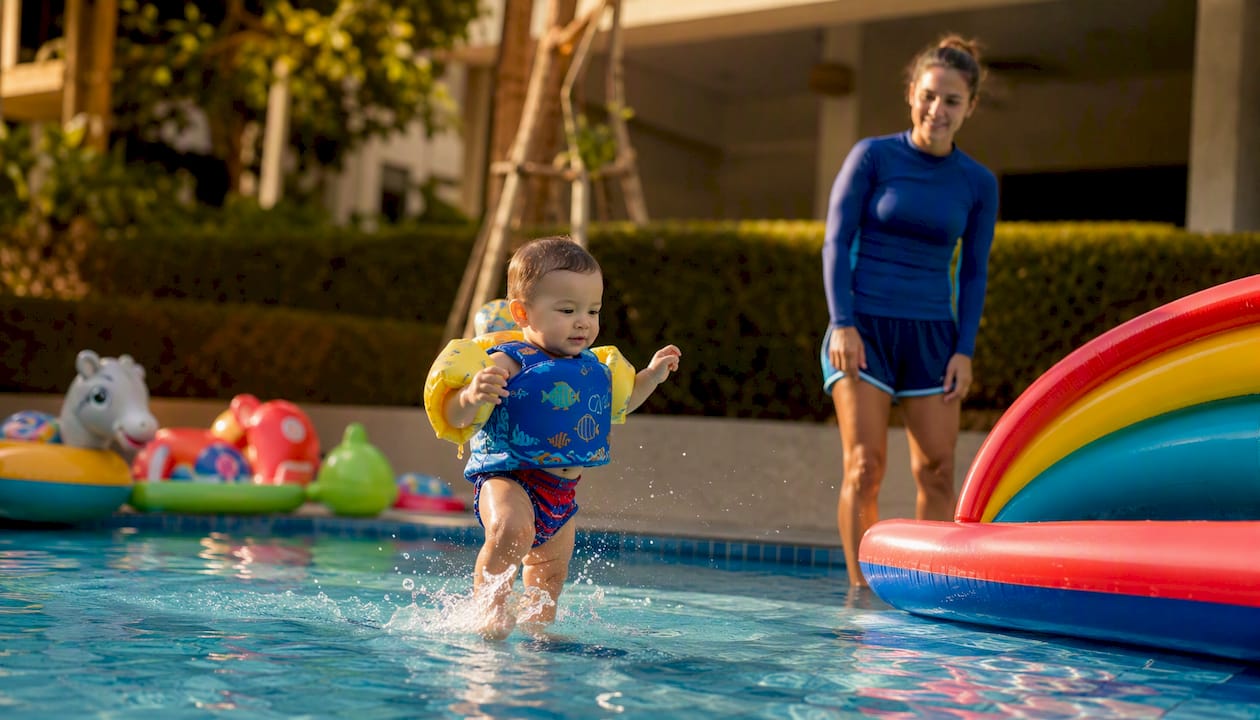
Log distance in feet, number of strokes or kicks before stopping, and whether the child orients toward the exit or wall independently. Orientation-to-exit is its own sub-skill: a child who can propel but swims away from the edge has not yet completed this milestone.
The “can do once” vs. “does reliably” distinction
This is where most parent logs fall short. A single successful roll is exciting; it is not a milestone. A printable milestone checklist approach recommends dating a skill only after observing it three separate times across different sessions. Record the date of each observation, not just the first.
Pro Tip: When logging subtle progress indicators — like reduced startle or improved neck relaxation — note them in a “soft skills” column separate from the main skill log. Instructors use these notes to adjust technique cues before the formal milestone is attempted.
How to document progress: templates, video, and a sample log
The core log template
Every session entry needs seven fields. Keep them short and factual.
Field | What to Record | Example |
Date / Time | Full date, start time | March 14, 2026 |
Skill attempted | Plain-language skill name | Roll front-to-back |
Objective metric | Seconds, attempts, distance | 2 of 3 attempts, face clear 3 sec |
Environment | Pool type, temperature | Heated indoor pool |
Instructor | Name and credential | Jane D., ISR-trained, CPR/First Aid certified |
Notes | Deviations, mood, context | Slight startle on first attempt; calm on second |
Media file | File name or timestamp | 2026-03-14_roll_attempt2.mp4 |
Video and photo best practices
Short, steady clips beat long shaky ones. Aim for 15–30 seconds per clip, shot from the pool deck at water level when possible, capturing the full action from start to finish. Name every file with the date and skill (2026-03-14_backfloat.mp4) so you can sort them chronologically without opening each one. Timestamp is automatic on most phones — leave it on.
For instructor review, a video documentation approach that captures both the attempt and the immediate follow-up (the child’s reaction after the skill) gives instructors the context they need to adjust cues.
Pro Tip: Film from a fixed position rather than following the child with the camera. A stable, wide shot showing the whole action is far more useful for instructor feedback than a close-up that cuts off the moment the roll completes.
Making observations reliable
Watch the skill attempted at least three times across separate sessions before marking it as observed.
Log missed sessions — note the date and reason (illness, travel). Gaps matter for interpreting regression.
Use the same objective measure each time. If you logged “3 seconds afloat” in session one, log seconds in every subsequent session, not “a long time.”
Record the number of successful attempts out of total tries, not just whether it happened.
Note environmental changes (new pool, different instructor, cold water) that might affect performance.
When to begin lessons and what safety rules to document
Readiness signals beyond age
ACFASP consensus is clear: individual developmental markers are better readiness criteria than a birthday. Before starting lessons, parents should check:
Can the child follow a simple one-step instruction?
Does the child sit independently with reasonable balance?
Is the child free of active ear infections or open wounds?
Has the pediatrician cleared the child for water activity?
Does the child show curiosity rather than extreme fear around water?
A readiness checklist can help parents organize these observations before the first evaluation.
The AAP position on lessons and supervision
“Swim lessons can be an important part of a drowning prevention strategy for many children. However, even children who have had swim lessons can drown. There is no substitute for constant adult supervision near water.” — HealthyChildren.org (AAP)
Lessons are one protective layer. They do not replace a four-sided fence with a self-latching gate, a pool alarm, or a designated water watcher who is not distracted by a phone. Document these safety measures alongside swim progress — they are part of the same record.
Instructor credentials to log
Record these before the first lesson and update if the instructor changes:
ISR-trained or equivalent survival-swim certification
Current CPR certification (adult and pediatric)
Current First Aid certification
Years of experience with infants specifically
Program affiliation and curriculum framework
Research on formal swim lessons shows that participation can reduce drowning risk among children aged 1–5, but outcomes depend on lesson quality and retention. Instructor credentials are not a formality — they are a predictor of outcome.
How to keep skills sharp between lessons
Consistency outweighs age as a predictor of skill retention. Seasonal-only lessons create re-learning periods that reduce net progress compared to year-round practice. A child who swims weekly in summer and not at all from September through May will spend the first weeks of the following season recovering ground, not gaining it.
A simple maintenance schedule
Week | Focus skill | Session length | Frequency |
1–2 after lessons end | Back float duration | about 15 minutes | 2x per week |
3–4 | Roll-to-breathe cue response | about 15 minutes | 2x per week |
Ongoing | Propulsion + edge orientation | about 15 minutes | 2–3x per week |
Log each practice session in the same template used for formal lessons. Note the date, skill, objective metric, and who supervised. If a skill regresses — float duration drops, roll requires a second cue — note it immediately and flag it for the next instructor session.
Dos and don’ts for between-lesson practice
Do keep sessions short and skill-focused. Ten focused minutes beats thirty minutes of unstructured splashing.
Do log every session, including ones where the child refused or was tired.
Do use the same cues the instructor uses. Consistency in language matters.
Don’t force submersion drills if the child is distressed. Negative water experiences set back progress.
Don’t skip logging a session just because nothing new happened. Maintenance data is still data.
For at-home practice ideas that complement formal lessons, the home swim technique guide offers structured drills parents can run safely between sessions.
What instructors assess before marking a skill as mastered
Survival-first programs do not graduate a skill on one good day. The standard is reliability across multiple sessions, not peak performance on a single attempt.
Assessment thresholds by skill
Skill | Minimum threshold | Reliability standard |
Breath control / submersion | Holds breath or blows bubbles on cue | 3 of 3 attempts, 2 separate sessions |
Supported back float | Face clear, ears submerged, seconds afloat | 3 confirmations across separate sessions |
Independent back float | Unassisted, face clear, 30+ seconds | 3 of 3 attempts, no instructor contact |
Roll front-to-back | Completes on first cue, face clear | 3 of 3 attempts, 2 separate sessions |
Swim-to-edge / propulsion | Reaches wall from 3+ feet unassisted | Consistent across 3 separate sessions |
How to document when thresholds are not met
Remediation is normal and expected. Log it the same way you log success:
Note the specific threshold that was not met (e.g., “float duration 18 seconds, threshold 30 seconds”).
Record the instructor’s recommended drill or focus for the next session.
Set a target date to retest and log it.
If three consecutive sessions show no progress toward the threshold, note it and request a private session review.
Plateaus are functional, not failures. Quiet consolidation phases are where “can do once” converts to “does reliably” — often through refinements in head position or kick timing that are invisible to a parent watching from the deck. Switching programs during a plateau frequently resets progress rather than accelerating it.
For a detailed look at how academies formally track these thresholds, the parent guide to swim academy progress tracking walks through what a structured assessment looks like from the instructor’s side.
Key Takeaways
Documenting infant swim milestones with objective metrics — not impressions — is the single practice that makes progress records useful for safety decisions and instructor feedback.
Point | Details |
Log objective metrics every session | Record seconds afloat, attempts out of three, and distance — not general impressions. |
Date a skill only after three confirmations | Mark a milestone complete only after observing it across three separate sessions. |
Lessons are one safety layer, not a replacement | Constant adult supervision, four-sided fencing, and pool alarms remain non-negotiable alongside lesson progress. |
Consistency beats age for skill retention | Year-round or frequent practice prevents re-learning periods that seasonal-only lessons create. |
Superheroswimacademy integrates progress reporting | Parents receive regular updates and clear goals, making documented milestones part of every lesson package in Palm Beach and Broward counties. |
The part most parents miss about swim documentation
The documentation habit most parents skip is logging the sessions where nothing dramatic happened. A flat week where your child floated for the same 18 seconds as last week is not a wasted entry. It is evidence of a consolidation phase, and it tells an instructor that the foundation is stable before the next skill is introduced.
There is also a tendency to treat water comfort as a proxy for water safety. A child who loves the pool, splashes confidently, and has no fear of submersion is a child who is comfortable. Comfort and competency are not the same thing. Early exposure builds acclimation and confidence, but swimming competency is an integrated skill set that takes years to build reliably. The log is what separates one from the other.
Parents who document consistently also tend to notice regressions earlier. A child who floated independently for 30 seconds in March and is down to 12 seconds in September has not “forgotten” how to swim — the skill has degraded from disuse. That is a recoverable situation, but only if you have the March number to compare against. Without the log, you are guessing.
One more thing worth saying plainly: the roll-back-to-float is the milestone that matters most for infant safety, not the one that looks most impressive at a pool party. A child who can propel across a pool but cannot roll to breathe independently is not yet safe in the water alone. Document the survival anchors first.
Superheroswimacademy: structured lessons with built-in progress tracking for Palm Beach and Broward families
Parents who have built a solid documentation habit deserve a program that meets them there. Superheroswimacademy offers private lessons at home, small group classes in heated pools, and parent-and-child sessions across Palm Beach and Broward counties, with instructor-led progress reports built into every package. Every instructor completes CPR, First Aid, and the academy’s own survival swim curriculum before teaching a single child.
With over 2,500 children taught, the academy’s approach centers on clear, measurable goals communicated directly to parents after each session. That means the log you have been building throughout this guide has a direct home: bring it to your first evaluation, along with any recent video clips, and the instructor can start from your child’s actual current baseline rather than square one. To book an evaluation or learn more about lesson packages, visit Superheroswimacademy and request a spot in Palm Beach or Broward.
Useful sources and further reading
Swim Lessons for Children: When to Start and What to Consider (HealthyChildren.org / AAP) — The AAP’s primary guidance on lesson timing, supervision requirements, and swim lessons as a drowning-prevention layer. Bring your documented log to your pediatrician if you have questions about readiness.
ACFASP Advisory: Minimum Age for Swim Lessons — Consensus document on developmental readiness markers and the evidence base for lessons across the 18–60 month window. Useful for understanding why individual variability matters more than age cutoffs.
Evaluating Water Competency Attainment Among Young Children (PMC) — Peer-reviewed research examining minimum and mean ages at which children demonstrate components of unsupported water competency and the effect of formal group lessons.
Recommended
Comments