
Pool Rules for Toddlers: Safety Rules Parents Can Teach
- superheroswim
- 2 days ago
- 13 min read

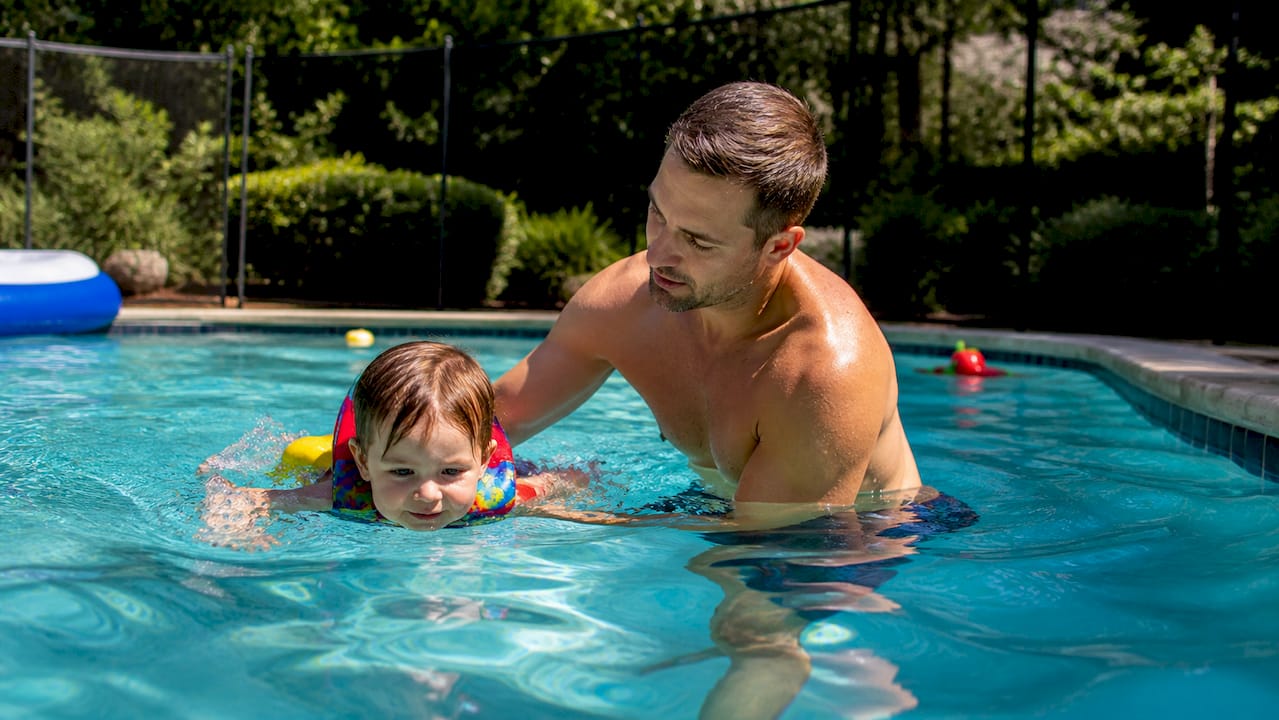
The most protective setup for any toddler near a pool combines arm’s-reach supervision by an assigned adult, a four-sided fence with a self-closing, self-latching gate that meets recommended safety standards, a U.S. Coast Guard-approved life jacket for open water, removal of pool toys when swim time ends, enrollment in survival swim lessons, and a caregiver trained in CPR. No single rule does the job alone. These layers work together, and every one of them matters.
Here are the core pool rules your toddler needs to learn and practice:
Always ask a grown-up before going near the water
Hold an adult’s hand at the pool edge
Walk, never run, on the deck
No pushing or rough play near the water
Stay within arm’s reach of your assigned adult at all times
Wait at the edge until an adult says it is okay to enter
Never swim alone, even for a second
When swim time is over, step back from the pool
These rules are not suggestions. For children ages 1–4, they are the difference between a safe afternoon and a tragedy. Read on for how to teach each rule, set up your environment, and prepare for emergencies.
Key Takeaways
Toddler pool safety requires layered protection: arm’s-reach supervision, a four-sided fence with a self-latching gate, a USCG-approved life jacket for open water, toy removal after every session, CPR-trained caregivers, and survival swim lessons working together.
Point | Details |
Arm’s-reach supervision | One assigned Water Watcher stays within touching distance of toddlers at all times, no phone, no distractions. |
Four-sided fence standard | Fence at least 4 feet high, self-closing and self-latching gate, latch mounted 54 inches from the ground. |
USCG life jackets only | Arm floaties and inflatable rings are toys, not safety devices; only Coast Guard-approved jackets protect in open water. |
Teach exit skills early | Practice the wall-grab-and-pull exit from multiple pool points so muscle memory forms before it is ever needed. |
Superheroswimacademy lessons | Survival-first instruction for toddlers in Palm Beach and Broward counties, with CPR-certified instructors and clear progress milestones. |
Table of Contents
What physical barriers actually protect toddlers from pool access?
When should toddlers start swim lessons, and what should parents expect?
What hygiene and health rules apply to toddlers at the pool?
How do you build a family water safety routine that actually sticks?
A note from Superhero Swim Academy on why safety-first instruction matters
Survival swim lessons that give toddlers a real safety skill
What are the pool rules every toddler should follow?
Twelve rules, in order of priority. For each one, there is a short teaching tip written in language simple enough to use with a two-year-old.
Ask before you enter. Before any foot touches the water, your child asks an adult out loud. Practice this at home with a pretend pool (a towel on the floor). Say: “Show me how we ask before we swim.” Repeat until it is automatic.
Walk on the deck. Wet concrete is slippery. Running near a pool is one of the most common causes of head injuries for young children. Teach it as a game: “Slow feet near the water.” Praise every time they remember without a reminder.
Stay within arm’s reach of your adult. For infants and toddlers, this means a caregiver can touch them at any moment. Explain it simply: “Stay close enough that I can hold your hand.” This rule always requires adult enforcement, not child memory.
Wait at the edge until an adult says go. Toddlers should never enter the water without verbal permission. Practice a “ready” signal, like a thumbs-up, so the routine becomes predictable and fun.
No pushing or rough play near the pool. A child pushed into water unexpectedly can panic even in shallow areas. Role-play gentle behavior on the deck and explain: “We keep our hands to ourselves near the water.”
Use the buddy system. Even for older preschoolers (3–4+), no child swims without a partner nearby. For toddlers, the buddy is always an adult. Introduce the concept early so it feels natural as they grow.
No diving in shallow water. Toddlers should enter feet-first every time. Demonstrate the correct entry repeatedly. This rule becomes more critical as children grow into the preschool years and gain confidence.
No toys left at the pool edge. A floating toy is an invitation. Toddlers will reach for it without thinking. After every session, toys go into a bag or bin away from the water. Make cleanup part of the swim routine.
Wear your gear. If a life jacket is required, it goes on before anyone approaches the water. No negotiating. Frame it as part of the “getting ready” ritual, the same as sunscreen.
No running to get a toy that fell in. Teach children to stop, call an adult, and wait. Practice this scenario so the response is rehearsed, not improvised.
Exit when an adult says so. Toddlers do not self-regulate fatigue or cold well. The adult calls time. Practice “pool’s closed” as a signal that ends the session without argument.
Never swim alone. This rule applies at every age, but for toddlers it means an adult is in or immediately beside the water at all times. Water safety guidance for children birth to 5 from Seattle Children’s Hospital reinforces that children this age should never be left unsupervised near any water source, even briefly.
Age-specific reality check: Infants (0–1) have zero ability to follow rules independently. Every rule is adult-enforced. Toddlers (1–3) can begin to recognize and repeat rules but cannot be trusted to apply them under excitement. Preschoolers (3–4+) can follow simple verbal rules with consistent reinforcement, but adult supervision remains non-negotiable.
How should you supervise a toddler in the pool?
The Water Watcher is the single most important role at any pool session involving young children. One adult, assigned before anyone enters the water, whose only job is watching the children in and around the pool. No phone. No conversation. No alcohol. No multitasking. Cleveland Clinic’s pool safety guidance is direct: the Water Watcher must be capable of swimming and ready to physically intervene the moment something goes wrong.
Arm’s-reach supervision means exactly that. For infants and toddlers, the supervising adult should be close enough to touch the child without taking a step. If the child is in the water, the adult is in the water or leaning over the edge with a hand available. “Watching from the patio” is not supervision for this age group.
At backyard parties, the Water Watcher role needs a rotation system. Here is what works:
Assign shifts before guests arrive, not after the party starts
Keep shifts short (15–20 minutes) so attention stays sharp
Use a visible handoff cue: the outgoing Watcher physically passes a bright wristband or hat to the incoming Watcher
Post the rotation schedule near the pool gate so everyone knows who is on duty
Never assume someone else is watching
Pro Tip: Buy a bright orange or yellow silicone wristband and designate it the “Water Watcher band.” Whoever wears it is on duty. When the shift ends, the band transfers to the next adult in person. This one physical object eliminates the most dangerous assumption at pool parties: that someone else is watching.
Additional supervision best practices:
Remove all distractions from the Water Watcher’s hands before their shift begins
Keep a phone nearby for emergencies only, face-down and on silent
If the Water Watcher needs to leave for any reason, the pool closes until a replacement is in position
For above-ground pools, remove the ladder when the pool is not in use so unsupervised access becomes physically impossible
What physical barriers actually protect toddlers from pool access?
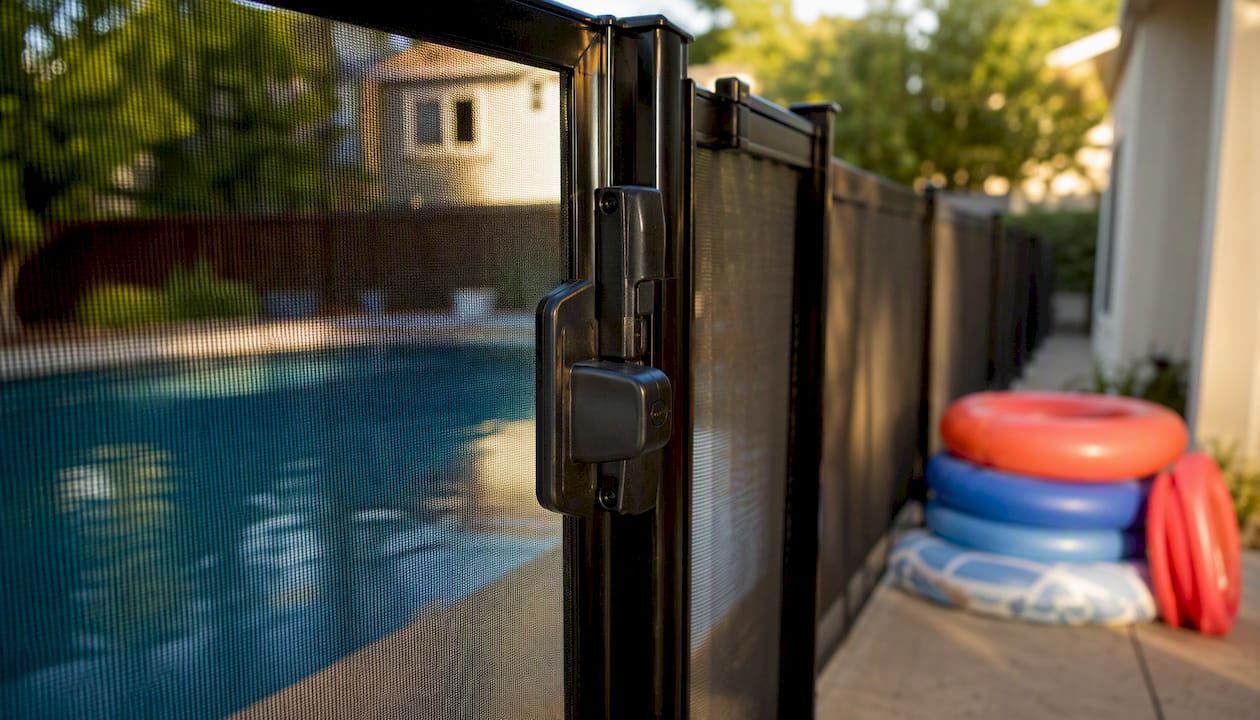
A four-sided isolation fence is the single most effective physical barrier between a toddler and a pool. “Four-sided” means the fence fully surrounds the pool on all sides, including the side facing the house. A three-sided fence using the house as the fourth wall leaves a direct path from any open door. Healthychildren a fence at least 4 feet high with a self-closing, self-latching gate, with the latch mounted ideally 54 inches from the ground, well above a toddler’s reach.
Run through this checklist before every pool season and after any gap in use:
Gate closes and latches on its own every time, without being pushed
No furniture, planters, or toys are positioned near the fence that a toddler could climb
Gate is never propped open, even briefly
Drain covers are in place and secure (anti-entrapment covers required by federal law)
Above-ground pool ladder is removed and stored when the pool is not in use
No gaps at the fence base wider than 4 inches
CDC drowning data consistently identifies children ages 1–4 as the highest-risk group for drowning, and the majority of those incidents happen in residential pools. A properly installed four-sided fence with a functioning self-latching gate is one of the most direct interventions available to parents.
Statistic callout: Drowning is a leading cause of unintentional injury death among children ages 1–4 in the United States, according to CDC data. Most of these incidents occur in home pools, often within a few minutes of the child being out of sight.
Pool covers and alarms are useful additions, not substitutes. PoolSafely cautions that covers and alarms should never replace a four-sided fence or active adult supervision. Some pool covers can trap a child underneath if they are not a certified safety cover. Motorized covers can create a false sense of security. A pool alarm that sounds after a child has entered the water is already too late for a toddler who cannot swim. HealthyChildren.org’s guidance on pool dangers reinforces this point directly.
Check local building codes. Many municipalities in Florida and across the U.S. have specific pool barrier ordinances that go beyond minimum federal guidance. Your county’s building department or the PoolSafely website can point you to the applicable requirements.
Which flotation devices actually protect your toddler?
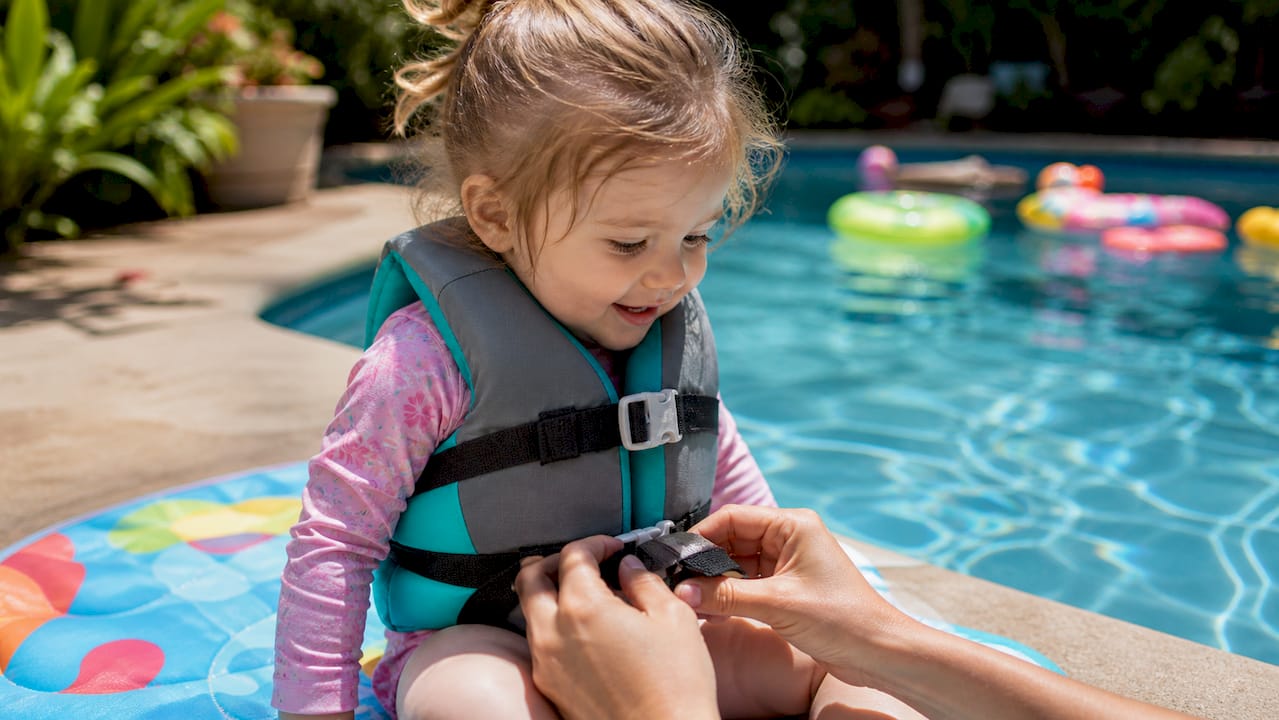
One category of device protects toddlers in open water: U.S. Coast Guard-approved life jackets. Everything else, including arm floaties, inflatable swim rings, water wings, and pool noodles, is a toy. CDC summer swim safety guidance is clear that flotation toys can create a false sense of security and must never substitute for adult touch supervision.
Here is how to sort devices into the right categories:
Use: U.S. Coast Guard-approved Type II or Type III life jackets sized for the child’s weight, worn on boats, docks, and open water
Use with supervision: Coast Guard-approved life jackets as an extra layer in pools for children who are not yet swimmers
Never rely on for safety: Arm floaties, inflatable rings, swim vests without USCG approval, pool noodles, or any inflatable toy
Pro Tip: To test a life jacket fit on a toddler, lift the child by the jacket’s shoulder straps while supporting them under the arms. The jacket should not ride up over the chin or face. If it does, the jacket is too large. A properly fitted jacket keeps the chin clear and the child’s face above water.
Life jackets are not a supervision replacement. A toddler wearing a USCG-approved life jacket still needs an adult within arm’s reach. The jacket buys seconds in an emergency. Supervision prevents the emergency from happening.
When should toddlers start swim lessons, and what should parents expect?
The American Academy of Pediatrics supports swim lessons for most children starting at age 1, with the acknowledgment that readiness varies and that lessons do not eliminate drowning risk. For children ages 1–4, the realistic outcomes from quality instruction include back floating, rolling to a float from a face-down position, reaching the pool wall, and basic water comfort. These are survival skills, not competitive strokes.
What to look for when choosing a program:
Instructors certified in CPR and First Aid before they ever enter the water with a child
A survival-first curriculum that prioritizes floating and self-rescue over stroke technique
Clear progress milestones communicated to parents after each session
Small instructor-to-child ratios for toddler classes
A program that treats lessons as one layer of protection, not a guarantee
HealthyChildren.org notes that swim lessons reduce drowning risk substantially for young children, but no lesson program drown-proofs a child. Parents who understand this distinction make better safety decisions. A child who has completed a survival swim course still needs a fence, still needs a Water Watcher, and still needs a life jacket on open water.
Understanding why toddlers benefit from structured swim lessons goes beyond the pool itself. Lessons build water confidence that reduces panic, and panic is what turns a manageable situation into a fatal one. Between lessons, short supervised practice sessions in shallow water reinforce what the instructor taught. Keep these sessions brief (10–15 minutes), focused on one skill, and always with an adult in the water.
When evaluating programs, check what qualified swim instructors bring to child safety and review red flags that signal an unsafe lesson program before enrolling.
What hygiene and health rules apply to toddlers at the pool?
Non-toilet-trained children must wear a swim diaper to any public or shared pool. Most facilities require a fitted swim diaper paired with plastic pants over it. Regular disposable diapers absorb water and become useless within seconds of pool entry. Pool rules from public aquatic facilities consistently prohibit changing diapers on the pool deck for hygiene reasons. Use the designated changing area, every time.
For parents who want to minimize chemical exposure during pool sessions, pairing a swim diaper with non-toxic diaper options is worth considering, particularly for children with sensitive skin.
Beyond diapers, these health rules protect your toddler and everyone else in the water:
Apply broad-spectrum SPF 30+ sunscreen 15–30 minutes before pool time, and reapply every 90 minutes
Dress toddlers in UV-protective rash guards to reduce sun exposure during extended sessions
Keep pool sessions to 20–30 minutes for children under 2, and no more than 45–60 minutes for toddlers 2–4, with breaks in between
Watch for shivering, blue lips, glassy eyes, or unusual clumsiness. These are signs of cold or fatigue, and they mean the session ends now
Do not bring a child to a shared pool if they have had diarrhea within the past two weeks
Rinse toddlers with fresh water before and after pool entry
For a broader look at non-toxic summer gear that pairs well with pool outings, including sunscreen and rash guard options, this guide to clean beach and pool gear covers the basics.
Toddlers do not recognize when they are getting too cold or too tired. That judgment belongs entirely to the adult on deck.
How do you build a family water safety routine that actually sticks?
Rules posted on the fridge get ignored. Rules that become rituals get followed. The difference is repetition and buy-in. A family water safety pledge is one of the most practical tools available because it converts abstract rules into a short, signed commitment that children and adults revisit together.
Here is a printable-style checklist of adult responsibilities and child promises to include in your family pledge:
Adults promise to:
Assign one Water Watcher before any child enters the pool area
Stay within arm’s reach of toddlers at all times in or near the water
Check the gate latch and fence before every swim session
Remove pool toys from the water and deck when swim time ends
Keep a phone nearby for emergencies only
Learn CPR and renew training regularly
Children promise to:
Ask before going near the water
Walk on the deck
Wait for the “go” signal before entering
Stay close to their adult
Call for help if something goes wrong
Sample family pledge (copy and post on your refrigerator):
“Our family keeps the water safe. We ask before we swim. We walk near the pool. We stay close to our adult. We never swim alone. Grown-ups watch without distractions and check the gate every time. We all follow these rules because we love each other.”
Pro Tip: Have every family member, including toddlers old enough to hold a crayon, “sign” the pledge. Children who participate in creating a rule are significantly more likely to follow it. Laminate it and post it at eye level near the pool gate.
Build a weekly gate-and-alarm check into your routine. Every Sunday morning, before the week’s swim sessions begin: test the gate latch, check for climbable objects near the fence, confirm the pool alarm is functional, and remove any toys that drifted back to the deck. The whole check takes under three minutes and addresses the most common access failures.
How do you teach a toddler to exit the pool safely?
Getting out of the pool is a skill, and for toddlers it is a survival skill. A child who falls in accidentally needs to know how to reach the wall and how to pull themselves out. This is one of the first things a quality survival swim program teaches, and parents can reinforce it at home.
Start at the steps or the shallowest point of the pool. With an adult in the water beside the child, practice this sequence repeatedly:
Face the wall or step
Reach up and grab the edge or rail with both hands
Pull the body up and swing one leg over
Slide onto the deck on the stomach, then stand
For very young toddlers (12–18 months), the adult guides the motion and provides support. The goal is muscle memory, not independence. By 2–3 years, many children can complete the exit sequence with verbal prompting only.
Practice the exit from different points around the pool, not just the steps. If a child falls in at the deep end, they need to know how to get to the nearest wall and move along it to the steps. Teach them to turn toward the wall immediately and kick toward it. Keep this practice session short and positive. Five repetitions with praise is more effective than twenty repetitions with frustration.
A word on the “swim, float, swim” sequence: survival swim programs teach toddlers to roll onto their back and float when they are tired, then roll back and swim again. This skill buys critical time for a caregiver to reach the child. It is not a replacement for supervision, but it is the most valuable physical skill a toddler can have in the water. Swim lesson progress milestones for toddlers give parents a realistic picture of what to expect at each age.
A note from Superhero Swim Academy on why safety-first instruction matters
At Superheroswimacademy, every instructor completes rigorous training in CPR, First Aid, and a survival-first swim curriculum before working with a single child. That is not a marketing claim. It is the baseline we hold ourselves to because the children we teach are 1, 2, and 3 years old. A lesson that prioritizes fun over survival skills is not a lesson we offer.
Structured lessons complement every environmental and supervisory measure described in this article. They do not replace a fence, a Water Watcher, or a life jacket. What they do is give a toddler a fighting chance in the seconds before an adult can reach them. That is the gap survival swimming fills.
Parents in Palm Beach and Broward counties who want to explore local lesson options can find more at Superheroswimacademy.
Survival swim lessons that give toddlers a real safety skill
Superheroswimacademy has taught over 2,500 children in Palm Beach and Broward counties. The difference between a standard swim class and a survival lesson is the first skill taught: not kicking, not arm strokes, but how to float on your back and breathe until help arrives.
Every Superheroswimacademy instructor holds CPR and First Aid certification and follows a proven survival-first curriculum. Lessons are available as private sessions at your home pool, small group classes, and parent-and-child sessions designed for children as young as 12 months. Parents receive clear progress updates after each session so they know exactly what their child has learned and what comes next.
Swim lessons are one layer of protection. They work best alongside a four-sided fence, an assigned Water Watcher, and a caregiver trained in CPR. Lessons do not replace supervision. They give your toddler a skill that supervision alone cannot provide.
Ready to book a survival swim lesson for your toddler in Palm Beach or Broward County? Reserve a spot at Superheroswimacademy and see available lesson formats for your child’s age.
Sources
These are the primary sources behind the guidance in this article. Each one is free, authoritative, and specific to the U.S. context.
Recommended
Comments