
Lightning Pool Safety: Policies, Drills, and Quick Checklists
- superheroswim
- 3 days ago
- 12 min read

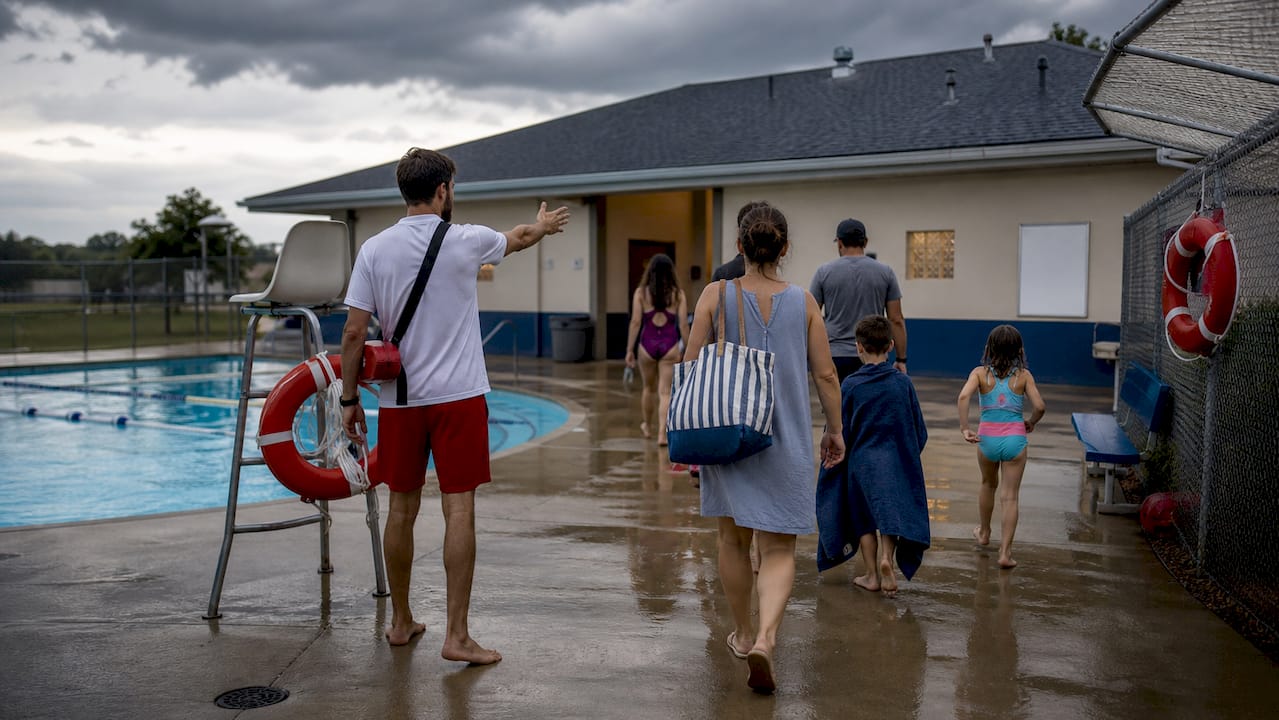
If you hear thunder or see lightning, clear the pool immediately. That is the rule. Everything else in this guide helps you execute it well.
Here is what to do in the first 60 seconds:
Clear the water. Blow the whistle, use the PA, or call out directly. Every swimmer exits now.
Direct people to a hardened shelter. A fully enclosed building with plumbing and wiring, or a hard-topped metal vehicle. Not an open pavilion. Not a screened enclosure.
Secure loose equipment. Lane lines, kickboards, and chairs become projectiles in high wind.
Account for everyone. Head count at the shelter point. Do not assume everyone made it inside.
Do not wait for an app to confirm the threat. Poolsafely is direct: exit at the first sign of thunder or lightning, and move to a fully enclosed building or hard-topped vehicle.
The person with authority to call the closure is the lifeguard on duty or the pool manager. That authority is non-negotiable. Staff should never feel pressured to keep a pool open when conditions are hazardous, per guidance from the American Lifeguard Association.
What NOT to do during a lightning event:
Do not use showers or corded phones. Water and metal conduct electricity.
Do not stand near metal ladders, handrails, or pool equipment.
Do not shelter under a tree, in an open gazebo, or on a lifeguard stand.
Do not wait for rain to start. Lightning can strike miles from the rain core, with clear skies overhead.
Pro Tip: Post a laminated one-page closure checklist at every guard station. When adrenaline is high, a printed checklist beats memory every time.
Key Takeaways
Sound lightning pool safety practice comes down to one rule applied consistently: clear the water at the first sign of thunder or lightning, shelter in a hardened structure, and wait a full 30 minutes after the last strike before anyone returns to the water.
Point | Details |
Clear at first thunder | Exit the water immediately; do not wait for lightning to be visible or rain to start. |
30-minute restart rule | Restart the clock from zero if new thunder or lightning occurs during the wait. |
Designated weather watcher | Assign this role every shift and document it; detection tech supports but never replaces this person. |
Safe shelter only | Fully enclosed buildings or hard-topped vehicles; open pavilions and screened enclosures are not safe. |
Log every closure | Record time, authority, incidents, and GFCI/equipment checks after every weather event. |
Table of Contents
How the 30–30 rule tells you when to clear and when to reopen
Where to shelter and which spots at pool facilities are actually dangerous
What lifeguards and pool operators are actually responsible for
How to use lightning detection tech without over-relying on it
What Superheroswimacademy has learned from running lightning drills
How the 30–30 rule tells you when to clear and when to reopen
The National Weather Service puts it plainly: “When thunder roars, go indoors.” The 30–30 rule gives that mantra a precise operational frame.
First 30: If the gap between a lightning flash and the thunder that follows is 30 seconds or less, the storm is within roughly 6 miles. Clear the pool immediately.
Second 30: Wait at least 30 minutes after the last thunder or lightning before allowing anyone back in the water. If new thunder or lightning occurs during that wait, restart the clock from zero.
The flash-to-bang method is a useful field check. Count the seconds between the flash and the thunder, then divide by 5. That gives you the approximate distance in miles. A 10-second count means the storm is about 2 miles away. A 15-second count puts it at 3 miles. At those distances, the pool should already be cleared.
Timing examples:
Flash, then 8 seconds of silence before thunder: storm is roughly 1.6 miles away. Clear immediately.
Flash, then 35 seconds before thunder: storm is about 7 miles away. Begin moving people toward shelter now; do not wait for it to close further.
No flash visible but thunder is audible: clear the pool. Audible thunder means lightning is within striking range.
Pro Tip: For large aquatic facilities, crowded events, or outdoor pools with limited covered shelter, use a more conservative buffer. Consider clearing at the first audible thunder regardless of flash-to-bang count. The cost of a false alarm is a brief inconvenience. The cost of waiting too long is not recoverable.
Where to shelter and which spots at pool facilities are actually dangerous
Safe shelter during a lightning event is not just “go inside.” The type of structure matters, and several common pool-area structures offer false security.
Safe shelters:
Fully enclosed buildings with complete wiring and plumbing (locker rooms, recreation centers, clubhouses)
Hard-topped metal vehicles with windows fully closed
Any structure with a certified lightning protection system installed per NFPA 780 or UL-96A standards
Unsafe places commonly found at pool facilities:
Open pavilions and picnic shelters (no walls = no protection)
Screened enclosures, even large ones
Lifeguard stands and elevated platforms
Shower areas (water and plumbing conduct lightning current)
Tents and canopies
Areas near tall trees, metal fencing, or light poles
One caveat that surprises many operators: indoor pools are not automatically safe. The Lightning Protection Institute notes that lightning can travel through plumbing, wiring, and metal framing. An indoor pool without a certified lightning protection system per NFPA 780 or UL-96A remains vulnerable. Do not assume “enclosed” means “protected” unless your facility’s protection has been verified by a licensed installer.
Scenario examples:
Small backyard pool: The house itself is the shelter. Move everyone inside, away from windows, and avoid plumbing until the storm passes.
Community pool with an open pavilion: The pavilion is not safe. Direct patrons to the nearest fully enclosed building, even if it means walking further. If no building is accessible, hard-topped vehicles in the parking lot are the next best option.
Aquatic center with locker rooms: Locker rooms with full walls and a roof are the correct shelter, provided the facility has verified lightning protection. If not, the parking lot vehicles may be safer than standing near the pool’s plumbing or metal framing.
Pro Tip: Walk your shelter routes before the season starts. Time them. A 90-second walk to the locker room feels very different when 80 patrons are moving at once. Identify bottlenecks and assign staff to specific posts along the route.
What lifeguards and pool operators are actually responsible for
Lightning pool safety does not run on instinct. It runs on assigned roles, practiced communication, and a written Emergency Action Plan (EAP). Here is how to structure it.
Roles and authority
Incident commander: The pool manager or head lifeguard. Makes the final call to clear or reopen. This role must be named in the EAP, not left to whoever happens to be senior that day.
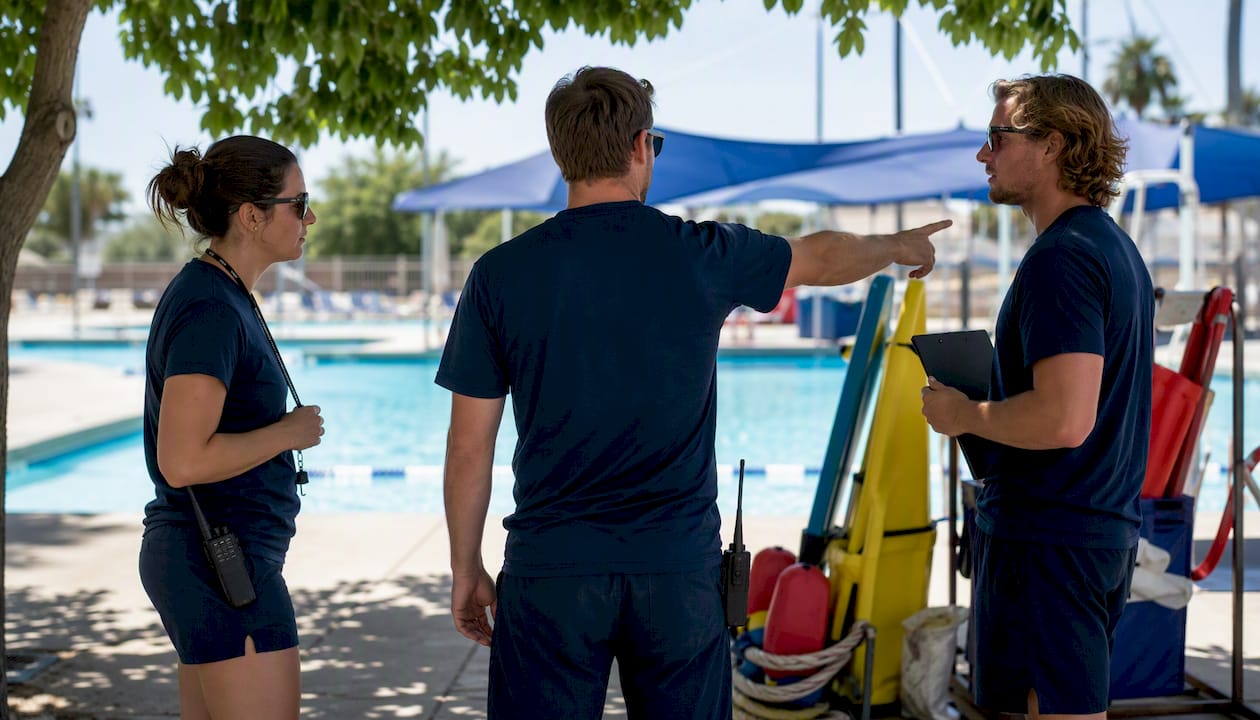
Weather watcher: A designated staff member whose job during high-risk weather is to monitor conditions continuously. The USLA recommends designating a weather watcher and identifying safe shelters before operations begin, with evacuation considered when lightning is within approximately 10 miles.
Lifeguards: Execute the evacuation. Each guard is assigned a zone and a shelter route. They do not leave until their zone is clear.
Facility staff: Secure equipment, manage patron flow at shelter entry points, and assist patrons with mobility needs.
Communication protocols
PA announcement at first sign of thunder or lightning (see sample script below)
Three short whistle blasts as the universal “exit the water” signal at most facilities; confirm your facility’s signal in the EAP
Radio check-in between incident commander and weather watcher every 10 minutes during active monitoring
Direct verbal direction for patrons near the pool who may not hear the PA
Sample PA script:
Evacuation steps
Lifeguards blow signal and direct swimmers to exit.
Incident commander activates PA and confirms shelter assignments with staff by radio.
Each guard clears their zone and moves patrons toward the designated shelter route.
Staff at shelter entry points count patrons as they enter.
Incident commander confirms head count against entry records or wristband count.
Patrons with mobility needs are assisted first; assign at least one staff member to this task in the EAP.
Incident commander logs the time of closure and the reason.
EAP checklist items to include:
Named incident commander and backup
Named weather watcher role and monitoring schedule
Designated shelter locations with capacity estimates
Evacuation routes with staff assignments
Communication protocols (PA, whistle, radio)
Patron accountability procedure
Post-storm inspection and reopening criteria
Incident log template
Annual drill schedule
For guidance on how qualified swim instructors integrate safety protocols into their daily practice, the training expectations are worth reviewing before drafting your EAP.
Pro Tip: Run a tabletop drill before the season opens. Sit the team down, walk through a scenario (“It’s 2:15 PM, a parent reports hearing thunder”), and ask each staff member to state their role. Debrief on gaps. A 30-minute tabletop catches most confusion before it matters.
How to use lightning detection tech without over-relying on it
Detection systems give you lead time. They do not replace the 30–30 rule or the human weather watcher. That distinction matters operationally.
Categories of detection tools:
Lightning alarms and ground-based detectors: Devices mounted at the facility that detect electromagnetic signals from lightning strikes within a set radius. They can trigger audible or visual alerts and integrate with PA systems.
Commercial alert services: Subscription services that push real-time lightning data to a phone or dashboard, often with customizable radius alerts and historical strike maps.
Public tools: NOAA Weather Radio, NWS forecasts, and radar apps. Free, reliable for broad situational awareness, but not real-time strike detection.
Vendor selection tips:
Detection range: look for systems covering at least a 10-mile radius, consistent with USLA’s evacuation threshold
False-positive rate: ask vendors for documented performance data; a system that cries wolf too often gets ignored
PA integration: a detector that triggers your PA automatically removes one human step from the chain
Battery backup and power-failure behavior: the system must function during a power outage
Maintenance checklist:
Test the alarm monthly and after any significant storm
Replace batteries on schedule per the manufacturer’s spec
Check sensor mounting and calibration annually
Post signage at the pool deck noting that the alarm supplements but does not replace staff judgment
Limitations operators must understand:
Limitation | Practical implication |
Detection delay | Alerts lag real-time conditions by seconds to minutes; the audible thunder rule is faster |
Range blind spots | Ground-based detectors can miss distant strikes; use NWS radar as a backup layer |
No “all clear” authority | No device can declare it safe to reopen; only the 30-minute post-thunder clock does that |
Power dependency | A surge or outage can disable the detector; the weather watcher role must not depend on it |
Detection apps and services are useful for monitoring local weather emergency updates and getting advance warning before a storm arrives. Use them for situational awareness. Use your ears for the trigger.
Step-by-step actions during the storm itself
Once the pool is cleared, the work is not over. Here is the procedure while the storm is active.
For staff
Confirm all patrons are in shelter and accounted for.
Secure any remaining loose equipment on the deck (chairs, umbrellas, lane equipment).
Stay inside shelter. Do not re-enter the pool area to retrieve items.
Avoid using corded phones or touching metal surfaces inside the shelter.
Monitor conditions from inside; assign the weather watcher to track thunder intervals.
Consider shutting down pool pumps, automation controllers, and salt-cell systems at the breaker. Lightning can damage these systems through direct strikes, near-strike surges, and ground-potential rise.
Log the time the storm began and any observations (strike proximity, power fluctuations).
For swimmers
Exit via the nearest ladder or step, not by grabbing metal handrails if avoidable. Move calmly.
Avoid showers and corded phones once inside. Lightning can travel through plumbing and conductive paths inside buildings.
Stay away from windows and metal doors.
If caught in the open with no shelter available: crouch low on the balls of your feet, feet together, head down, ears covered. Do not lie flat. Do not stand under a tree.
First aid if a lightning strike occurs
Scene safety first. Lightning strike victims do not carry a charge. It is safe to touch them.
Call 911 immediately.
Begin CPR if the person is unresponsive and not breathing. Use an AED if one is available. Lightning strike victims often survive with prompt CPR.
Do not delay care while waiting for EMS. Start CPR and keep going.
Document the time of the strike, the victim’s condition on arrival of EMS, and the names of any witnesses.
How to reopen the pool safely after a storm
The 30-minute clock is the governing rule. Wait at least 30 minutes after the last thunder or lightning before allowing anyone back in the water. If new thunder or lightning occurs at any point during that wait, restart the clock from zero.
Before reopening, run through this inspection checklist:
Physical inspection:
Scan the deck for debris, standing water near electrical panels, or structural damage
Check pool equipment (pump, filter, heater, automation controller) for visible damage
Inspect lighting fixtures above and in the water
Look for damage to bonding wires or grounding connections at equipment pads
Electrical and equipment checks:
Test all GFCIs. A three-layer surge protection strategy (service-panel SPD, sub-panel SPD, and point-of-use protectors) reduces lightning-induced equipment failures, but GFCIs are the last line of defense. They trip at 4–6 mA and must be functional before the pool reopens.
Check for tripped breakers and restore only after confirming no equipment damage
Tag any device that shows signs of surge damage for service before use
Log any power anomalies observed during the storm
Incident log fields to complete after every weather closure:
Field | What to record |
Time of closure | Exact time the pool was cleared |
Who ordered closure | Name and role of incident commander |
Reason for closure | Thunder heard / lightning observed / detector alert |
Time of last thunder/lightning | Used to calculate the 30-minute restart |
Time of reopening | Exact time swimmers were allowed back in |
Who authorized reopening | Name and role |
Incidents during closure | Injuries, equipment damage, patron issues |
Maintenance actions taken | Equipment shut down, GFCIs tested, items tagged |
Witnesses | Names of staff present |
Ready-to-use training drills, signage, and policy templates
Training drill plan
Objective: Every staff member can execute their assigned role in a lightning closure without prompting.
Actors: Incident commander, weather watcher, two lifeguards, one facility staff member.
Timeline:
0:00 — Weather watcher reports thunder audible. Incident commander activates drill.
0:30 — Lifeguards blow signal; patrons (played by staff or volunteers) begin exiting.
2:00 — Deck cleared. Head count at shelter point.
3:00 — Incident commander confirms count, logs closure time, assigns weather watcher to monitor.
33:00 — Weather watcher confirms 30 minutes since last thunder. Incident commander authorizes inspection.
35:00 — Inspection complete. Pool reopened. Incident log completed.
Debrief prompts: Who hesitated? Was the PA script used correctly? Did the head count match? Were mobility-assistance needs handled?
For instructors who want to build this into their broader safety curriculum, Superheroswimacademy’s online courses include training frameworks that cover emergency procedures alongside swim instruction.
Sample pool deck signage
LIGHTNING SAFETY At the first sound of thunder or sight of lightning, all swimmers must exit the water immediately. Move to the enclosed building or a hard-topped vehicle. The pool will reopen 30 minutes after the last thunder or lightning. Staff will announce when it is safe to return.
Post this at pool entry points, the guard station, and locker room entrances.
Lightning safety policy template
Policy: Lightning Safety and Pool Closure
Authority: The incident commander (pool manager or head lifeguard on duty) has sole authority to order pool closure and reopening.
Trigger: Pool closes immediately upon audible thunder or visible lightning, regardless of distance.
30–30 rule: Pool remains closed for a minimum of 30 minutes after the last thunder or lightning. The clock restarts with any new thunder or lightning.
Weather watcher: A designated staff member monitors weather conditions during all operating hours. The weather watcher role is assigned at the start of each shift and documented in the shift log.
Evacuation routes:
Post-storm inspection: Incident commander completes the physical and electrical inspection checklist before authorizing reopening.
Documentation: Every closure is logged using the incident log template.
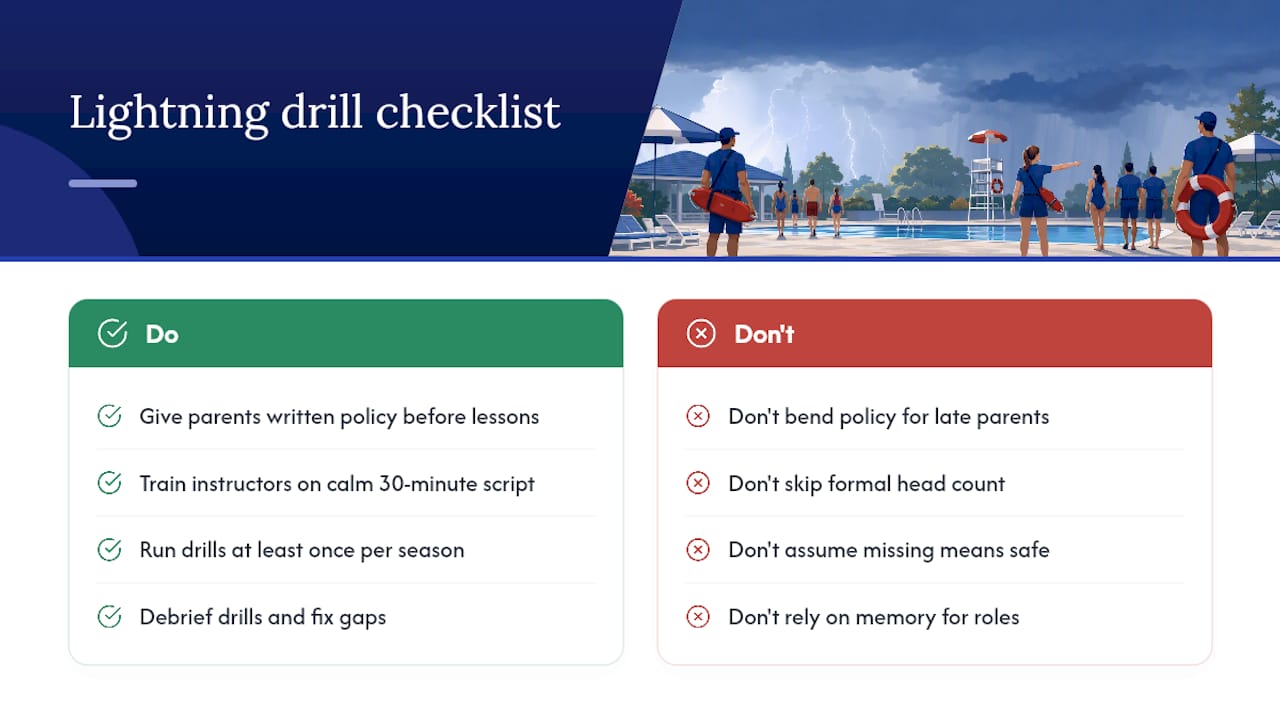
Drills: A full lightning evacuation drill is conducted at least once per season and documented.
Sample staff briefing script (pre-season)
Group instructors managing safety across multiple students can find additional practical frameworks at Superheroswimacademy’s guide on how group swim instructors manage safety.
What Superheroswimacademy has learned from running lightning drills
The 30–30 rule looks simple on paper. Running it with a pool full of children and parents who paid for a lesson is a different experience entirely.
At Superheroswimacademy, we have found that the hardest part of a lightning closure is not the evacuation itself. It is the conversation with parents who drove 40 minutes for a lesson and are now standing in a parking lot. The policy holds regardless. What makes it easier is preparation: parents receive a written lightning policy before their child’s first lesson, and our instructors are trained to explain the 30-minute rule calmly and specifically, not just say “we have to wait.”
Our drills run at least once per season, and we debrief every one. The most common gap we find is not in the evacuation steps but in the head count. Staff assume everyone made it inside because they did not see anyone left on the deck. A formal count at the shelter point is the only way to know for certain. We build that step into every drill until it becomes automatic.
The policy template and PA scripts in this guide reflect what actually works in practice, not just what looks good in a binder. If you are building or updating your facility’s EAP, use them as a starting point and adapt them to your specific shelter locations and patron volume. For parents enrolling young children in swim lessons, understanding how your instructor handles weather events is part of knowing your child is in good hands. Superheroswimacademy’s approach to backyard pool lesson preparation includes weather contingency planning as a standard part of every session setup.
The guidance exists. The tools are here. The only thing left is to put them in writing, practice them once, and make sure every person on your team knows their role before the first storm of the season arrives.
Sources
Use these primary sources when updating your facility’s EAP or training materials. Each one is free to access and regularly updated.
Recommended
Comments