
How Families Prioritize Swim Lesson Schedules
- superheroswim
- 3 hours ago
- 11 min read


Prioritize consistent, predictable lessons — aim for multiple short sessions per week for skill retention — then adapt format and timing to fit your family’s calendar. That single rule does more for your child’s water safety than any single perfect lesson ever will.
Here are the five priorities to act on right now:
Consistency first. Lock in a recurring weekly slot before you choose anything else. Aim for 2–3 sessions per week; frequency beats intensity every time.
Match the lesson format to your logistics. Private, small-group, parent-child, and in-home concierge options each serve different family constraints.
Coordinate the whole household. Shared calendars, rotating drop-off duty, and a brief weekly check-in prevent lessons from becoming a recurring argument.
Build in contingency. Choose a program with a clear make-up policy and rolling enrollment so a sick day doesn’t derail a month of progress.
Cut transition time. The closer the lesson is to your existing routine — school pickup route, weekend morning, after-dinner — the more likely it sticks.
The American Academy of Pediatrics recommends swim lessons starting at age 1 for most children, and the CDC identifies drowning as a leading cause of unintentional injury death among children ages 1–4. Superheroswimacademy, serving Palm Beach and Broward counties, is built around exactly this kind of calendar-first, safety-focused approach.
Pro Tip: Before you research lesson options, open your family calendar and block three candidate time slots. You’ll make a better decision when you know what’s actually available.
Table of Contents
Why does scheduling consistency matter for swim skill retention?
What does a practical swim lesson schedule actually look like?
How do you get the whole family on board with the swim schedule?
How do you know when to change the schedule or lesson format?
What does swim lesson scheduling actually cost in time and money?
Why Superheroswimacademy’s approach supports consistent family scheduling
Superheroswimacademy: flexible lessons for families who can’t afford to miss a week
Why does scheduling consistency matter for swim skill retention?
Consistent lessons do two things sporadic ones cannot: they build muscle memory and they keep water safety reflexes sharp. A child who misses two or three weeks doesn’t just pause progress — they often spend the next several sessions recovering ground they already covered. The benefits of a consistent swim routine compound in ways that irregular enrollment simply can’t replicate.
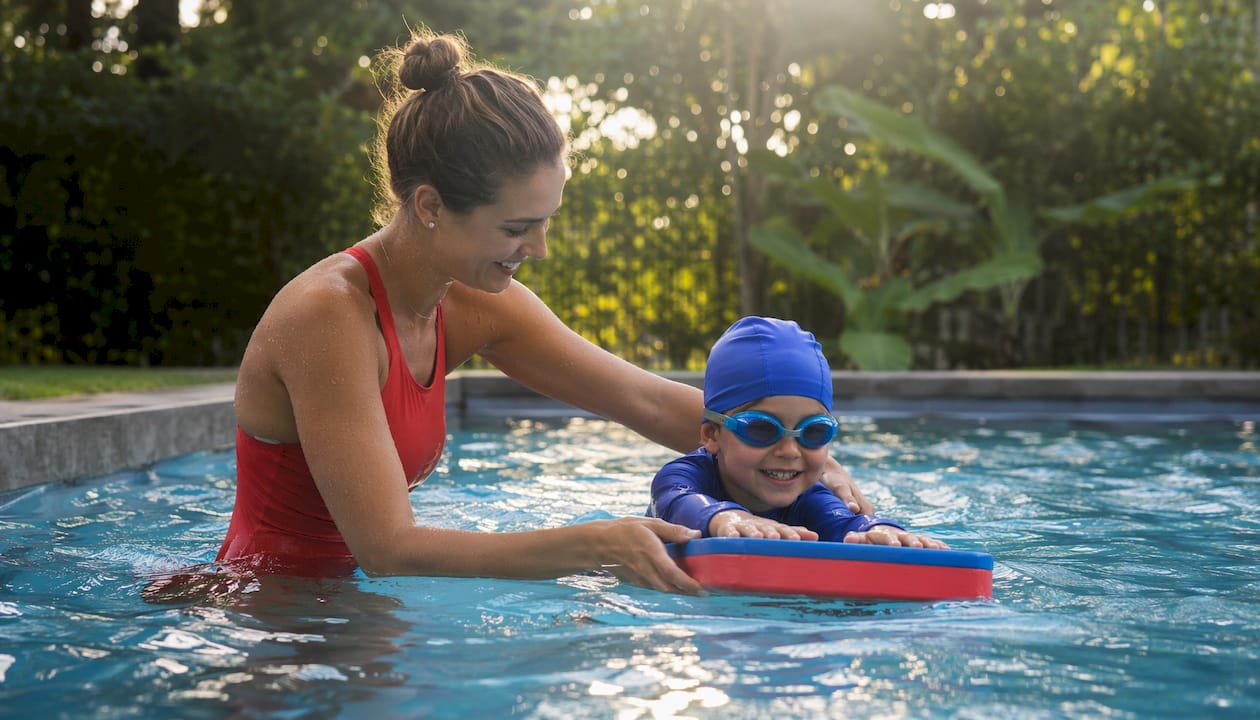
The safety stakes make this more than a scheduling preference. Drowning is a leading cause of unintentional injury death for young children in the United States, and survival skills erode faster than most parents expect after a long break. Year-round, rolling-enrollment programs prevent the regression that follows multi-month seasonal gaps — the kind that happens when families treat swimming as a summer-only activity.
Beyond safety, there’s a behavioral dividend. Many parents notice calmer, more focused children after structured swim sessions. Swimming supports emotional regulation in ways that carry over into the school week, acting as a weekly reset that benefits the whole household, not just the swimmer.
Skill retention: Regular water exposure reinforces motor patterns that irregular lessons interrupt.
Safety readiness: Survival responses require consistent practice to become automatic.
Emotional benefits: Short, structured sessions correlate with improved focus and calmer behavior.
Routine anchoring: A fixed lesson slot reduces weekly decision fatigue for parents.
How often should your child swim, based on age and goal?
2–3 sessions per week is the baseline for skill retention across all age groups, as recommended by professional guidance. Adjust from there based on where your child is developmentally and what you’re trying to accomplish.
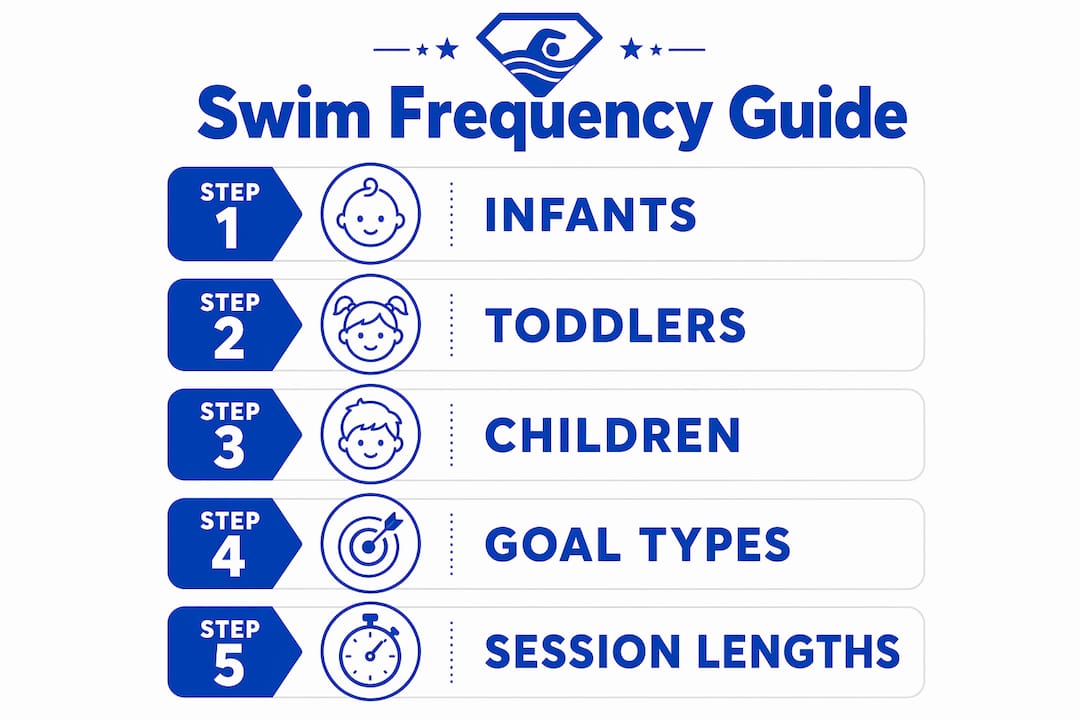
Age Group | Recommended Frequency | Typical Session Length | Primary Goal |
Infants (6–12 months) | 2–3x per week | ~15 minutes | Water acclimation, parent-child bonding |
Toddlers (1–3 years) | 2–3x per week | ~15 minutes | Survival basics, breath control |
Preschool (3–5 years) | 2–3x per week | 30 minutes | Survival skills, stroke introduction |
School-age (6–12 years) | 2–3x per week | 30–45 minutes | Stroke development, recreational readiness |
Session lengths come from age-appropriate duration guidance: infants and toddlers cap out around 15 minutes before fatigue sets in, while older children can sustain 30–45 minutes of productive instruction.
A few special cases worth knowing:
Intensive crash courses (daily lessons over 1–2 weeks) work well as vacation refreshers or summer jumpstarts, but shouldn’t replace year-round consistency.
Academic heavy weeks call for dropping to one session rather than skipping entirely. Presence matters more than volume.
Rapid skill gains are a signal to increase frequency temporarily, not to coast.
Pro Tip: When your schedule gets tight, choose a shorter, focused 20-minute private session over skipping the week. Quality contact with the water beats a gap every time.
Which lesson format fits your family’s schedule and goals?
Choose the format that preserves consistency and cuts friction for your household. The best lesson type is the one your child actually attends every week.
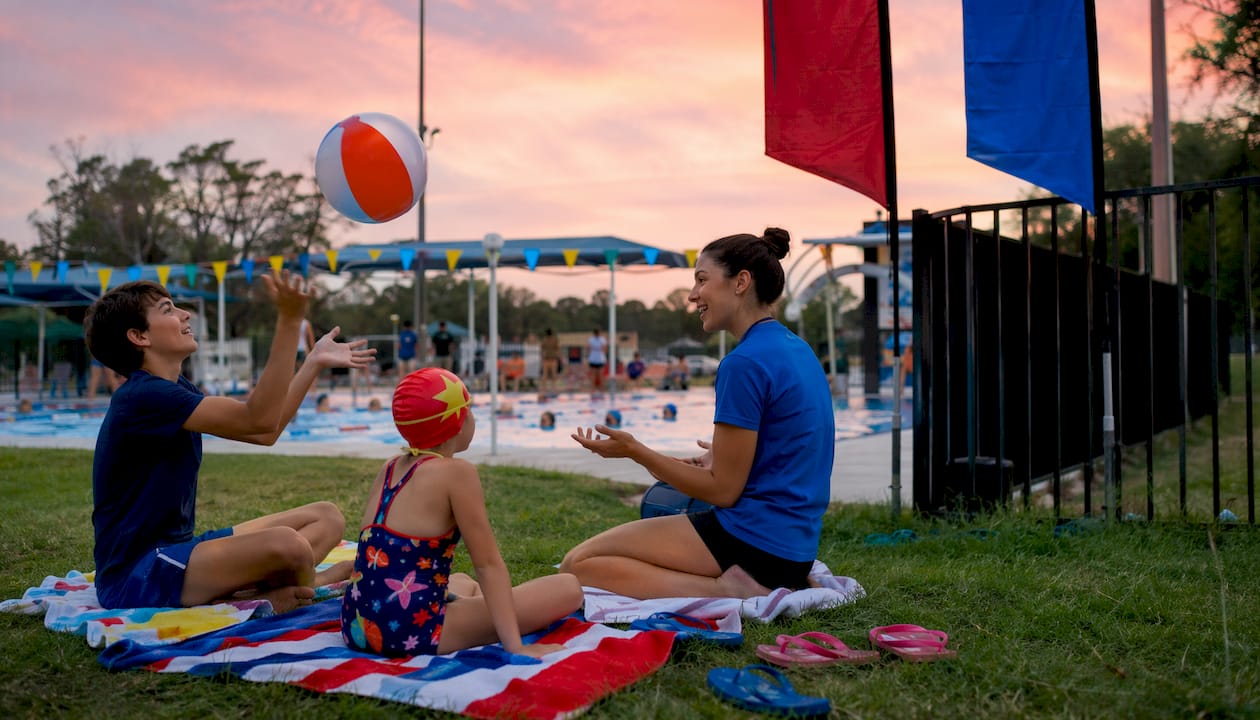
Private lessons offer the most scheduling flexibility and the fastest individual progress. You pick the time, the instructor adjusts to your child’s pace, and make-up sessions are easier to arrange. The trade-off is cost per session. For families with tight or unpredictable schedules, in-home private sessions eliminate commute time entirely.
Small-group lessons cost less per session and add a social element that motivates many children. The fixed class schedule is a feature for families who need external accountability, though it offers less flexibility when conflicts arise.
Parent-and-child sessions work especially well for infants and toddlers, where parental presence is part of the learning. They double as bonding time and give parents direct instruction on how to reinforce skills at home.
Intensive or bootcamp formats pack progress into a short window — useful for families with limited availability in a given month or for refreshing skills before summer. They’re a supplement, not a substitute for regular lessons.
In-home concierge instruction is the highest-friction-reduction option: the instructor comes to your pool. For multi-child households or families with demanding weekday schedules, this format can turn a logistical headache into a non-event.
When evaluating any program, look for these flexibility signals:
Rolling enrollment (no waiting for a new session to start)
A written make-up policy with a reasonable window
Online scheduling tools for rescheduling without a phone call
Multi-child booking options to consolidate trips
What does a practical swim lesson schedule actually look like?
Pick fixed weekly blocks and protect them the same way you protect a pediatrician appointment. Lessons that live on the calendar as recurring events get attended. Lessons that get scheduled week-to-week get skipped.
Here are four sample schedules families use successfully:
Weekday evening: Tuesday and Thursday at 5:30 PM, immediately after school pickup. Pair with a packed swim bag ready by the door Sunday night.
Weekend morning: Saturday at 9:00 AM before the day fills up. Add a second session Sunday if the program allows back-to-back booking.
Alternating-siblings rotation: Child A swims Saturday morning while Child B attends Sunday morning, cutting total drive trips in half.
Block scheduling: Two lessons back-to-back on Saturday morning for a single child, completing a week’s volume in one trip.
A few tactics that reduce friction for busy parents:
Keep a dedicated swim bag packed and by the door at all times (suit, goggles, towel, change of clothes).
Use a shared family calendar app — Google Calendar or Apple Calendar — with lesson slots as recurring events and 30-minute prep reminders.
Pre-block exam weeks and school holidays at the start of each term so you can swap lessons proactively rather than reactively.
Ask your program about lesson-swapping and booking flexibility before you enroll, not after your first conflict.
Weekend lesson availability is one of the most underrated scheduling tools for working families. A Saturday morning slot often outlasts three different weekday attempts.
Pro Tip: At the start of each school term, spend 10 minutes marking every school holiday, exam period, and family trip on your calendar. Then book swim lessons around those blocks — not the other way around.
How do you get the whole family on board with the swim schedule?
Shared planning and simple household rules make scheduling sustainable. When one parent carries the entire mental load of managing lessons, it eventually breaks down. When the whole household has a role, it runs.
Practical steps that actually work:
Hold a 15-minute family calendar meeting at the start of each month. Put lessons on the shared calendar, assign drop-off duties, and flag any conflicts before they become emergencies.
Rotate drop-off responsibility between partners or caregivers. No single person should own every trip.
Involve your child in choosing the time slot. A 4-year-old who picked Saturday morning feels ownership over it. Resistance drops noticeably.
Set a clear attendance expectation — lessons are a commitment, not optional based on mood — while leaving room for genuine illness or exhaustion.
Build a carpool network. Two or three families with children at the same program can cut individual driving by half with a simple rotation.
Pro Tip: Ask your child what they’re most excited to learn at their next lesson. That one question shifts the conversation from “do I have to go?” to “I want to show you what I can do.”
How do you know when to change the schedule or lesson format?
Reassess when progress stalls for more than three or four consecutive lessons, when your child shows consistent emotional resistance, or when a life-phase shift — new school schedule, exams, a new sibling — makes the current plan genuinely unsustainable.
A simple decision timeline:
Weeks 1–2: Notice the pattern. One bad week is noise. Two in a row is a signal.
Weeks 3–4: Try a targeted adjustment. Switch the time slot, reduce frequency by one session, or swap to a shorter private session.
Weeks 5–6: Evaluate the adjustment. If attendance and attitude improved, the new plan is working. If not, consider a format change.
Week 7+: Make the structural change — different format, different frequency, or a brief planned break with a firm restart date.
Signs that justify stepping back:
Consistent missed classes (more than one per month)
Emotional resistance that doesn’t resolve after a few weeks
Visible fatigue or declining performance across multiple sessions
Signs that justify moving up frequency:
Rapid skill gains that the current pace can’t keep up with
Child asking to go more often
Instructor recommending advancement
During heavy academic periods, lighter recovery-focused sessions preserve water time and skill retention without adding cognitive load. Dropping to one shorter session per week during finals month beats skipping entirely and losing three weeks of progress.
What does swim lesson scheduling actually cost in time and money?
Factor lesson price, travel time, and opportunity cost when choosing frequency and format. The cheapest per-session option often isn’t the cheapest when you add commute time and inflexible cancellation policies.
Key cost components to budget:
Per-lesson or package rates: Private lessons run higher per session than small-group formats; block packages typically reduce the per-lesson cost.
Session duration: Infants and toddlers need only about 15 minutes; preschoolers 30 minutes; school-age children 30–45 minutes. Shorter sessions cost less and are developmentally appropriate.
Travel and commute time: A 20-minute drive each way adds 40 minutes to every lesson. In-home private sessions eliminate this entirely.
Equipment: Swimsuit, goggles, and a swim cap are the basics. Most programs don’t require anything beyond that for young children.
Make-up and cancellation policies: A program with no make-up policy effectively charges you for lessons your child misses due to illness. Read the fine print before you book.
For multi-child households: stagger or double-book sessions at the same location on the same day. Two children swimming back-to-back on Saturday morning means one trip instead of two, cutting your weekly time commitment significantly.
Programs offering 8–12 week progressive blocks often provide the best cost-per-outcome ratio because progress is measurable and parents can see clear milestones within a defined timeframe.
Why Superheroswimacademy’s approach supports consistent family scheduling
Superheroswimacademy centers its program on survival-focused curriculum, certified instructors, and scheduling structures designed to keep children in the water consistently — because consistency is what produces safe, confident swimmers.
Every Superheroswimacademy instructor holds CPR and First Aid certification and is trained in the academy’s own proven survival swim curriculum. That’s not a checkbox — it’s the foundation of a program where parents can trust that every session, regardless of which instructor leads it, meets the same safety standard. With over 2,500 children taught, the outcomes speak to what consistent, structured instruction produces.
Parents receive regular progress updates and clear goal benchmarks, so you’re never guessing whether your child is advancing. Progress tracking tools and transparent communication mean you can make informed decisions about frequency and format changes rather than relying on gut feel.
Trust signals parents should verify with any swim program:
Instructor CPR and First Aid certification (current, not lapsed)
A written make-up and cancellation policy
Regular parent progress updates with defined milestones
A survival-focused curriculum, not just recreational stroke instruction
“Consistency is the single biggest factor in swimmer improvement. The swimmers who progress the most are almost always the swimmers who show up the most.” — North Rockland Aquatic Club Parent Handbook
Key Takeaways
Families who prioritize consistent, predictable swim lessons — ideally 2–3 short sessions per week — and build scheduling around their existing calendar rhythms produce the most durable results in water safety and skill retention.
Point | Details |
Prioritize 2–3 sessions per week | This frequency supports skill retention across all age groups, adjusted by age and goal. |
Match session length to age | Infants and toddlers need about 15 minutes; preschoolers 30 minutes; school-age children 30–45 minutes. |
Use rolling enrollment and make-up policies | Year-round programs with clear make-up rules prevent regression after illness or schedule conflicts. |
Involve the whole family in planning | Shared calendars, rotating drop-off duty, and child input reduce negotiation fatigue and improve attendance. |
Superheroswimacademy fits busy families | Flexible formats (private, group, parent-child, concierge), certified instructors, and progress tracking serve Palm Beach and Broward families. |
The scheduling truth most parents learn too late
The families who get the best results from swim lessons aren’t the ones who found the most prestigious program or the most decorated instructor. They’re the ones who showed up consistently — week after week, even when the session was short, even when the week was chaotic.
There’s a tendency to treat swim lessons as something to optimize: find the perfect format, the ideal frequency, the best time slot. That thinking leads to endless research and delayed enrollment. The calendar-first approach flips it. You block the time, you commit to the slot, and you let the program do its job. A good survival swim curriculum delivered consistently will always outperform a great one delivered sporadically.
What often gets overlooked is the cost of overemphasis on performance at the expense of rhythm. Families who push hard for rapid advancement — adding sessions, chasing milestones — sometimes hit burnout before their child reaches the skills that actually matter for safety. A healthy, sustainable rhythm that preserves rest and family time produces better long-term outcomes than a sprint that ends in a three-month break.
The practical promise: when you commit to a consistent schedule, the progress becomes visible within weeks, not months. That visibility is what keeps families enrolled.
Superheroswimacademy: flexible lessons for families who can’t afford to miss a week
Families in Palm Beach and Broward counties who want survival swim instruction without the scheduling headache have a direct option: Superheroswimacademy offers private lessons at your home pool, small-group classes in heated pools, parent-and-child sessions, and luxury concierge instruction — all designed around the reality that your week doesn’t bend to a fixed class schedule.
Rolling enrollment means you don’t wait for a new session to open. Make-up policies mean a sick day doesn’t cost you a lesson. Multi-child booking options mean one trip can cover two kids. And because every instructor is CPR and First Aid certified and trained in the academy’s proven survival swim curriculum, you’re not trading safety for convenience.
Check availability or request a scheduling consultation at Superheroswimacademy.com — serving Palm Beach and Broward counties, with formats that fit your family’s actual week.
Useful sources for parents who want to go deeper
The resources below cover lesson frequency, family scheduling strategies, and the academy’s own program guides.
Swim Lesson Frequency Best Practices for Young Kids — Superheroswimacademy’s guide to how often children should attend for optimal outcomes.
Age-Appropriate Swim Instruction: A Parent’s Guide — Covers recommended lesson content and durations by age group.
How Swim Academies Accommodate Busy Families — Explains rolling enrollment, scheduling apps, and make-up policies in practice.
How to Balance Swim Lessons with School Activities — Practical advice for managing academic demands alongside lesson commitments.
How to Handle Conflicting Swimming Lesson Schedules in a Big Family — Family coordination strategies from Healthy Parenting Habits.
How Elite Swimming Shapes Family Well-Being — Research-backed perspective on balancing training intensity with family health.
Superheroswimacademy.com — Academy landing page for booking, program details, and scheduling support in Palm Beach and Broward counties.
Recommended
Comments