
How to Vet an In-Home Swim Instructor for Kids
- superheroswim
- May 22
- 8 min read

Drowning is the leading cause of accidental death in children ages 1 to 4, and the window to act is short. If you’re searching for a vet in-home swim instructor, you’re already asking the right question. But not every instructor who shows up at your pool is qualified to teach the survival skills that actually keep kids safe. There’s a significant gap between learning to splash around and learning to self-rescue. This guide gives you the exact criteria, questions, and red flags you need to find an instructor who teaches real water competency, not just recreational confidence.
Table of Contents
Key takeaways
Point | Details |
Survival skills over strokes | Look for instructors who teach self-rescue, water exit, and unexpected fall-in responses, not just freestyle. |
Credentials matter | Verify CPR, First Aid, and water safety certifications before the first lesson begins. |
Home environment is part of the lesson | A qualified instructor will assess your pool barriers, gates, and exit paths on arrival. |
Progress is measurable | Children should hit specific milestones like swimming 25 yards and exiting water independently. |
Supervision never stops | Swim lessons build skills, but active adult supervision remains non-negotiable at all times. |
What to know before hiring a vet in-home swim instructor
Before you start interviewing instructors, you need to know what you’re actually looking for. The term “swim instructor” covers a wide range. Some teach recreational technique at community pools. Others specialize in survival competency for young children in private settings. These are not the same job.
Credentials you should require
At minimum, your instructor should hold current CPR and First Aid certification. Beyond that, look for credentials specific to water safety and child development. Organizations like the American Red Cross and the YMCA offer recognized instructor certifications, but the most important thing is whether the instructor’s training specifically covers survival skills for children under age 5.
Survival competency for ages 1 to 4 includes self-rescue skills like surfacing, floating, and independently exiting the water. If an instructor’s background is purely stroke-based, that’s a gap you should take seriously.
What survival-focused lessons actually look like
There’s a meaningful difference between a child who can swim laps and a child who can survive an unexpected fall into a pool. AAP guidelines emphasize survival competency that includes practicing in clothes, responding to unexpected water entry, and swimming at least 25 yards. Ask any instructor you’re considering whether these scenarios are part of their curriculum. If they hesitate or say “we’ll get to that later,” keep looking.
Home pool safety prerequisites
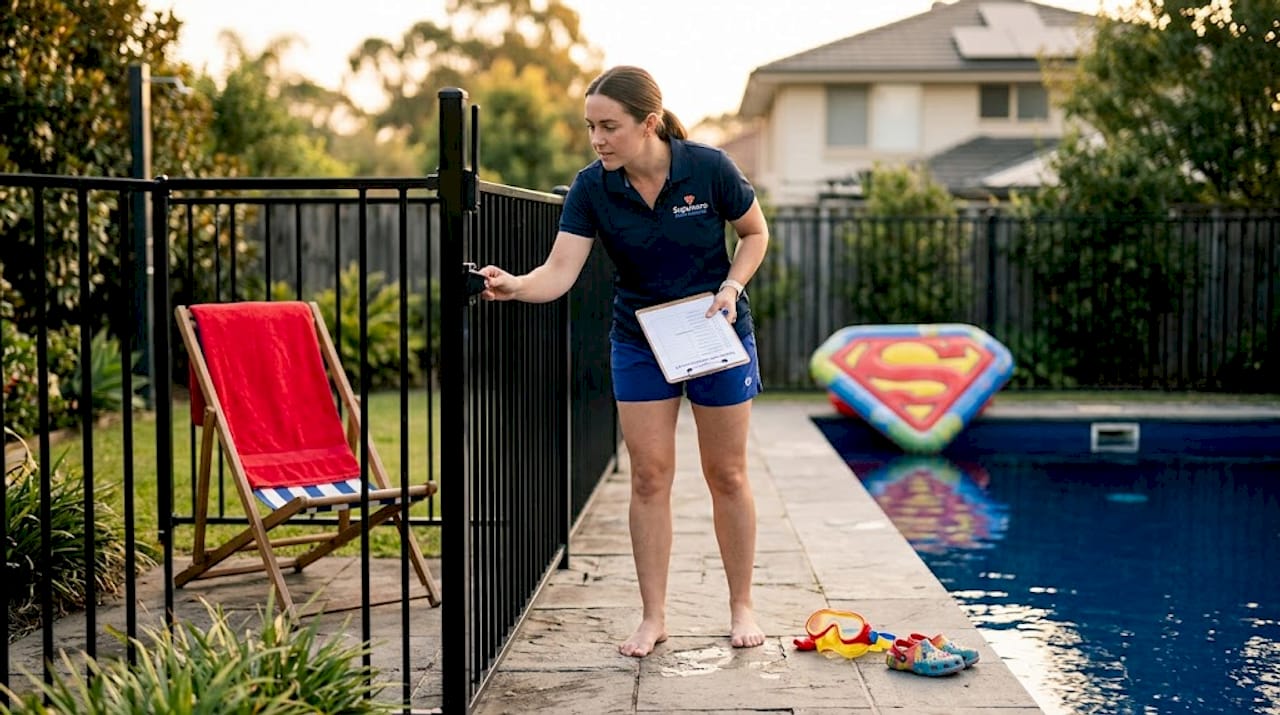
Your home pool environment is part of the equation. Before lessons begin, check these items:
Pool barriers and fencing are in place and functioning
Gate latches are self-closing and child-resistant
Clear exit paths exist from the water to a safe area
No loose toys or floats that could distract or create false confidence
You know where the nearest phone is during lessons
Pro Tip: Treat the first instructor visit as a safety audit of your pool. A qualified instructor will walk the space and align the lesson plan to your specific exit conditions and barriers before anyone gets in the water.
How to vet and select a qualified instructor
Once you understand the baseline requirements, the vetting process becomes much more focused. Here’s how to move from a list of candidates to a confident hire.
Research certifications and background first. Before you speak to anyone, verify their credentials online or request documentation. Check that CPR and First Aid certifications are current, not expired. Ask specifically whether their training includes water survival instruction for children under age 5, since general swim instructor certifications don’t always cover this age group.
Ask directly about their survival skills curriculum. Request a written or verbal description of their lesson plan. A qualified instructor should be able to explain how they progress from basic water comfort to functional self-rescue. Ask whether they practice fall-in scenarios and swimming in clothes, since these are often skipped in recreational-only programs.
Request a trial lesson or observation session. Watching an instructor work with a child tells you more than any conversation. Look for calm, consistent communication with the child, clear progression between skills, and a structured approach to safety. If an instructor is reluctant to be observed, that’s a red flag.
Verify insurance and liability coverage. A professional mobile swim instructor should carry liability insurance. Ask for proof. This protects you if there’s an incident during a private swimming session at your home.
Evaluate fit with your child. Technical qualifications matter, but so does personality. Young children learn better with instructors who are patient, encouraging, and able to read a child’s emotional state. A great instructor adjusts the pace based on the child, not the clock.
Check references from other parents. Ask specifically whether the instructor taught water survival skills, how the child progressed, and whether the instructor communicated clearly with parents throughout. Reviews from parents of similarly aged children carry the most weight.
Pro Tip: When you call references, ask one specific question: “Did your child learn to get themselves out of the water independently?” That answer tells you more about the instructor’s focus than any credential.
Private 1-on-1 instruction offers better supervision and more effective skill development than group classes, especially for toddlers. At-home swim training amplifies this advantage because the child is learning in the exact environment where an emergency would most likely occur.
Common mistakes parents make when choosing instruction
Even well-intentioned parents make choices that leave gaps in their child’s water safety. Here are the most common ones.
Choosing an instructor based on price alone. The least expensive option is rarely the most qualified. At-home swim training for survival skills requires specialized training that commands a fair rate. If an instructor’s pricing seems unusually low, ask why.
Assuming recreational swim classes cover survival skills. They often don’t. A child who can swim a lap in a pool may still panic and struggle to exit water after an unexpected fall. Learning to swim does not automatically mean safe self-rescue. Parents need to verify this distinction explicitly.
Skipping the home environment check. Many parents focus entirely on the instructor’s credentials and forget that the physical environment matters just as much. An instructor unfamiliar with your pool layout cannot effectively teach your child to exit safely.
Not verifying that certifications are current. CPR and First Aid certifications expire. An instructor who was certified two years ago may not be current. Always ask for documentation with dates.
Overlooking emergency preparedness in the curriculum. Ask instructors how they integrate realistic emergency scenarios. Programs should teach functional exit and self-rescue behaviors rather than only building recreational confidence.
“Swim lessons are an important layer of protection, but they do not replace active adult supervision. Parents must stay engaged and present, even after their child has developed strong water skills.” — Pediatric water safety guidance from the American Academy of Pediatrics
This point cannot be overstated. Swim lessons support drowning prevention but do not replace supervision. Your job as a parent does not end when the lesson does.
What progress looks like and how to measure it
One of the biggest frustrations parents have with swim instruction is not knowing whether their child is actually improving. Here’s what measurable progress looks like for survival-focused at-home swim training.
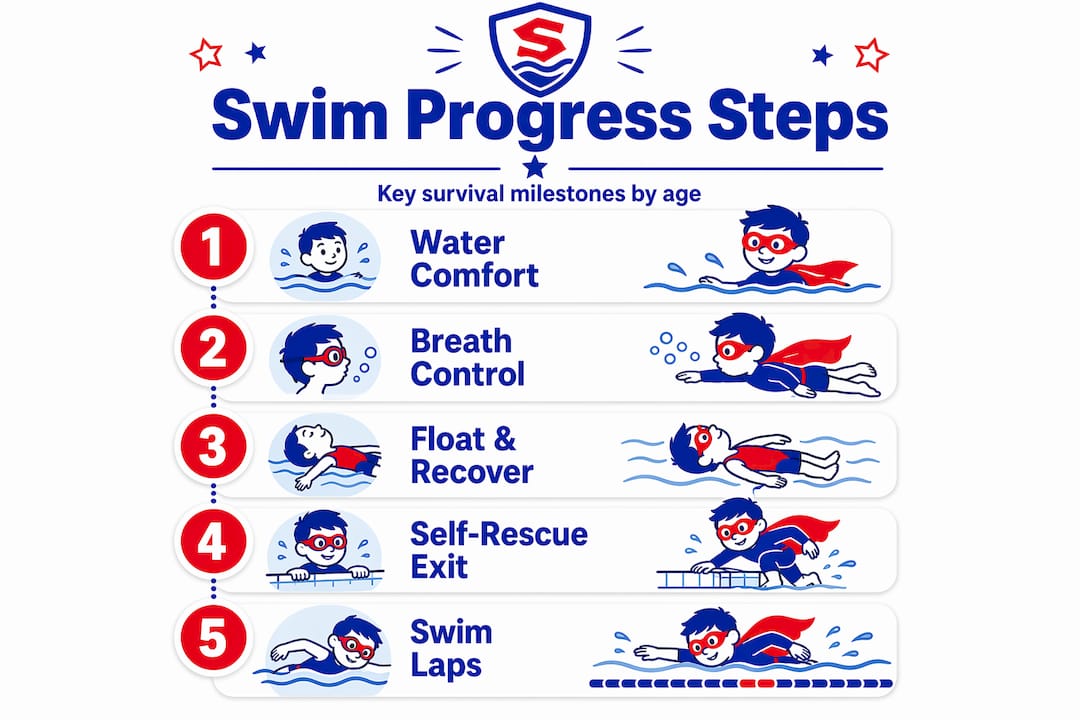
Milestone | Age range | What to look for |
Water comfort and breath control | 12 to 24 months | Child tolerates face submersion without distress |
Independent floating | 18 to 36 months | Child can float on back unassisted for 10 or more seconds |
Self-rescue from unexpected entry | 2 to 4 years | Child surfaces, orients, and moves toward the wall or steps |
Swimming in clothes | 3 to 5 years | Child can swim at least a short distance while fully clothed |
Independent water exit | 3 to 5 years | Child can climb out of the pool without assistance |
These milestones are not arbitrary. They reflect what children need to survive a real water emergency. Recreational swimming progress, like learning the butterfly stroke, is a separate track entirely.
Talk to your instructor at the start of each lesson block about which milestone you’re targeting. Ask for a brief update after each session, even just a few sentences. The best instructors communicate proactively. If you’re not getting regular updates, ask for them. Parent participation in tracking progress is one of the strongest predictors of skill retention between sessions.
You can also find effective swim lessons in Lake Worth and surrounding areas that use milestone-based tracking as a standard part of their approach.
My honest take on what parents get wrong
I’ve worked with hundreds of families, and the pattern I see most often is this: parents do their homework on instructors and then stop there. They check the credentials, they like the personality, and they assume the job is done. What they miss is the curriculum question.
In my experience, the single most important thing you can ask a prospective instructor is: “Show me your lesson plan for a child who falls into the pool unexpectedly.” That one question separates survival-focused instructors from recreational ones faster than any certification check. Most recreational instructors have never thought through that scenario in detail.
I’ve also seen parents underestimate how much the home pool environment shapes the lesson. An instructor who teaches at community pools all week and shows up at your backyard pool on Saturday is working in a completely different context. The depth, the exit points, the pool shape, the surrounding deck surface. All of it matters. A truly qualified in-home instructor treats the first session as an orientation to that specific environment, not just a standard lesson one.
The other thing parents rarely ask but absolutely should: “What do you do if my child panics?” The answer reveals whether an instructor has real experience with young children or just technical training. Panic management is a skill. It’s not in any certification manual. It comes from time in the water with real kids.
What I’ve learned is that the best instructors are not necessarily the most credentialed. They’re the ones who can hold a two-year-old’s trust, read the moment when to push and when to back off, and build genuine confidence rather than just compliance. That combination is what produces a child who can actually save themselves.
— SUPERHERO
Superheroswimacademy: survival-first swim lessons at your home
At Superheroswimacademy, every instructor is trained in CPR, First Aid, and a proven survival swim curriculum built specifically for infants, toddlers, and young children. The focus is not on strokes. It’s on giving your child the skills to surface, float, and exit the water on their own. With over 2,500 children taught across Palm Beach and Broward counties, parents consistently report measurable improvements in water confidence and safety within just a few sessions. Every family receives clear milestone goals and regular progress updates so you always know where your child stands. Check available lesson locations to find private swimming sessions near you, or visit the Superheroswimacademy FAQ to get answers before you book.
FAQ
What does a vet in-home swim instructor mean?
A vet in-home swim instructor is a certified swim professional who has been vetted for credentials, safety training, and survival skills curriculum, and who teaches private swimming sessions at your home pool rather than at a public facility.
What certifications should an in-home swim instructor have?
At minimum, look for current CPR and First Aid certification plus specific training in water survival competency for children under age 5, since general instructor certifications do not always include this.
How do in-home swim lessons differ from group classes?
Private 1-on-1 sessions allow the instructor to focus entirely on your child’s pace and skill gaps, and lessons take place in the exact environment where your child is most likely to encounter water, making the training more realistic and effective.
At what age should children start survival swim lessons?
The American Academy of Pediatrics supports swim lessons starting at age 1 for most children, with a focus on survival competency for ages 1 to 4 including floating, self-rescue, and independent water exit.
Do swim lessons replace the need for adult supervision?
No. Swim lessons support drowning prevention but are not a substitute for active adult supervision. Parents must remain present and attentive any time a child is near water, regardless of skill level.
Recommended
Comments