
How Repetition Shapes Swim Learning in Young Children
- superheroswim
- 11 minutes ago
- 8 min read

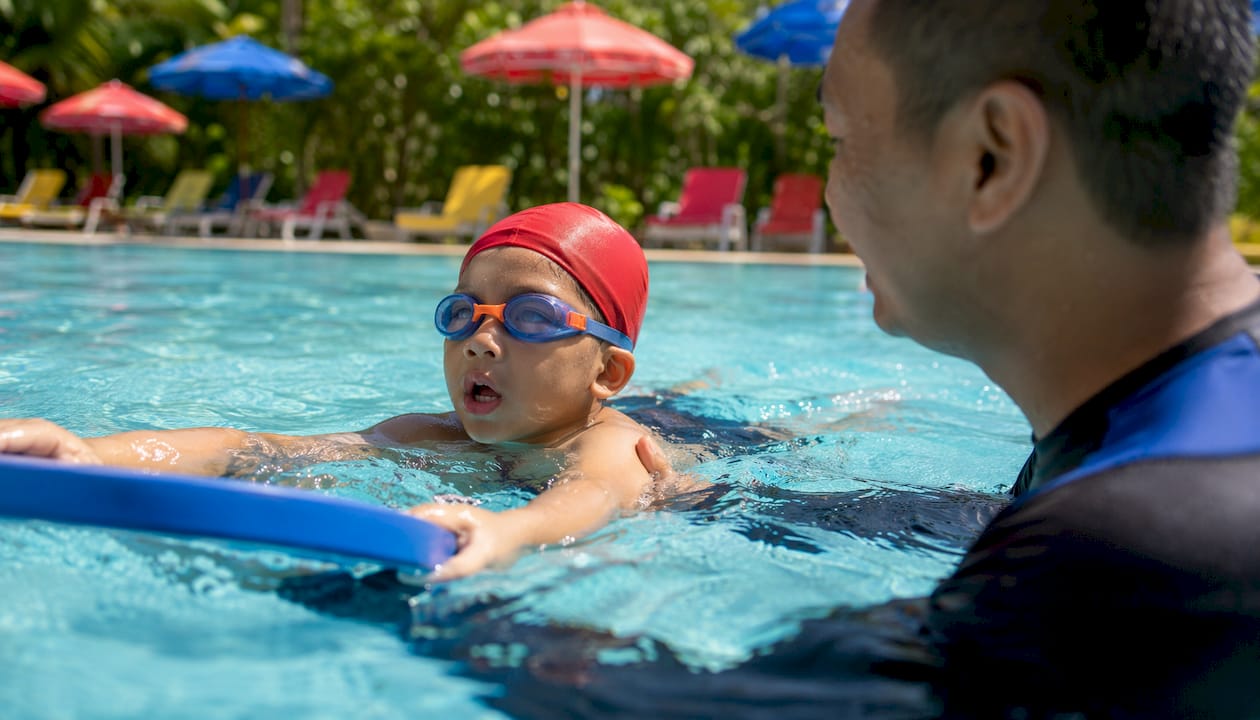
Repetition turns new swim movements into automatic, reliable skills that keep children safer in the water. Superheroswimacademy has seen this firsthand through teaching many children: the kids who progress fastest aren’t the most naturally gifted, they’re the ones who practice the right movements consistently.
Practice 3–4 times per week in short sessions (10–15 minutes for toddlers) rather than long, infrequent ones.
Focus on quality over quantity. One correctly executed float is worth more than ten sloppy ones.
Never leave a child unattended near water, even during casual practice. Every Superheroswimacademy instructor holds CPR and First Aid certification because emergencies don’t announce themselves.
Table of Contents
How repetition in swim learning rewires the brain and body
Repetition works because the brain physically changes with practice. Each time a child performs a movement, the neural pathway for that movement gets a little stronger, a little faster, and a little more insulated. After enough correct repetitions, the movement stops requiring conscious thought and becomes automatic motor execution. That’s the shift from “thinking about kicking” to just kicking.
Children’s brains are especially receptive to this process. Neural plasticity is highest in the early years, which is exactly why swim skills learned young tend to stick. When a child has to think hard about staying afloat, fear fills the cognitive space that thinking takes up. Once floating becomes automatic, that mental bandwidth frees up and fear shrinks.
Think of it like tying shoes. The first fifty times, it’s a deliberate, step-by-step task. Eventually, your hands just do it. Swimming works the same way, except the stakes are higher when the skill fails.
Repetition strengthens neural pathways so that motor skills become reliable under pressure, not just in calm practice conditions. A child who has floated on their back hundreds of times will reach for that skill instinctively if they slip into a pool.
The benefits of a consistent routine extend beyond the physical. Predictable repetition also reduces water anxiety by making the pool feel familiar rather than threatening.
What good repetition looks like inside a swim lesson
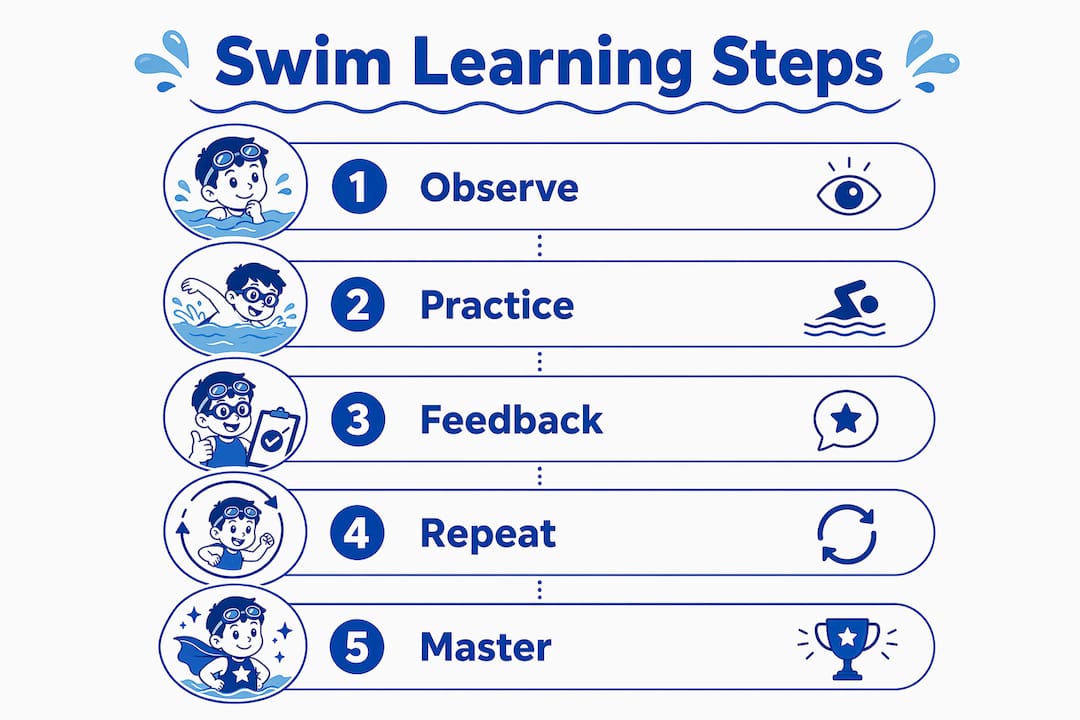
Professional instructors don’t just repeat the same drill endlessly. They build progressions, and each step is a short, focused repetition of a sub-skill before the pieces get combined.
A typical progression for a young child looks like this:
Breath control first: blowing bubbles, then submerging the face briefly
Floating: back float with support, then with decreasing support, then independently
Kicking: supported kick with a wall or noodle, then kick while floating
Arm coordination: scooping motion practiced standing in shallow water, then combined with kick
Full skill integration: linking float, kick, and arm movement into a short self-rescue sequence
What separates good repetition from mindless repetition is feedback. A child who kicks with bent knees and gets no correction will encode that bent-knee pattern. Deliberate practice requires an immediate, specific cue after each attempt: “Straighten your legs, like a pencil” rather than “Good job.”
Cue consistency matters too. When an instructor uses the same word or phrase every time (“big arms, big arms”), the child’s brain links that phrase to the correct motor pattern. Switching language mid-lesson breaks that link and slows encoding.
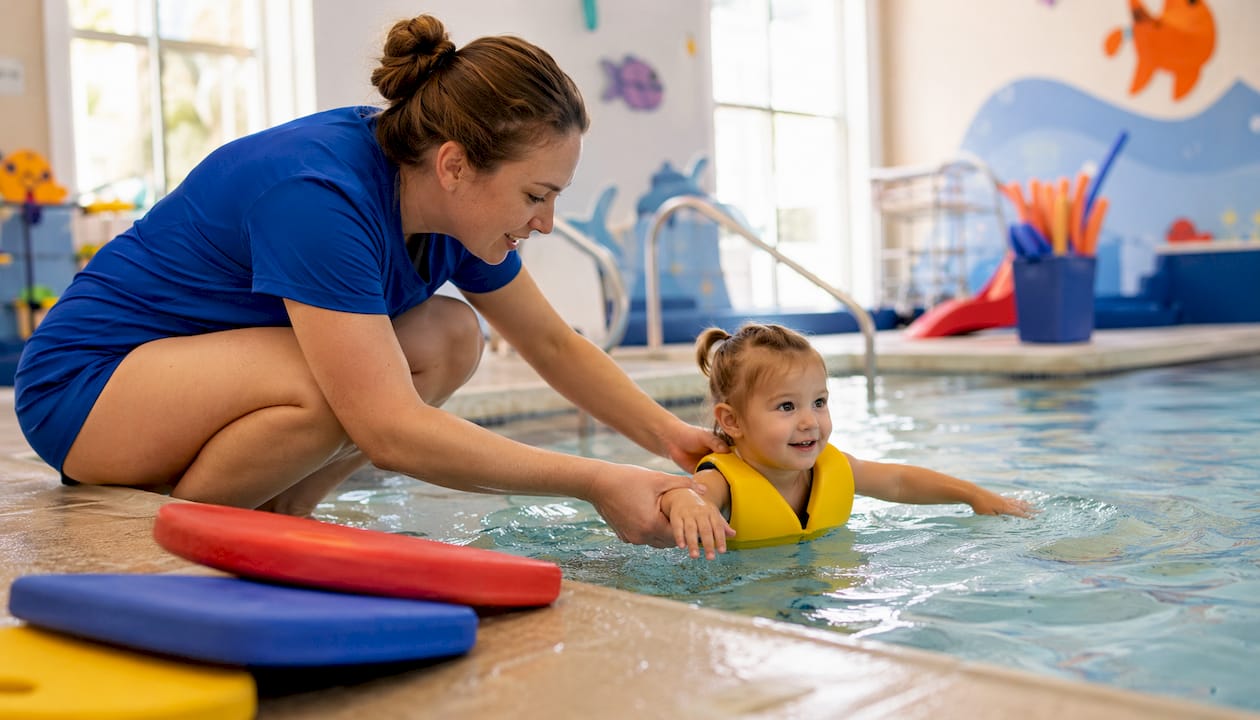
Pro Tip: Ask your child’s instructor what verbal cue they use for each skill. Repeat the same cue at home during practice. Consistent language between lessons and home practice accelerates the neural connection.
A parent-friendly at-home repetition plan
Home practice between lessons is where repetition compounds. The goal isn’t to teach new skills; it’s to reinforce what the instructor has already introduced. Keep sessions short and positive, and stop before your child gets tired or frustrated.
A simple session template: start with two minutes of water play to settle nerves and build comfort. Move into two or three short drills that mirror what the instructor is working on. End with something fun, a splash game or a favorite float, and close with specific praise tied to what they did well (“You kept your face in the water for three whole seconds!”).
Session length and frequency by age:
Infants (6–18 months): 10 minutes, 2–3 times per week. Focus on water comfort, gentle submersion, and back float with full parental support.
Toddlers (18 months–3 years): 10–15 minutes, 3–4 times per week. Add bubble blowing and supported kicking.
Preschoolers (3–5 years): 15–20 minutes, 3–4 times per week. Reinforce independent float, kick, and basic arm motion.
Three drills that work well at home in a shallow pool or bathtub:
Bubble breathing: Have your child place their mouth at the water surface and blow out slowly. Count to three, lift, breathe, repeat. Five rounds is plenty. The cue: “Blow out like you’re cooling soup.” This builds the breath control that prevents panic underwater.
Back float with a hand bridge: Place one hand under your child’s head and one under their lower back. Gradually reduce pressure on the lower-back hand over several sessions. The cue: “Ears in the water, belly up to the sky.” Never force the position; let them find it.
Kick practice on the step: Sit your child on a pool step so their legs are in the water. Ask them to kick with straight legs. Count five kicks, rest, repeat. The cue: “Legs like a pencil, not a frog.” This isolates the kick pattern before adding the complexity of floating.
Always practice in water shallow enough that your child can stand, and stay within arm’s reach. No forced submersion, ever.
Common repetition mistakes and how to spot them
Not all repetition helps. Some patterns actively set children back, and parents are often the first to notice the signs.
Red flags to watch for:
Technique breakdown under fatigue: kicks get sloppy, arms stop reaching, the child starts sinking more than usual. This is the body encoding a degraded pattern.
Practicing the same error repeatedly: if a child consistently kicks with bent knees and no one corrects it, that bent-knee kick becomes the stored habit.
Emotional shutdown: crying, refusing to enter the water, or clinging. This signals the session has gone too long or the difficulty jumped too fast.
Boredom-driven disengagement: glazed eyes, distracted play, going through motions. Repetition without attention doesn’t encode well.
When technique falls apart, the fix is simple: shorten the session and drop back to one cue. Don’t push through bad form hoping it will self-correct. Skill erosion happens when the nervous system adopts a degraded pattern under fatigue and stores it as the default.
Pro Tip: Use the “three good reps” rule. When your child executes a skill correctly three times in a row, end that drill on a win. Stopping at the peak of success encodes the correct pattern and keeps motivation high.
If a child resists practice entirely, back off for a day and reintroduce water through play with no skill demands. Forced repetition in a distressed state teaches fear, not swimming.
How experts apply repetition: deliberate practice and what the research shows
The clearest finding from motor-learning research is that quality plus variability plus feedback outperforms raw volume every time. A scoping review on swim learning in children ages 5–12 found that contemporary methods emphasizing variability and exploration produce more adaptable swimmers than rote repetition of a single “ideal” pattern. Coaches call this “repetition without repetition,” meaning the goal is the same but the conditions shift slightly each time.
Industry models estimate that complex motor skills require 10,000–50,000 repetitions to become fully automatic, and correcting an ingrained incorrect habit often takes more repetitions than learning the skill correctly in the first place.
That figure isn’t meant to intimidate. It’s a reason to start early, practice correctly, and never let errors go uncorrected.
Study / Source | Intervention | Key finding |
Frontiers scoping review (2025) | Variability-based vs. linear repetition in 5–12-year-olds | Variable practice produced more adaptable skill transfer than rote repetition |
BMC Sports Science VR study | VR video modeling before pool sessions | Improved stroke metrics and engagement vs. traditional-only group |
SwimSwam technique development | Technique integrity checkpoints during rep sets | Prevented degraded form from being stored as muscle memory |
Motor imagery adds another layer. Brief mental rehearsal before physical practice reduces cognitive load and speeds the shift from “thinking hard about every movement” to associative motor learning. For anxious young learners, watching a short video of the skill before attempting it can lower the fear response and improve first-attempt quality.
Superheroswimacademy applies these principles directly. Every instructor completes CPR and First Aid certification plus the academy’s own survival-swim curriculum, which structures repetition around observable skill anchors rather than fixed rep counts. Parents receive regular progress updates so they know exactly which skills their child is consolidating and what to reinforce at home. The personalized coaching approach means each child’s repetition plan adjusts to their pace, not a generic class schedule.
Pro Tip: Before a home practice session, show your child a short video of the skill you’ll be working on. Even 60 seconds of observation primes the motor system and often improves first-attempt quality.
Key Takeaways
Consistent, quality repetition is the single most reliable path to swim skill mastery and water safety for young children.
Point | Details |
Repetition builds automatic skills | Correct reps strengthen neural pathways so children respond instinctively in the water. |
Short, frequent sessions beat long ones | Aim for 10–15 minutes, 3–4 times per week, matched to your child’s age and attention span. |
Quality over volume | One correctly executed float is worth more than ten sloppy ones; stop when form breaks down. |
Avoid practicing errors | Uncorrected mistakes become habits; use consistent verbal cues and technique checks every session. |
Superheroswimacademy’s approach | CPR/First Aid-certified instructors and regular parent progress updates reinforce deliberate, safe repetition for many children taught. |
Why deliberate repetition is the real work of swim learning
Most parents assume swim progress is about time in the water. It isn’t. It’s about the quality of attention during that time. A child who spends twenty minutes in a pool doing random splashing gains far less than one who spends ten minutes on a single, well-cued skill with a parent or instructor watching closely.
At Superheroswimacademy, every lesson is built around this principle. Instructors trained in CPR, First Aid, and the academy’s survival-swim curriculum don’t just run children through drills. They watch for technique drift, adjust cues in real time, and send parents home with specific feedback so practice between lessons actually reinforces the right patterns. That parent partnership is what makes the repetition compound.
Superheroswimacademy: where deliberate repetition meets real results
Children who practice correctly, consistently, and safely become confident swimmers faster than those who simply log hours in the pool. Superheroswimacademy’s survival-focused lessons in Palm Beach and Broward counties are built around exactly that principle: structured, feedback-rich repetition that parents can see and track.
Services include private in-home lessons, small group classes in heated pools, parent-and-child sessions, and online courses for parents who want to coach home practice with confidence. Every instructor holds CPR and First Aid certification. Every family receives regular progress updates tied to real skill milestones.
If you’re ready to give your child a foundation that goes beyond splashing around, book a lesson or explore the online courses to start reinforcing the right patterns at home today.
Useful sources for parents who want to go deeper
Frontiers scoping review: learning to swim in 5–12-year-olds — A 2025 research review comparing traditional and contemporary motor-learning methods in children’s swim education; useful for understanding why variability matters alongside repetition.
BMC Sports Science: VR-supported video modeling in swimming — A randomized study on using short VR observation sessions before pool practice to accelerate skill acquisition; relevant if your child is anxious or struggles with first attempts.
SwimSwam: technique development and repetition — Practitioner guidance on technique integrity checkpoints and why correcting errors early prevents them from becoming permanent habits.
U.S. Swim School Association — Industry standards for learn-to-swim programs in the United States; a useful reference when evaluating any swim school’s curriculum and safety practices.
National Drowning Prevention Alliance — U.S.-focused water-safety guidance and drowning prevention resources; recommended reading before starting any home water practice with young children.
Recommended
Comments