
Social Learning in Toddler Swim Lessons: What Parents Need to Know
- superheroswim
- Aug 6
- 10 min read

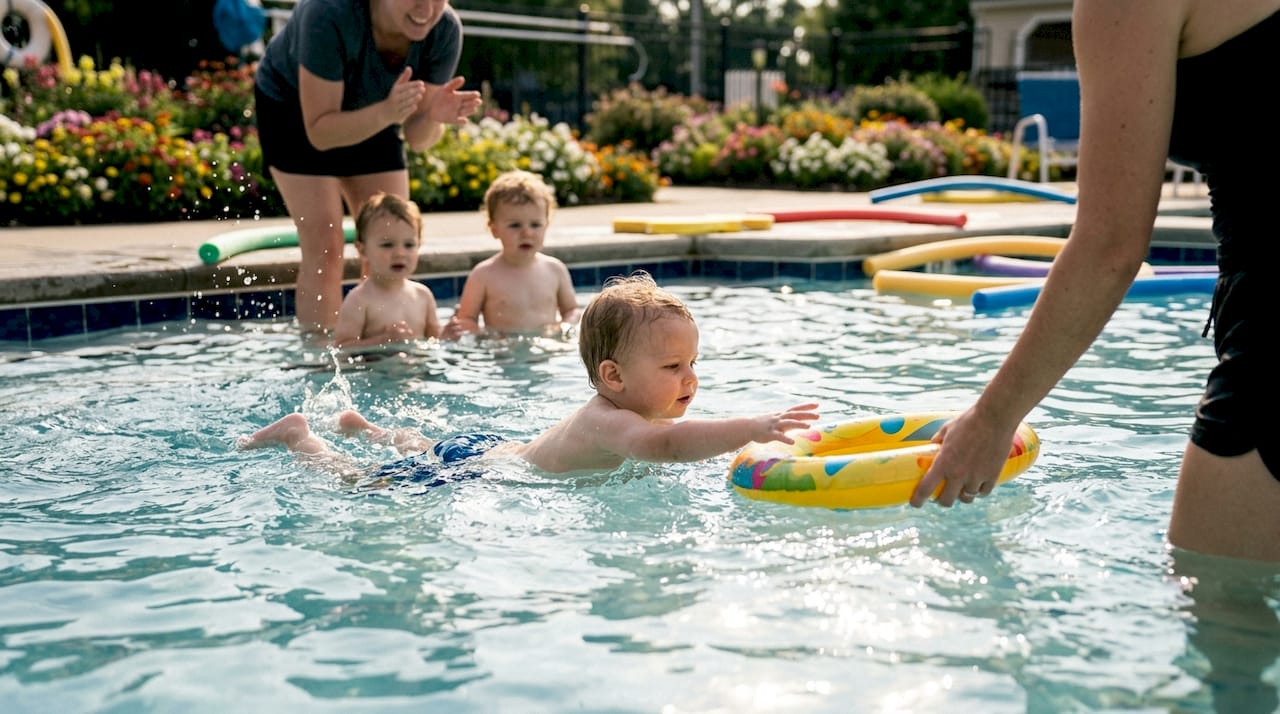
Social learning is the fastest route to water confidence for toddlers. When a child watches a peer blow bubbles, hears the instructor cheer, and tries it themselves, they are not just playing. They are running the core loop of observational learning: watch, imitate, get feedback, repeat. That loop, embedded inside a well-run swim class, builds social-emotional skills alongside genuine water competency.
Three things make it work:
Imitation and modeling. Toddlers copy peers and instructors constantly. A child who hesitates at submersion will often try it after watching a friend do it first.
Guided play and social reinforcement. Games with a skill target produce far more willing repetitions than drills, and peer encouragement amplifies the effect.
Cooperative interaction. Turn-taking, helping, and following multi-step cues in the water map directly onto preschool and classroom behaviors.
The practical takeaway: enroll your toddler in a quality small-group or parent-child class where instructors use play deliberately, not just to fill time.
Table of Contents
How social learning actually happens in toddler swim classes
What the research shows about swimming and social development
Typical timeline: what to expect in the first year of lessons
Actionable steps to support social learning in and out of the pool
Why play-based social learning deserves more credit than it gets
Superheroswimacademy: survival swim lessons built around social learning
How social learning actually happens in toddler swim classes
The core mechanisms are modeling, imitation, observational learning, and social reinforcement. Each one shows up in a typical class, often within the same five-minute stretch.
Instructors do more than demonstrate a skill. They narrate it. “Watch me put my chin in the water. Now you try.” That narration turns a physical action into a repeatable mental script a toddler can retrieve the next time. Guided play in swim lessons teaches core skills through games and dramatically increases willing repetitions when each game targets a clear skill, rather than leaving children to splash freely.
Here is what that looks like in practice. An instructor holds a ring just below the surface and blows bubbles toward it, narrating the whole time. Two or three toddlers watch. One reaches for the ring, submerges briefly, and surfaces to clapping from the instructor and a nearby parent. The child next to her immediately tries the same thing. No coaxing required. The peer’s success was the cue.
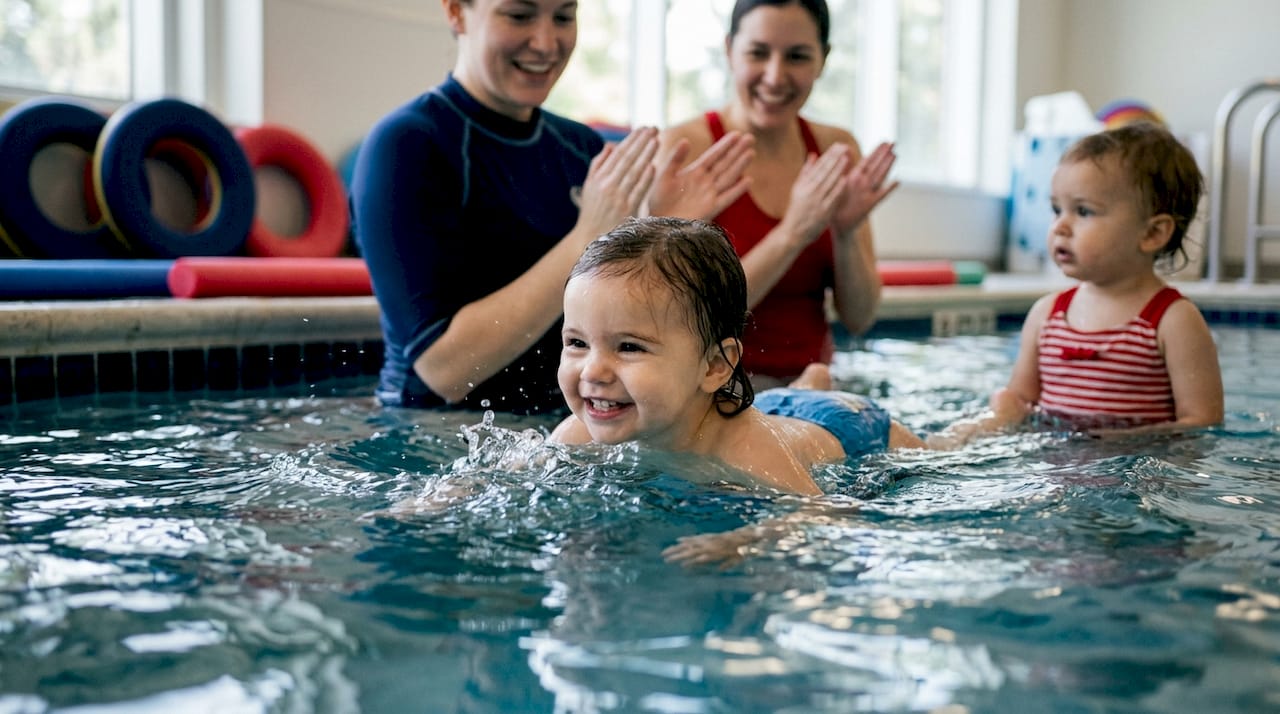
That sequence is not accidental. It is the design. Water confidence built through social exposure is the critical early stage before technical skill linking and independence. Instructors who understand this sequence structure games to produce that peer-modeling moment on purpose, then layer in the safety skill underneath it.
Which social and emotional skills swim lessons help develop
The pool is a surprisingly rich classroom for social-emotional development. The aquatic environment acts as a social site where toddlers practice cooperative behaviors and multi-step cues that support school readiness. Here are the specific skills parents can watch for, each tied to a real class moment:
Empathy and encouragement. Toddlers cheer for each other. It sounds small, but noticing a peer’s effort and responding to it is an early empathy behavior. Group swim classes build confidence precisely because that peer recognition is real, not scripted.
These skills do not stay at the pool’s edge. Children who practice turn-taking in water tend to generalize it to other group settings, which is why researchers describe the pool as a school-readiness environment.
Why lesson format and teaching approach matter
Format affects how much peer modeling a child gets, how quickly they gain independence, and how well an instructor can scaffold social interaction. No single format is best for every toddler.
Format | Social exposure | Instructor-to-child ratio | Typical skill focus | Best for |
Parent-and-child | High (caregiver + instructor) | 1:4 or better | Water comfort, basic safety, bonding | Anxious toddlers, children under 2 |
Small-group (3–4 children) | High (peers + instructor) | 1:4 recommended | Social skills, peer modeling, foundational strokes | Toddlers 2+ ready for peer interaction |
Private lessons | Low (instructor only) | 1:1 | Rapid skill acquisition, targeted correction | Children with specific fears or accelerated goals |
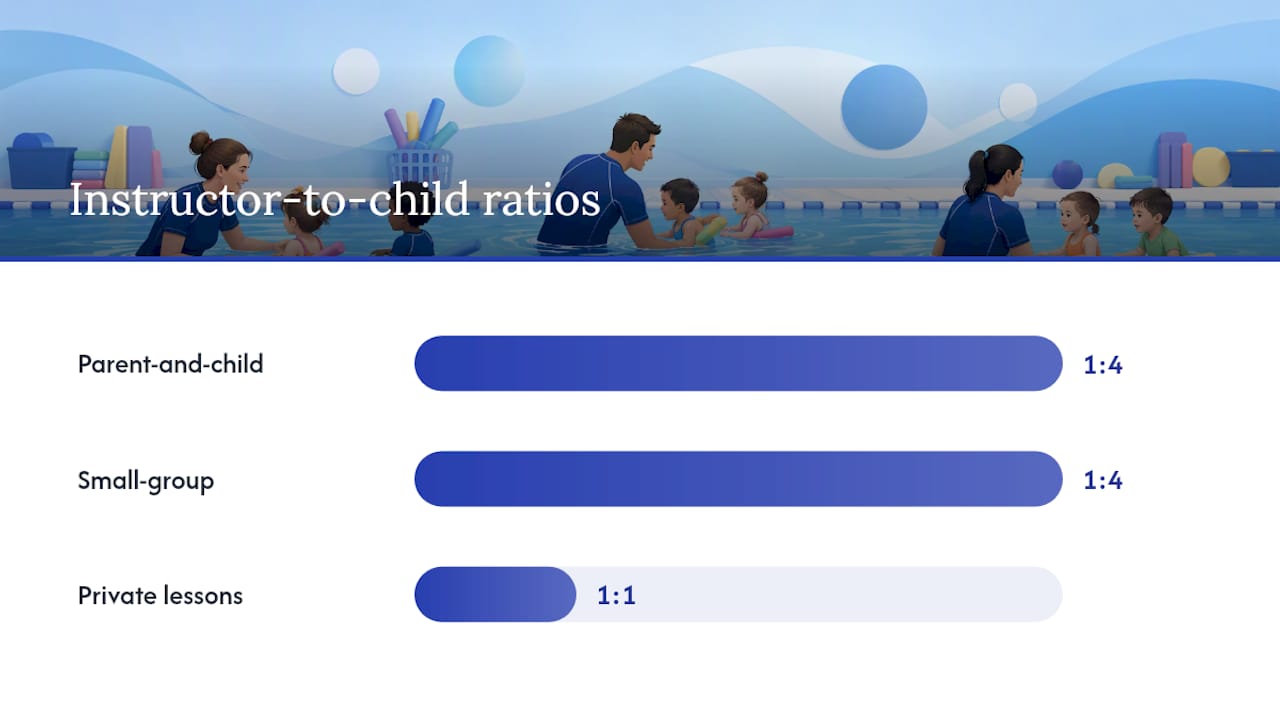
USA Swimming recommends a 1:4 instructor-to-student ratio for beginners, and that number matters for social learning as much as safety. A ratio of 1:8 or higher means the instructor cannot scaffold individual interactions or catch a child’s fear response before it becomes a pattern.
Pro Tip: If your toddler is anxious around water or new people, start with a parent-and-child format. The caregiver’s presence lowers the stress threshold enough for imitation to kick in. Once your child is imitating the instructor without prompting, that is the signal to try a small-group setting where peer modeling takes over as the primary driver.
For an outgoing toddler who already splashes confidently, a small-group class is usually the stronger choice from day one. The peer energy accelerates repetition in a way a private lesson cannot replicate.
What the research shows about swimming and social development
The evidence is stronger than most parents expect, and more nuanced than most marketing claims suggest.
A longitudinal study on quality early-years swimming programs found that children in structured aquatic programs reached developmental milestones up to 18 months ahead of international benchmarks across cognitive, linguistic, social, and physical domains. That is a large effect for a single activity. The key qualifier is “quality.” Program curriculum, instructor skill, and small class sizes explain most of the difference between programs that show gains and those that do not.
Controlled studies add precision to that picture. Structured swim lessons show moderate positive correlations between swimming proficiency and social-emotional competence, with correlation coefficients ranging from r = 0.44 to r = 0.62 and a pooled estimate of r ≈ 0.58 (p<0.01).
Evidence type | Finding | Strength |
Longitudinal study | Developmental lead across multiple domains | Strong, but quality-dependent |
Controlled studies | Correlations between swim proficiency and social-emotional competence (r = 0.44–0.62, pooled r ≈ 0.58) | Moderate, statistically significant |
Practitioner evidence | Water confidence precedes technical skill; social exposure is the key early stage | Consistent across programs |
One honest limit: most studies rely on self-selected families who enroll in lessons, which introduces selection bias. Families who prioritize swim lessons may also prioritize other enrichment activities. That does not erase the findings, but it means parents should be skeptical of any program claiming dramatic developmental outcomes from lessons alone.
When to start and how to judge your toddler’s readiness
The AAP recommends swim lessons as an important layer of protection and notes that lessons can begin as early as age 1, though readiness varies by child. Parent-child classes at 12–18 months focus on water comfort and basic safety responses rather than independent swimming. Independent participation in a peer group typically becomes realistic around age 2–3, depending on social and motor development.
Signs your child may be ready for a structured class:
Comfortable being held in water by a caregiver without sustained distress
Able to follow a simple one-step instruction (“kick your feet”)
Shows curiosity about water rather than extreme avoidance
Has basic head control and can hold a supported float position briefly
Tolerates water on the face during bath time without panic
Readiness is not a fixed age. A 2-year-old who has had regular bath-time water play may be more ready than a 3-year-old with no prior exposure. Cleveland Clinic guidance recommends starting exposure at home before the first lesson: pour water over your child’s head during bath time, introduce goggles as a fun prop, and sing songs that involve splashing. That incremental exposure lowers the novelty threshold so the first pool visit is not overwhelming.
For early exposure guidance, the parent’s guide to infant swim lessons walks through what to expect in the first weeks of a parent-child class.
How social learning in lessons links to water safety
Swim lessons are one important layer of protection. They contribute to water competency, but they do not replace active supervision. A toddler who has completed six months of lessons still needs an adult within arm’s reach near any body of water.
The full safety framework looks like this:
Swim lessons — Formal lessons reduce drowning risk. USA Swimming’s data supports formal lessons as a meaningful risk-reduction tool, particularly when ratios are small and curriculum is structured.
When evaluating a program, ask directly about instructor credentials and safety practices. Instructors working with infants and toddlers should hold current CPR and First Aid certification, training specific to infant and toddler survival skills, and a clear curriculum with measurable progression goals. Class size limits matter too. A ratio above 1:4 for beginners is a red flag.
Typical timeline: what to expect in the first year of lessons
Social gains tend to appear before swim-skill independence, which is the pattern most parents find surprising. Here is a realistic milestone map:
Months 1–3: Your child begins imitating the instructor and watching peers. Comfort in the water increases noticeably. You will see less crying at entry and more willingness to try a prompted action. Swim skills at this stage are mostly supported: assisted floating, basic kicking with help.
Months 3–9: Peer interaction becomes more deliberate. Your child may reach toward a classmate, cheer, or wait their turn without prompting. Turn-taking and basic cooperation appear in games. Swim skills progress to brief independent kicks, face submersion, and wall-reaching. Tracking these milestones against a clear progression plan helps you know whether the program is working.
Months 9–18: Social behaviors generalize outside the pool. Children who have been in consistent group lessons often show stronger group-participation skills in other settings. In the water, you may see brief independent floating, assisted back float, and early survival responses like rolling to float.
18+ months of consistent lessons: Independent water competency and survival skills become realistic goals. Social confidence in the pool is well established. Children at this stage often encourage newer classmates, which reinforces their own skills through teaching.
Frequency matters. Weekly lessons produce faster gains than bi-weekly, and consistent attendance across months matters more than intensity in any single session.
Actionable steps to support social learning in and out of the pool
Three immediate actions make the biggest difference: choose a program with small ratios and a clear curriculum, practice guided play at home between lessons, and reinforce social routines around the pool (waiting turns, cheering for others, naming feelings).
Questions to ask any program before enrolling:
What is your instructor-to-child ratio for toddler classes?
Are your instructors CPR and First Aid certified?
How do you use play in lessons, and which skill does each game target?
How do you track and communicate progress to parents?
What does a typical 30-minute class look like for a 2-year-old?
Red flags to avoid:
No measurable progress benchmarks or vague answers about curriculum
Classes that are mostly free splashing with no skill focus
Ratios above 1:4 for toddler beginners
No parent viewing or communication about what was practiced
Instructors without documented CPR/First Aid credentials
For a full breakdown of warning signs, the swim lesson red flags guide covers the most common problems parents encounter.
Home-practice ideas between lessons:
Bath-time bubble blowing: have your child blow bubbles in the bath water, then count how many they can do in a row.
Role-play “help a friend”: take turns being the helper and the swimmer with a sibling or stuffed animal.
Goggles as a comfort tool: let your child wear goggles in the bath to normalize face-in-water contact before the next class.
Peer buddy practice: if a friend or cousin also takes lessons, arrange a supervised pool visit where they can model for each other.
Key Takeaways
Social learning in toddler swim lessons accelerates social-emotional development while building the water competency and safety behaviors that matter most in the early years.
Point | Details |
Social learning drives early gains | Imitation, peer modeling, and guided play produce faster confidence and skill gains than drills alone. |
Research supports the connection | Controlled studies show correlations of r = 0.44–0.62 between swim proficiency and social-emotional competence, with a pooled estimate of r ≈ 0.58 (p<0.01). |
Format shapes the outcome | Small-group classes (1:4 ratio) maximize peer modeling; parent-child classes suit anxious toddlers best. |
Safety requires multiple layers | Lessons reduce drowning risk but do not replace touch supervision, pool barriers, and caregiver CPR training. |
Superheroswimacademy | Offers small-group and parent-child classes in Palm Beach and Broward counties with CPR-certified instructors and clear progression goals. |
Why play-based social learning deserves more credit than it gets
Most parents focus on the swim skill. Can my child float? Can they reach the wall? Those are the right questions, but they miss something the research makes clear: the social environment is not the backdrop to learning, it is the mechanism.
The 18-month developmental lead found in longitudinal research is not explained by extra time in the water. It is explained by what happens in that water: a child watching a peer succeed, deciding to try, getting feedback, and repeating. That loop runs dozens of times in a single class. Over months, it compounds.
What I think parents underestimate is the emotional regulation piece. Managing fear of water is one of the hardest things a toddler does in a structured setting. A child who learns to breathe through that discomfort, stay in the water, and try again is not just learning to swim. They are building a tolerance for challenge that shows up everywhere else. The pool is one of the few environments where that kind of productive discomfort is built into the activity by design.
The caveat worth stating plainly: program quality is everything. A class with a 1:8 ratio, no curriculum, and an instructor who is not watching individual children will not produce these gains. The research on developmental leads and social-emotional correlations comes from quality programs. That distinction is what parents should carry into every enrollment conversation.
Superheroswimacademy: survival swim lessons built around social learning
Superheroswimacademy offers something specific that parents coming from this article will recognize immediately: small-group and parent-child classes where play is mapped to survival skills, not used as filler. Every instructor holds CPR and First Aid certification and is trained in the academy’s own survival swim curriculum. With over 2,500 children taught in Palm Beach and Broward counties, the program tracks measurable progress and keeps parents informed at every stage.
Private lessons at your home, heated pool group classes, and parent-and-me sessions are all available, so the format can match your child’s temperament and readiness level. If your toddler is anxious, start with a parent-child session. If they are ready for peers, a small-group class gives them the social modeling this article describes in action.
Book a lesson and see where your child is on the progression map. The first step is a conversation, not a commitment.
Useful sources and further reading
Why Young Children Should Learn to Swim: Learnings from Participation in Early Years Swimming
Swim Lessons for Children: When to Start & What to Consider — HealthyChildren.org
Learn-to-Swim
Do Play-Based Swim Lessons Work? | WaterWiseKids
When Should My Child Learn How To Swim? — Cleveland Clinic
Recommended
Comments