
The Role of Personalized Swim Coaching for Kids
- superheroswim
- Jun 27
- 8 min read

Personalized swim coaching is defined as instruction tailored to each child’s individual abilities, learning pace, and emotional readiness rather than a fixed group curriculum. This approach is the most effective method for building water safety and swimming confidence in young children. Formal swimming lessons reduce drowning risk by up to 88% in young children compared to no formal training. That number alone tells you why the quality and structure of your child’s lessons matter far more than simply getting them in the water. Superheroswimacademy has built its entire program around this principle, teaching over 2,500 children using a survival swim curriculum that puts individual progress and safety first.
What is the role of personalized swim coaching in skill development?
Personalized swim coaching accelerates skill development because a coach can correct a mistake the moment it happens. In a group class with six children, a coach cannot watch every child at once. One child may be kicking from the knee instead of the hip for three full lessons before anyone notices. In a personalized setting, that error gets fixed in the first five minutes.
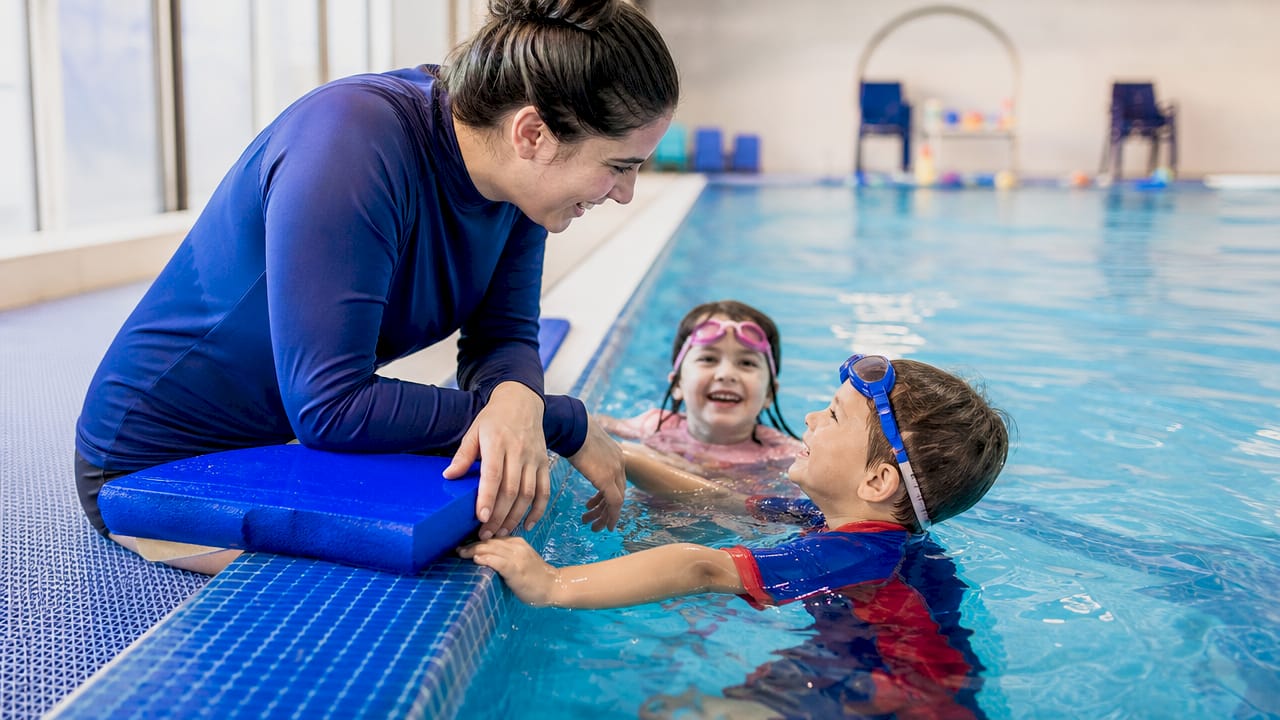
Private instruction offers focused attention, fewer uncorrected mistakes, and timely feedback that group instruction simply cannot match. This matters most for young children, whose movement patterns are still forming. A habit reinforced incorrectly at age four is much harder to undo at age seven.
The emotional benefits are just as real as the technical ones. When a coach adjusts a lesson specifically for your child, your child feels seen. That feeling builds confidence faster than any drill. A child who feels confident in the water takes more risks, tries harder skills, and recovers from setbacks without shutting down.
Custom swim training targets the exact skills your child needs right now. For one child, that might mean breath timing during freestyle. For another, it means getting comfortable putting their face in the water. A coach working with a group must move the whole group forward. A coach working with your child moves your child forward.
Real-time corrections catch bad habits before they become permanent.
Paced progression means your child never feels rushed or left behind.
Targeted drills address the specific technique gap holding your child back.
Emotional calibration lets the coach read your child’s mood and adjust intensity.
Consistent feedback loops between coach and parent keep goals aligned.
Pro Tip: Ask your child’s coach to name one specific technique they worked on after every lesson. If the coach cannot answer clearly, the session was not truly personalized.
How does personalized coaching improve water safety and self-rescue skills?
Water safety is not the same as swimming ability. A child can complete a lap of freestyle and still panic in an unexpected situation. Self-rescue ability is the true marker of success at an early stage, not stroke proficiency. Personalized coaching dedicates time to skills like front-to-back floats, breath control, and rolling from a face-down position to a face-up float.
Personalized coaching prioritizes water competency and sensory adjustment over stroke mechanics when working with young children. This means a coach spends real time helping a child get comfortable with submersion, unexpected splashing, and the feeling of water in their ears before teaching any formal stroke. That sensory foundation is what makes a child safe, not just skilled.
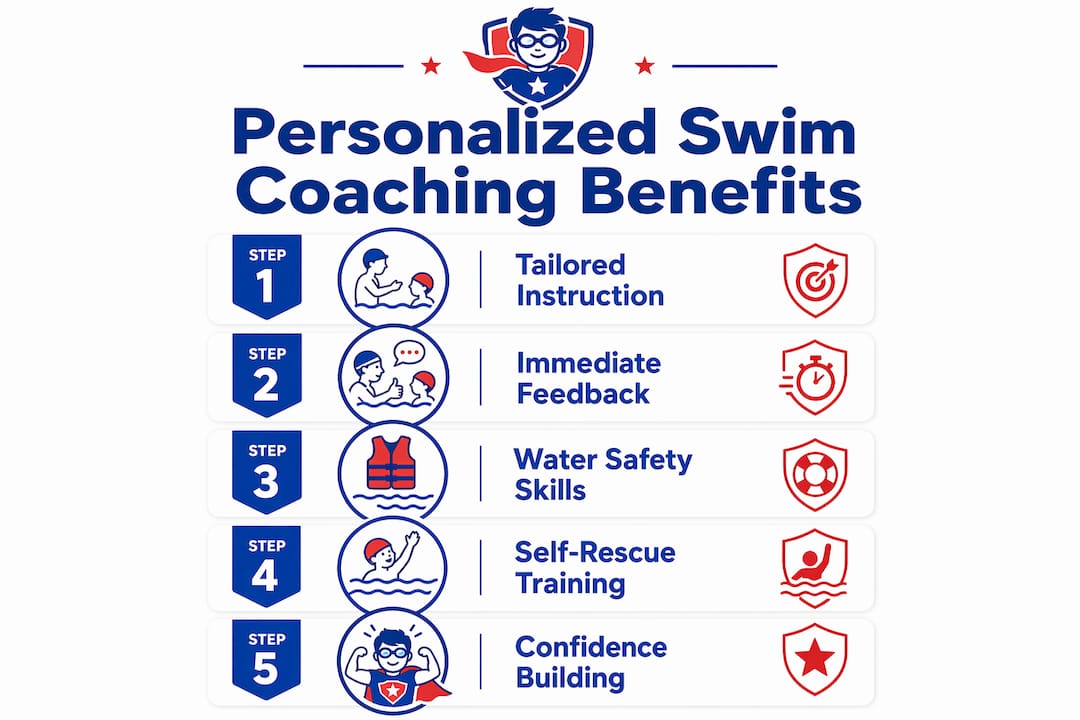
Here is how a quality individualized swimming lesson builds safety step by step:
Assess fear and comfort level. The coach identifies what the child fears before introducing any new skill.
Build submersion tolerance. The child learns to hold their breath and open their eyes underwater at their own pace.
Teach the back float. This single skill has saved lives. A child who can flip to their back and float can survive an accidental fall into water.
Introduce breath control. Rhythmic breathing during movement is practiced until it becomes automatic.
Practice self-rescue sequences. The child learns to swim to a wall, grab the edge, and call for help.
Each step is only introduced when the previous one is solid. A group class often moves the whole group to step three even when two children are still struggling with step one.
Pro Tip: When evaluating any swim program, ask specifically what self-rescue skills are taught and at what point in the curriculum. A program focused only on strokes is not a safety program.
Superheroswimacademy’s survival swim curriculum is built around exactly this sequence. Every instructor trains in CPR and First Aid, which means safety is embedded in the program structure, not just the lesson plan. You can learn more about qualified swim instructor standards and why they matter for your child’s outcomes.
How does personalized coaching support neurodivergent children?
Neurodivergent children benefit from individualized swimming lessons more than almost any other group. Twelve weeks of structured swim lessons improve motor skills and school behavior in children, including those with autism spectrum disorder. That improvement in balance and coordination carries directly into the classroom. Swimming is one of the few physical activities that engages both sides of the body simultaneously, which supports neurological development in ways that land-based activities do not.
Sensory factors play a large role in how neurodivergent children experience the pool. Parents underestimate the impact of sensory factors like water temperature and noise on a child’s swim progress. A child with sensory sensitivities may shut down entirely in a loud, crowded pool. A personalized coach can request a quieter lane, adjust water temperature when possible, and introduce the pool environment gradually rather than all at once. These adjustments are impossible to make in a standard group class.
“Coaches must avoid pushing performance alone and focus on swimmer mental wellness. Co-constructing goals with the child avoids psychological overload and builds genuine motivation.” — Frontiers in Sports and Active Living, 2026
Process-oriented goal setting is the right approach for neurodivergent learners. Instead of “swim one lap by friday,” the goal becomes “put your face in the water three times today.” Small, achievable checkpoints build confidence without triggering anxiety. Individualized checkpoints within group swim lessons can deliver this kind of personalization even when one-on-one instruction is not available. A skilled coach adjusts cues and feedback for each child even within a group setting.
Sensory preparation before entering the pool reduces overwhelm.
Process goals replace outcome goals to lower anxiety.
Consistent routines help neurodivergent children feel safe and ready to learn.
Adjusted communication styles match the child’s processing speed.
For parents exploring how structured learning supports neurodivergent learners across settings, the connection between physical skill-building and academic performance is well documented.
How can parents choose the right personalized swim program?
The right program is one where your child’s coach knows your child, not just your child’s age group. Start by observing a lesson before enrolling. Watch whether the coach gives the same instruction to every child or adjusts based on what each child is doing. That difference tells you everything.
Ask these questions before committing to any program:
Does the curriculum include self-rescue skills, or only strokes?
How does the coach communicate progress to parents after each lesson?
What training does the coach have in child development, not just swimming technique?
How does the program handle a child who is afraid of the water?
What is the student-to-coach ratio?
A low ratio is not enough on its own. A coach with three children can still run a generic lesson. What matters is whether the coach tracks each child’s individual goals and adjusts the lesson accordingly. Benefits of a consistent swim lesson routine compound over time, but only when the lessons are genuinely tailored to your child’s current level.
Communication between coach and parent is a feature, not a bonus. You should know what your child worked on, what they struggled with, and what the next milestone is. If a program cannot tell you that, it is not truly personalized.
Criteria | What to look for |
Coach qualifications | CPR, First Aid, child development training |
Safety curriculum | Self-rescue skills included, not just strokes |
Parent communication | Regular updates with specific progress notes |
Lesson structure | Goals set per child, not per age group |
Sensory awareness | Coach adjusts environment for individual needs |
Local programs like Superheroswimacademy in Palm Beach and Broward counties build parent communication directly into the program structure. Parents receive clear goals and regular updates so they always know where their child stands.
Key takeaways
Personalized swim coaching is the most effective way to build water safety, self-rescue skills, and genuine confidence in young children because it adapts instruction to each child’s individual needs in real time.
Point | Details |
Safety over strokes | Self-rescue skills like back floats matter more than stroke proficiency at early ages. |
Real-time feedback | Personalized coaching corrects technique errors immediately, preventing bad habits. |
Neurodivergent support | Sensory adjustments and process goals make swimming accessible for all learners. |
Parent communication | Regular progress updates keep coaching aligned with your child’s goals. |
Drowning risk reduction | Formal lessons reduce drowning risk by up to 88% compared to no training. |
What I have learned watching kids learn to swim
Parents often ask me whether private lessons are worth the extra cost compared to group classes. My honest answer is that the question misses the point. The real issue is not cost. It is whether your child is actually being coached or just supervised near water.
I have watched children spend an entire season in group lessons without losing their fear of submersion. The same children, moved into a personalized program, overcame that fear within a few weeks. The difference was not the child. It was the attention. A coach who can stop a lesson mid-drill and say “I see you tensing up, let’s try this differently” is doing something a group instructor simply cannot do.
The other misconception I see constantly is that faster progress means better progress. Parents want their child swimming laps by the end of summer. But a child who can float on their back and swim to the wall is safer than a child who can swim freestyle but panics when they fall in unexpectedly. Speed of stroke acquisition is the wrong metric. Water competence is the right one.
Setting swim learning goals that focus on competence rather than performance changes everything. It shifts the child’s mindset from “I failed because I did not swim a lap” to “I succeeded because I floated for ten seconds.” That shift is what builds a child who loves the water instead of one who tolerates it.
— SUPERHERO
Superheroswimacademy: personalized swim lessons in South Florida
Superheroswimacademy serves families across Palm Beach and Broward counties with a survival swim curriculum built around individual child needs.
Every instructor at Superheroswimacademy holds CPR and First Aid certification and trains in the academy’s own proven survival swim curriculum. Parents receive clear goals and regular progress updates after lessons. The program has taught over 2,500 children, with parents consistently reporting faster progress and greater confidence in the water. Whether you are looking for in-person lessons at one of the academy’s South Florida locations or prefer to start with online swim courses, Superheroswimacademy offers a structured path to safer, more confident swimmers. Visit Superheroswimacademy to find the right program for your child.
FAQ
What is the role of personalized swim coaching for young children?
Personalized swim coaching tailors instruction to each child’s abilities, fears, and learning pace. It is the most effective method for building water safety, self-rescue skills, and swimming confidence in young children.
How does personalized coaching reduce drowning risk?
Formal swimming lessons reduce drowning risk by up to 88% in young children. Personalized coaching strengthens that protection by prioritizing self-rescue skills like back floats and breath control over stroke mechanics.
Can personalized swim coaching help neurodivergent children?
Twelve weeks of structured swim lessons improve motor skills and school behavior in children with neurodivergent needs including autism spectrum disorder. Personalized coaches adjust sensory factors and use process-oriented goals to make lessons accessible and effective.
How is personalized coaching different from group swim lessons?
Group lessons divide a coach’s attention across multiple children, which means errors go uncorrected longer. Personalized coaching provides real-time feedback and adjustments specific to your child’s technique and emotional state in every session.
What should parents look for in a personalized swim program?
Look for a coach with CPR and First Aid training, a curriculum that includes self-rescue skills, and a program that communicates specific progress updates to parents after every lesson.
Recommended
Comments